A Modern Playbook for Gemini AI SEO
Updated December 27, 2025

Gemini AI SEO is the practice of optimizing your website and content to be cited as a trusted source in Google's AI generated answers. As we look toward 2025 and 2026, success in search is less about ranking in blue links and more about becoming a direct information provider for the AI itself. This strategy ensures your brand’s data appears directly in the conversational search results that users now see first.
The New Frontier of AI Search Visibility
Winning in search has fundamentally changed. As we barrel toward 2025, real visibility means optimizing for the AI generated answers that dominate the top of search results. This is the new frontier of digital marketing. Getting your content cited by a model like Gemini isn't just a goal; it's the ultimate measure of success, ensuring your brand is seen as an authority.
This guide demystifies Gemini AI SEO. We will pull back the curtain on how Google's Large Language Model finds and uses information to construct its answers. This is a practical playbook for modern SEO managers and brand teams who need to prove their impact in this new environment of generative SEO.
Why Optimizing for Gemini AI Matters Now
The integration of Gemini into Google Search is altering user behavior. People now receive direct, synthesized answers, often eliminating the need to click through to a website. In fact, research indicates AI Overviews can significantly reduce click through rates, making a direct citation within the AI’s response more valuable than ever before. This shift underscores the power of leveraging AI for expert question answering to satisfy user intent instantly. This is your chance to move your strategy from reactive to proactive.
Understanding the Shift to Generative SEO Workflows
Adapting to this change means adopting a new workflow. While many classic SEO principles remain valid, the emphasis and tools must evolve. The focus shifts from raw keyword volume to the context of a query and absolute factual accuracy. Success now is measured not by simple rank tracking but by what we call “Answer Share,” which is how often your brand is the source of truth in AI answers. For a deeper look, check out our guide on modern AI search engine optimization for more context.
Auditing Your Website for AI Readiness
Before you can optimize for Gemini, you need to understand your current position. Consider it a health checkup for your website from the perspective of an AI trying to comprehend and trust your content. This "AI readiness audit" is not optional; as of 2025, it is the essential first step in building a generative SEO strategy that delivers results.
This audit reveals the friction points that prevent AI crawlers from seeing your content as a primary source. You will quickly identify opportunities to improve how Gemini interprets your expertise, which is critical for earning citations and visibility in AI generated answers.
Analyzing Technical Health for Gemini AI SEO
A solid technical foundation is the bedrock of SEO, and it is even more critical for AI. If a large language model struggles to crawl your site or understand its structure, it will not trust your content. The audit must begin with technical basics viewed through this new AI lens. Your focus should be on a few key areas like structured data (Schema.org), crawlability, and site speed. A slow site or messy structured data is a huge red flag for an AI trying to verify facts quickly.
Evaluating Content for LLM Tracking and Semantic Context
Once your site is technically sound, it is time to examine the content itself. AI models hunt for clarity, structure, and context. They need to see a logical flow and understand how different concepts on your site connect. Internal linking is a massive piece of this puzzle. Linking related articles creates topical clusters, weaving a semantic web that helps Gemini see your deep expertise. For a much deeper dive, our complete site audit checklist covers these points and more.
Assessing Your E-E-A-T and Gemini AI Authority Signals
Experience, Expertise, Authoritativeness, and Trustworthiness (E-E-A-T) are paramount for Gemini AI SEO. The model is designed to prioritize sources that demonstrate high credibility. Your audit needs to be ruthless here. Start with author bios. Are they detailed and linked to social profiles or other publications? Then, check your external citations. Are you linking out to reputable, authoritative sources to back up your claims? Answering these questions gives you a clear picture of how trustworthy your site appears to a machine.
| Audit Area | Key Metric | What to Look For |
|---|---|---|
| Technical SEO | Schema Validation Errors | Missing Organization, Article, or Author schema. |
| Content Structure | Internal Link Depth | Key pages should be discoverable within 3 clicks from the homepage. |
| Authority Signals | External Link Quality | Outbound links to academic, government, or industry leading sites. |
| Entity Recognition | Unambiguous Terminology | Clear definitions of core business concepts and services. |
Tools like Riff Analytics can significantly speed up this process. They are built to automatically flag technical and structural problems that interfere with LLM tracking and interpretation, allowing you to move from analysis to action much faster.
Optimizing Content for AI Citations and Mentions
Getting your brand cited by Gemini is not luck; it is the result of a deliberate, repeatable content strategy. To earn mentions in 2025 and beyond, your content must be structured so an AI can easily parse, verify, and reference it. This means we must stop thinking purely about keywords and start focusing on factual clarity and semantic structure.
The new approach is all about making your key information as digestible as possible for a machine. You are essentially creating citable snippets that Gemini can lift and present with confidence, all backed by your domain's authority. This requires a different way of writing and formatting your most important pages.
Crafting AI Ready Content for Gemini SEO
At the heart of generative SEO is factual, unambiguous language. Vague marketing claims and fluffy introductions are just noise to an AI. Instead, lead with data, define key terms explicitly, and answer questions directly. AI models are trained to find the most direct path to a correct answer, so your content should pave that path. For instance, a page about project management software should state, "Our software helps teams reduce administrative tasks by an average of 15 percent, according to a 2024 user survey." That specific, verifiable claim is exactly what an AI looks for. Get more data from this breakdown of AI search engine market share.
The Role of Conversational Headings in Generative SEO
Forget old school, keyword focused H2s. Your headings should now mirror how real people ask questions. Think of your subheadings as direct answers to the queries your audience is typing into search bars. Instead of a heading like "Software Features," try something more conversational, such as "What Are the Core Features of Our Platform?" This direct Q&A format makes it incredibly easy for Gemini to map a user's query to your content, improving your chances of being featured.
Building Your Internal Knowledge Graph for AI Search Visibility
An internal knowledge graph is how Gemini connects the dots across your entire website. It's built through strategic internal linking that establishes clear relationships between different topics and entities on your site. When you link from a high level concept to a more detailed explanation, you are teaching the AI about that relationship. This is where a deep understanding of your own expertise becomes a powerful SEO tool. You are not just linking pages; you are building a semantic map that proves your authority. Our guide on Trusted LLM Optimization provides deeper insights into building this kind of authority from the ground up.
Building a Winning Source Strategy for Gemini
Your website alone is not enough to win with Gemini AI SEO. Gemini does not just read your content; it looks for corroboration across the web to validate your claims and determine if you are a trustworthy source. A winning strategy for 2025 means building a powerful network of citations that boosts your authority from the outside in. Every mention from a reputable source acts as a vote of confidence, signaling to the AI that your information is credible.
Identifying Sources Gemini Actually Trusts for AI SEO
Gemini prioritizes factual accuracy by giving heavy weight to information from sources with a proven track record of reliability and deep expertise. These usually fall into a few key categories, and these are where your outreach and partnership efforts should be focused. The sources that truly move the needle include academic and research institutions, reputable news outlets, and authoritative industry reports. A citation from a university study or a mention in a major news publication are powerful trust signals.
How to Find Source Opportunities That Matter for Generative SEO
The goal is not just to get mentioned anywhere; it is to strategically earn a spot in high authority domains. This begins with a workflow to pinpoint relevant opportunities where your expertise adds real value. Forget broad, generic outreach. According to a 2024 report by SparkToro, nearly two thirds of Google searches are now zero click, making brand mentions and citations within AI answers more critical than ever for visibility. One of the smartest tactics is to analyze the sources your competitors are already earning citations from. Tools like Riff Analytics can show you the exact domains AI engines rely on for your industry, highlighting where competitors get cited and you do not.
A Workflow for Source Acquisition in Your Gemini AI SEO Strategy
Once you have identified your target sources, it is time for targeted outreach. Your pitch needs to be built around providing unique data, expert commentary, or original research that a publication can use. This is not about begging for a link; it is about offering genuine value. This strategic approach to building external authority is what separates successful Gemini AI SEO from old school link building. The focus is squarely on quality and relevance over sheer quantity. You can get a better sense of Gemini's growth and market position in the generative AI space here.
How to Measure Your Gemini AI SEO Impact
If you cannot measure it, you cannot improve it. That old business mantra is more relevant than ever for Gemini AI SEO. As we move deeper into 2025, traditional metrics like keyword rankings and organic traffic do not tell the whole story. Success is not about getting clicks anymore. It is about becoming a trusted source inside the AI's answer.
To prove your work has value, you need a modern measurement framework. This means shifting your focus from page views to Answer Share, from backlinks to Citation Rate, and from simple keyword tracking to Mention Frequency. These are the KPIs that actually reflect your brand's visibility and authority in an AI driven world.
Moving Beyond Traditional SEO Metrics for AI Search Visibility
The core difference is simple. Classic SEO tracks your position on a list of links. Generative SEO measures your influence on a generated answer. This shift demands a new set of tools and a new way of thinking about performance. Platforms like Riff Analytics are built for this new reality. They provide tools for LLM tracking, letting you monitor how often Gemini and other models cite your brand, analyze the context of those mentions, and see how you stack up against the competition. To truly gauge your success, you must start measuring content performance effectively and connect your efforts to real business growth.
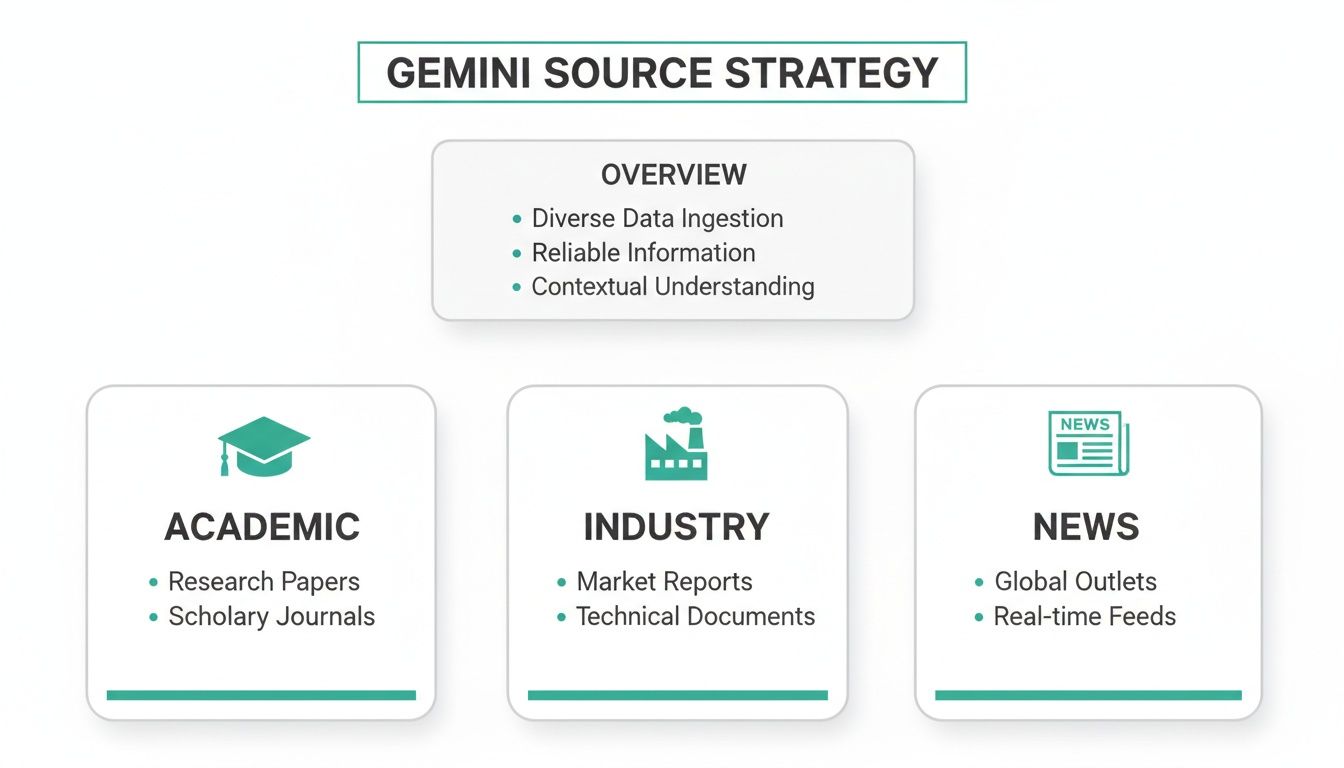
This visual reinforces the idea that building authority across academic, industry, and news sources is a tangible, measurable strategy for improving your visibility in AI search.
Key Performance Indicators for a Gemini SEO Initiative
Adopting a new measurement model starts with defining the right KPIs. These metrics paint a clear picture of your performance and help you show the real ROI of your work to stakeholders. Key metrics you should be tracking include Answer Share, which is the percentage of AI generated answers for your target topics where your brand is mentioned or cited. Another is Citation Rate, which measures how often your specific data or articles are directly referenced as a source. These metrics provide a much more accurate picture of your influence.
Comparing Traditional SEO KPIs with Gemini AI SEO Metrics
To truly understand the shift, you need to see the new metrics side by side with the old ones. The focus is shifting from visibility in a list to influence within a conversation. This change is crucial for demonstrating verifiable expertise through citable data points and authoritative sources.
| Focus Area | Traditional SEO KPI | Gemini AI SEO Metric | Why It Matters Now |
|---|---|---|---|
| Visibility | Keyword Rankings | Answer Share | Measures presence inside the AI answer, not just on a results page. |
| Authority | Backlink Count | Citation Rate | Tracks direct source attribution, a much stronger trust signal for LLMs. |
| Brand Presence | Organic Traffic | Mention Frequency | Captures unlinked brand mentions that build authority over time. |
| Content Goal | Clicks and Impressions | Factual Snippet Adoption | Shows content is being used as a verifiable source of truth by the AI. |
By moving to this new framework, you are not just adapting; you are aligning your strategy with how modern search actually works. It allows you to prove value in a way that resonates with both the technology and your stakeholders.
Summary of Your Gemini AI SEO Strategy
Winning in the world of Gemini AI SEO requires a fundamental shift in both mindset and measurement. The focus is moving from clicks to citations, from rankings to genuine influence within AI generated answers. Success in 2025 and 2026 will be defined by the teams who master this new discipline. The key is to start treating the AI as your primary audience. Give it clear, factual, well structured information, and you will position your brand to dominate this new era of search. The core principles of proving expertise and building trust have not changed, but how you apply them has.
Frequently Asked Questions
How does Gemini AI SEO differ from traditional SEO?
The main difference is the goal. Traditional SEO aims to rank a webpage to earn a click. Gemini AI SEO focuses on getting your brand's information cited directly inside an AI generated answer. This requires prioritizing factual accuracy, structured data, and topical authority over older tactics like keyword density.
What is the best way to track visibility in Gemini?
Manual checking is not scalable or reliable due to the dynamic nature of AI responses. The most effective approach is to use a specialized AI visibility platform like Riff Analytics. These tools query models at scale, tracking your "Answer Share," citation frequency, and competitive mentions to provide measurable KPIs.
Should I optimize existing content or create new pages for Gemini?
Start by auditing and retrofitting your highest performing existing pages. Inject citable facts, add summary tables, use structured data, and rewrite headings into conversational questions. After strengthening your core assets, analyze competitor citations to identify content gaps that you can fill with new, purpose built pages designed to be authoritative sources.
How important is E-E-A-T for Gemini AI SEO?
Experience, Expertise, Authoritativeness, and Trustworthiness (E-E-A-T) are more critical than ever. According to Google’s own guidance, its systems give more weight to content from sources demonstrating strong E-E-A-T. Clear author bios, citations to authoritative studies, and a consistent history of expert content are direct inputs into the AI's trust score for your domain.
What is LLM tracking in the context of SEO?
LLM tracking involves using specialized software to monitor how Large Language Models like Gemini use and cite your brand and content in their generated answers. It helps you measure key metrics like Answer Share and Citation Rate, providing a clear view of your visibility and authority within AI search environments.