Your Guide to AI Search Engine optimization
Updated December 21, 2025
AI search engine optimization is the practice of creating and structuring your content so AI driven search engines like Google's AI Overviews, Perplexity, and ChatGPT can find, understand, and feature it. Looking ahead to 2026, the focus is shifting from ranking in a list of blue links to becoming a citable, authoritative source for AI generated answers. This guide will walk you through exactly how to adapt your strategy for this new era of search.
Understanding the Landscape of AI Search Engine Optimization
Think of it this way: traditional SEO is like using a paper map. It's a reliable tool based on fixed routes and known landmarks. You follow the established roads to get to your destination. AI Search Engine Optimization (AISEO), on the other hand, is your real time GPS. This modern approach anticipates traffic, suggests faster routes, and even understands your preference for scenic roads. It’s all about optimizing your digital presence so AI systems can easily find, comprehend, and cite your information when they generate responses for users. The game is no longer just about ranking number one. Instead, the primary goal is to become a trusted, authoritative source that AI models select to build their answers. This shift is critical because the entire user journey is changing.
The New Reality of AI Search Visibility
Generative search features have fundamentally altered how people find information. Google's AI Overviews, for example, reshaped the search landscape in 2025. Research shows their presence surged from appearing for just 6.49% of keywords in January to a peak of nearly 25% by July, before stabilizing around 15.69% by November. This rapid adoption means nearly one in six queries might now prioritize an AI summary over traditional results. You can read the full research on this trend and its impact on Semrush. This new environment demands a focus on strategies like Generative Engine Optimization (GEO) and Answer Engine Optimization (AEO). Both disciplines aim to secure your brand’s spot within these valuable AI powered summaries.
Why Your Strategy for AI Driven SEO Must Adapt
Adapting your approach is no longer optional. It's a matter of survival. When a user gets a direct, comprehensive answer from an AI, their need to click through to a website diminishes. For many sites, this means a drop in organic clicks. However, being cited as a source within that AI answer builds immense brand authority and drives highly qualified traffic. Your focus must shift from broad keyword targeting to demonstrating deep, verifiable expertise on specific topics. This means creating content that is not only well researched but also structured for machine readability, a concept we’ll explore throughout this guide.
How AI Search Engines Actually Work
To win at AI search, you have to get inside its head. This isn't your old school SEO game of keywords and backlinks anymore. AI search operates on a totally different level. It's less about matching words and more about understanding the intent behind them. At the heart of this shift are Large Language Models (LLMs), the engines driving generative search. Think of them as incredibly sophisticated pattern recognition machines, trained on a staggering amount of the internet's text and code. They don't just see your query; they interpret what you're really asking for. This means when someone searches "best way to fix a leaky faucet without a plumber," the AI knows they're not just looking for pages with "faucet" and "plumber." It understands the user wants DIY instructions for a beginner, probably using tools they already have. Grasping this contextual leap is the first step toward effective ai search engine optimization.
The AI Method of Crafting Answers from Authoritative Sources
Instead of just handing you a list of links, an AI search engine acts like a research assistant. It reads dozens of trusted sources, pulls out the most important pieces, and synthesizes them into a single, conversational answer. The goal is to solve the user's problem right there on the results page. For your content to be included, the AI has to see it as a credible, reliable building block for that final answer. It's constantly judging your content on signals of experience, expertise, authoritativeness, and trustworthiness (E-E-A-T). This screenshot from Semrush shows a generative answer in action, pulling facts from several different websites.
Notice how the generated text is a mosaic, weaving together information from multiple domains and citing each one. Earning one of those citations means your content needs to offer a unique, verifiable piece of the puzzle that contributes to the complete picture.
The Role of Semantics in Modern AI Search Optimization
A huge part of ai search optimization is mastering semantics, the meaning and relationships between words and ideas. The AI is building a knowledge graph, connecting concepts. It knows "Apple" the company is linked to "iPhone" and "Tim Cook," but has nothing to do with "apple" the fruit. To play this game, your content must be rich with related terms, synonyms, and context. When you discuss AI search visibility, mentioning concepts like "LLM tracking" and "generative SEO" helps the engine build a more complete picture of your page's topic and authority. According to industry analysis from HubSpot, the game is shifting to providing "direct, concise answers to user queries, often in the context of voice search and AI assistants." It’s all about clarity and authority.
Comparing Traditional vs. AI Search Workflows
The journey from a user's question to a final answer looks completely different in the AI world. Understanding this helps you see exactly where to focus your efforts.
| Stage | Traditional Search Workflow | Generative AI Search Workflow |
|---|---|---|
| Query Input | User enters keywords (e.g., "best running shoes") | User asks a question (e.g., "What are the best running shoes for someone with flat feet?") |
| Information Retrieval | Engine matches keywords to indexed web pages | Engine interprets intent and identifies relevant concepts and authoritative sources |
| Ranking | Pages are ranked based on hundreds of signals like backlinks and keywords | Sources are evaluated for E-E-A-T, clarity, and factual accuracy |
| Result Display | A list of ten blue links is presented | A synthesized, conversational answer is generated with citations to source material |
The table makes it clear: the goal has pivoted from ranking a webpage to becoming a citable source for the AI's final answer. Your job is to be the most reliable, clearly explained expert on your topic.
Adapting Your Content for AI Visibility
Moving from theory to practice means making a deliberate shift in how you build and structure your content. For your brand to actually show up in AI generated answers, your content needs to do more than just inform. It must be machine readable, authoritative, and framed as a direct solution. This isn't about traditional keyword stuffing. It's about mastering three core pillars: content framing, structured data, and authoritative signals. Nailing these areas ensures your website speaks the same language as the AI. You're making your expertise so clear and well organized that Large Language Models (LLMs) don't just understand it, they trust it enough to present it as a fact to their users. In 2026 and beyond, this is the bedrock of any real ai search engine optimization strategy. Recent data shows a massive 86% of SEO professionals are now integrating AI into their strategies. It’s working, too. A huge 65% of businesses are seeing better SEO results, using AI for everything from content outlines (63%) to keyword research (60%).
Framing Your Content for Effective AI Consumption
The first pillar is content framing. Think of it like you’re writing an instruction manual for a robot. You wouldn't use fuzzy language or bury the important steps in a wall of text. You’d use sharp headings, short sentences, and a logical flow. The same idea applies here. AI models are built to find and pull out direct answers. Your job is to make that as easy as possible. Use Question Based Headings. Instead of a generic title like "Product Features," switch to "What Are the Key Features of Product X?" This directly mirrors how a real person would ask a question. Give the Answer Immediately. Put a clear, direct answer to the heading's question right in the first paragraph. This "inverted pyramid" style gives the AI the nugget of information it needs right away. This approach doesn't just feed the bots; it also creates a much better experience for human readers, which is a powerful signal in its own right. A key part of this is leveraging Artificial Intelligence Personalization to create user experiences that feel dynamic and responsive.
Using Structured Data as an AI Translator for your Content
If content framing is about using clear language, then structured data (or schema markup) is the grammar that holds it all together. It’s a bit of code you add to your site that explicitly tells search engines what your content is about. Think of it as a translator that leaves no room for guessing. Without structured data, an AI might see a page and struggle to tell the difference between a recipe, a product review, and an event listing. With it, you can label every piece of content with precision. As Google puts it, "When you provide structured data, you can help Google understand the content of the page and display it in a richer format in search results." The same logic applies directly to how LLMs choose information for AI Overviews. You can learn more about this in our guide on how to integrate ai seo with existing seo workflows.
Building Authoritative Signals for Generative SEO
The final pillar is building authoritative signals. AI models are designed to be risk averse. They will always prioritize information from sources that show deep, verifiable expertise. This is where you prove you’re a voice worth listening to. Effective generative SEO is all about showing, not just telling. You can build this kind of authority through a few key tactics. First, publish original research. Run your own studies, surveys, or data analyses. Original data is highly citable and instantly positions you as a primary source. Second, cite credible experts. Quote industry leaders, link out to academic studies, and reference reputable sources. This demonstrates your content is well researched and part of a larger expert conversation. Third, demonstrate experience. Use case studies, first hand stories, and detailed examples that prove you have real world experience with the topic you're writing about. These signals tell AI systems that your content isn't just regurgitated fluff, it's a valuable, credible resource worthy of being cited in an answer.
Understanding Generative Engine Optimization
If AI search engine optimization is the overall game plan, then Generative Engine Optimization (GEO) is the specialized set of plays you run to score. It’s the focused practice of optimizing your content to be found, trusted, and directly featured in the answers created by AI engines. As we head toward 2026, this distinction is more than just semantics, it's everything. AISEO is about aligning your entire digital presence with how AI systems work, from technical site health to brand authority. GEO, however, is the sharp point of the spear. It's the tactical work that gets your specific facts and figures cited in an AI Overview or a Perplexity response. It’s about winning the answer, not just the ranking.
A New Focus for Modern AI Optimization Strategy
The fundamental goal of Generative Engine Optimization is a world away from traditional SEO. You are no longer just competing for a top spot on a list of blue links. You are competing to become a foundational piece of knowledge that the AI uses to construct its answer. This requires a mental shift from chasing broad keyword rankings to building deep, verifiable authority on specific topics. Your content must be structured not just for human readability but for machine comprehension. The AI needs to see your page and instantly recognize it as a reliable source of facts. The diagram below breaks down the three pillars essential for achieving AI visibility: effective framing, data quality, and authoritative signals.
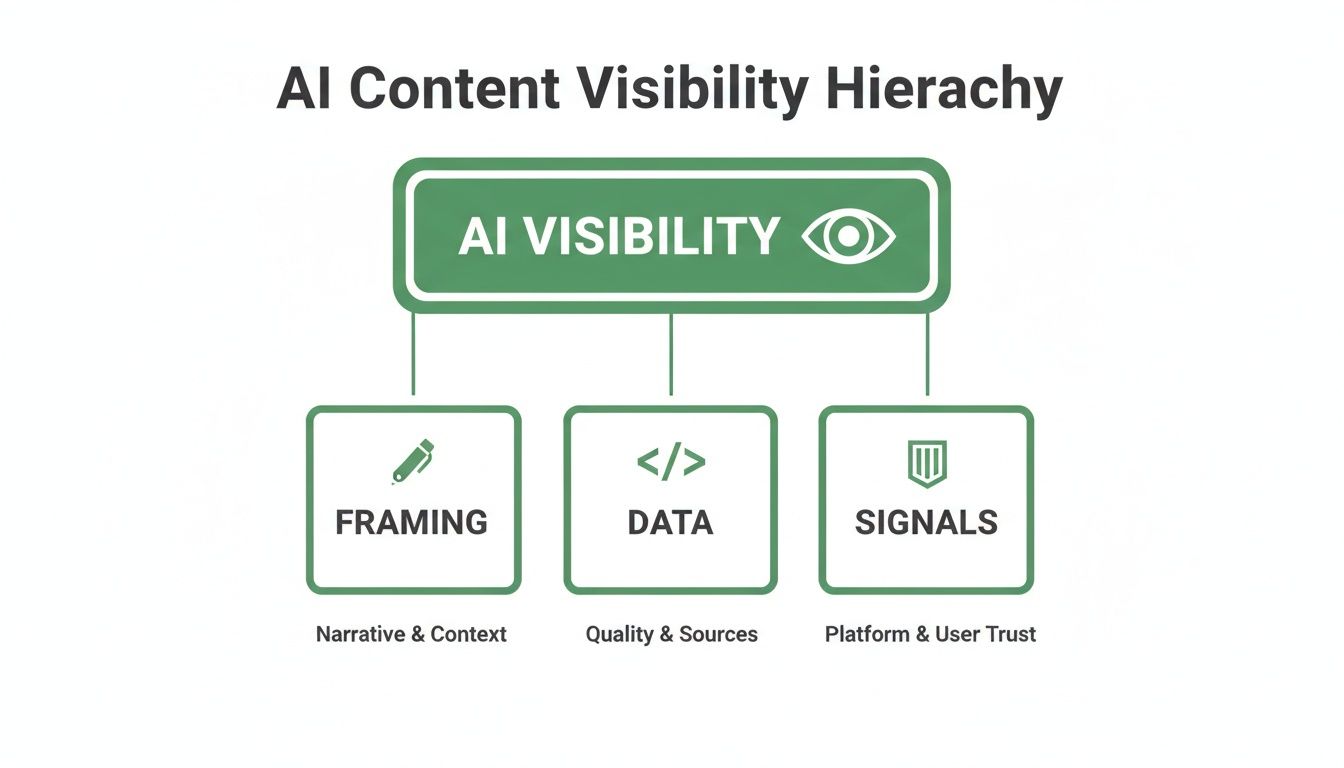
This visualization really clarifies that success in this new environment depends on mastering how you frame content, the quality of your underlying data, and the strength of your authority signals.
Comparing Traditional SEO to Generative AI SEO
To truly grasp the change, it helps to see the old and new models side by side. The objectives, tactics, and metrics are all evolving, and understanding these differences is the first step in adapting your daily workflows. For a deeper dive, check out our guide on Answer Engine Optimization. Here’s a look at how the two approaches stack up.
| Aspect | Traditional SEO | Generative Engine Optimization (GEO) |
|---|---|---|
| Primary Goal | Achieve a high ranking on the SERP (e.g., top 10 links). | Get cited as a source within an AI generated answer. |
| Core Tactic | On page optimization, link building, and keyword targeting. | Content framing, structured data, and topical authority. |
| Key Metric | Organic traffic, keyword rankings, and click through rate. | Citation frequency, brand mentions in answers, and source visibility. |
| Content Focus | Comprehensive articles targeting a primary keyword. | Modular content with direct answers to specific questions. |
This table highlights the transition from a volume based game (traffic and rankings) to an influence based one (citations and authority). It’s a completely different mindset. For more insights into this evolving field, you can learn more about the rise of Generative Engine Optimisation.
How to Measure Success in the AI SEO World
Heading into 2026, the old SEO playbook is officially broken. For years, we obsessed over organic traffic and keyword rankings, but those metrics just don't tell the whole story anymore. In a world of AI driven search, success isn't about getting a click, it's about becoming the source. Measuring the impact of your ai search engine optimization efforts now demands a completely different way of thinking. The question is no longer "How many people visited our site?" but rather, "How often is our brand cited as the trusted authority in an AI answer?" Answering that requires a new set of KPIs and tools built for this generative age. This shift has been accelerated by the explosion of zero click searches. As of March 2025, 10.4% of keywords now trigger AI Overviews, causing an average 15.5% drop in click through rates for many sites.
Key Metrics for AI Search Optimization Performance
To see what's really working, you have to look beyond Google Analytics. The new KPIs for ai search optimization are all about your visibility and influence inside the AI models. These metrics reveal if your content is actually resonating with the engines generating the answers. Here are the essentials you need to start tracking now. First is Citation Frequency, which counts how many times your domain is cited as a source. Think of it as the new "ranking." Second is Brand Mentions, which tracks how often your brand name appears in an AI answer, even without a direct link. It's a powerful signal of brand authority. Third is Share of Voice, which pits your citation frequency against your top competitors, showing you what percentage of the AI answer space you own.
A New Toolkit for Tracking Generative AI Performance
Let's be honest, traditional SEO tools were not built for this. To measure these new KPIs, you need platforms designed specifically for LLM tracking. These tools are built to monitor different AI engines and give you a clear view of your performance. Using an AI Overview tracker is a great way to get a clear picture of how your content is performing. This table breaks down the old way versus the new way of measuring SEO success.
| Measurement Area | Traditional SEO Workflow | AI Search Optimization Workflow |
|---|---|---|
| Primary Tool | Google Analytics, Search Console | AI Visibility Platforms (e.g., Riff Analytics) |
| Key Performance Indicator | Organic Traffic, Keyword Rank | Citation Frequency, Brand Mentions |
| Core Question | "How high do we rank?" | "How often are we the source?" |
| Success Signal | High click through rate (CTR) | High citation count and positive sentiment |
This really drives home the point. We're moving away from measuring raw traffic volume and toward measuring the quality and influence of your brand's presence within AI summaries.
Final Summary and FAQ for AI Search Optimization
As we've seen, the world of search is shifting under our feet. The core pillars of good SEO like a healthy website and quality content are still the bedrock of any solid online presence. However, ai search engine optimization adds a crucial new layer on top. It forces a laser focus on becoming a citable authority, using structured data so machines can understand you, and framing your content as direct answers. It’s an evolution, not a replacement. By adopting new metrics like citation frequency and using modern tools for LLM tracking, businesses can adapt and thrive in this new landscape. The fundamentals are still there, but the way you build on them to get seen has changed for good.
Frequently Asked Questions
How does E-E-A-T impact AI search engine optimization?
E-E-A-T (Experience, Expertise, Authoritativeness, Trustworthiness) is paramount. AI models are trained to avoid misinformation, so they prioritize sources that prove these qualities. Things like detailed author bios, original data, and clear sourcing are no longer optional. They are essential signals for establishing trust with both users and AI algorithms.
What is the difference between generative SEO and traditional SEO?
Traditional SEO focuses on getting your entire webpage to rank in a list of links. Generative SEO, a key part of AISEO, aims to get specific pieces of information from your content featured and cited inside an AI generated answer. It's a more surgical approach focused on becoming a verified source rather than just a destination.
Do keywords still matter for AI search visibility?
Yes, but their role has changed. Forget about keyword density. Instead, focus on topical depth and semantic richness. You need to use a wide variety of related terms and phrases that cover a subject comprehensively. The AI is looking for a complete and authoritative explanation, not just a repeated phrase.
How can a small business start with AI search optimization?
The best starting point is to own your niche. Begin by identifying the top 10-15 questions your customers ask. Create dedicated, in depth content that answers each one directly. Use the question as your main heading and provide a concise answer immediately. Enhance your "About Us" page to clearly state your credentials and real world experience. This focused strategy on authority and clarity is highly effective.