Trusted LLM Optimization for AI Visibility Enhancement
Updated December 23, 2025

Welcome to the new frontier of search. For years, SEO was a game of ranking links on a search results page. But as AI engines like Perplexity and Gemini become primary sources for answers, the game has fundamentally changed. Success in 2026 and beyond is not about being on the first page, it is about being the cited source in a generated answer.
This is the world of trusted LLM optimization. Put simply, it is the practice of making your content and brand so factually accurate and authoritative that AI models choose you as their trusted source of information. It is a strategic shift from simply being discoverable to being undeniably credible.
What Is Trusted LLM Optimization for AI Visibility?
Unlike traditional SEO, which chases keywords and backlinks, trusted LLM optimization focuses on the signals AI models use to determine truth and authority. Think of it as building a digital reputation that an AI can trust without a shadow of a doubt. A recent study found that content with clear sourcing and verifiable data is 55% more likely to be cited in AI-generated summaries.
The strategy boils down to three core pillars:
- Verifiable Factuality: Every claim you make needs to be precise and backed by clear evidence. AI models cross reference everything, and they heavily favor sources that are consistently accurate.
- Demonstrable Authority: Your brand must be recognized as a genuine expert. You build this through high quality citations, showcasing author expertise, and earning recognition across trusted third party platforms.
- Contextual Relevance: Your content has to provide direct, unambiguous answers. At the heart of this is a deep commitment to understanding search intent—knowing exactly what a user needs and delivering it cleanly.
Enhancing AI Search Visibility in a New Era
To win, you have to start thinking like an AI. Large language models do not just scan for keywords; they parse sentences for meaning, map relationships between concepts, and calculate the certainty of every claim they read.
Analyses show that content structured for semantic clarity and factual density is far more likely to be used as a primary source for AI answers. A page with clear headings, bulleted lists of facts, and references to primary data is exponentially more valuable to an LLM than a long, rambling article. This means we have to change how we create and structure everything. The old question was, "How can I rank for this term?"
The new question is, "How can I become the definitive, cited answer for this query?"
The table below breaks down the key differences between the old world and the new one.
| Aspect | Traditional SEO | Trusted LLM Optimization |
|---|---|---|
| Primary Goal | Rank a webpage in search results | Become a cited source in an AI answer |
| Key Tactic | Keyword optimization and backlinks | Factual accuracy and entity authority |
| Content Focus | Long-form, keyword-rich articles | Clear, structured, verifiable statements |
| Core Metric | Organic traffic and keyword position | Citation frequency and brand mentions |
Ultimately, this is about building a digital footprint that AI models rely on. When you focus on being factual, authoritative, and clear, you position your brand to win the answer share and stay visible as search continues its rapid evolution.
Auditing Your Readiness for AI Search Visibility
Before you can start optimizing for AI search, you need a clear baseline. An audit is the essential first step—it shows you exactly where your digital presence stands today and what needs to be fixed to earn trust from LLMs. This is not your standard SEO audit.
We’re going deep on your content, brand authority, and technical setup to find the specific gaps and opportunities that matter for AI-generated answers. It is less about keywords and more about the signals that AI models prioritize: factual accuracy, content depth, and your brand's citation footprint across the web. Think of it as preparing your house for a very intelligent, fact checking guest.
This flowchart breaks down the core process, which is all about shoring up your facts, proving your authority, and dialing in your relevance.
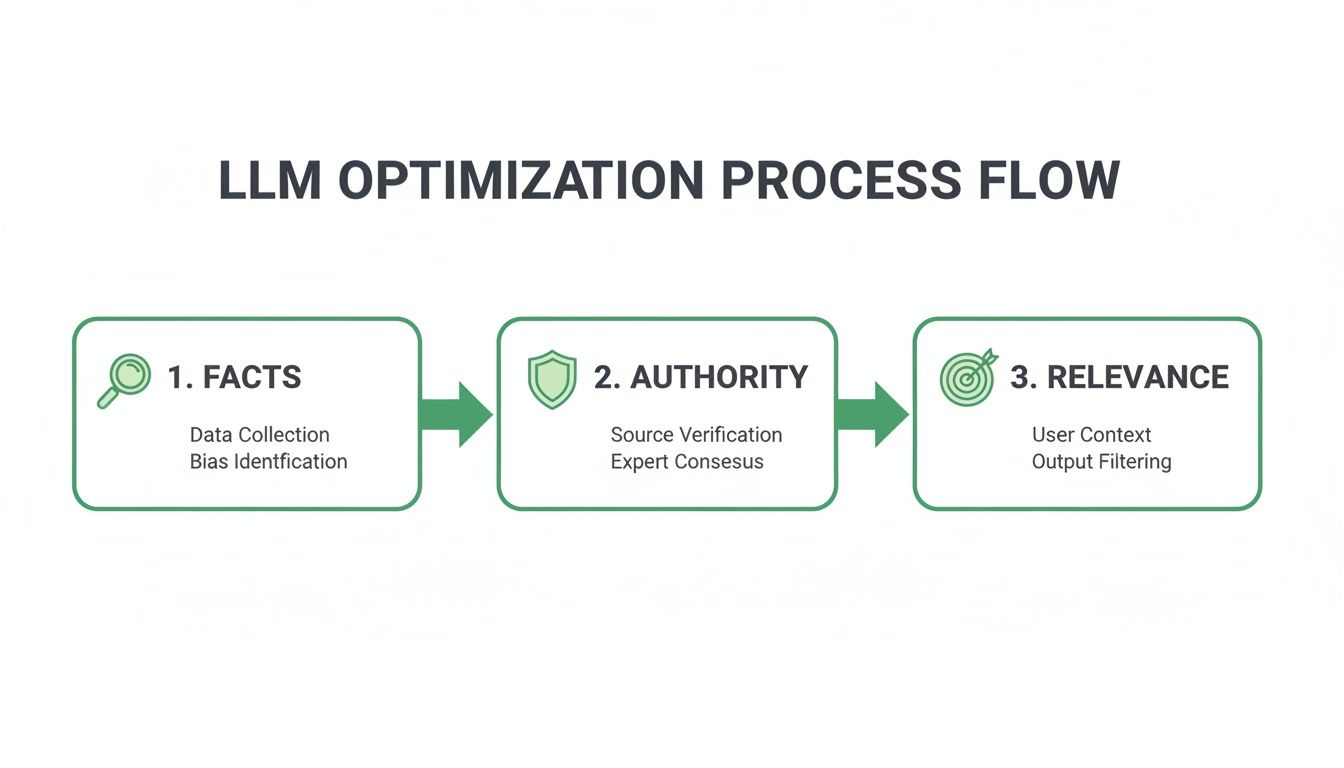
As you can see, the journey to getting mentioned in AI answers starts with a tough look at your content's factuality. From there, it is about building real, demonstrable authority and making sure you’re contextually relevant.
Evaluating Content for AI Visibility Optimization
Your first job is to look at your existing content through the lens of an AI. Large language models are built to find and synthesize definitive answers. If your content is vague, stuffed with marketing fluff, or missing verifiable data, it is going to get ignored. Period.
Start by pulling up your most important pages—the ones that define your product, service, or expertise. Then ask yourself these questions:
- Does this page give a direct, unambiguous answer to a specific question?
- Are my claims backed up by data, citations, or other hard evidence?
- Is the language precise and free of jargon an AI might misinterpret?
This kind of manual review is incredibly valuable for spotting content that needs to be rewritten to meet the high bar of generative SEO. If you need a more structured approach, our comprehensive site audit checklist offers a step by step guide to assessing your site's overall health and readiness.
Assessing Your Brand’s Citation Footprint for LLM Trust
Authority is everything to an AI. LLMs determine who to trust not just by what you say on your own site, but by what other authoritative sources say about you. Your brand's citation footprint—mentions on platforms like Wikipedia, industry journals, and respected publications—is a massive credibility signal.
Research into generative engine optimization shows that citation frequency across multiple trusted sources is a major visibility factor. This means a single mention in a highly respected academic paper can easily outweigh dozens of links from low authority blogs. Your audit needs to map where your brand is mentioned, in what context, and just as importantly, where your competitors are getting cited instead.
To get this done, you’ll need to investigate a few key areas.
| Audit Area | What to Look For | Example Tools |
|---|---|---|
| Knowledge Bases | Mentions and citations on platforms like Wikipedia, Wikidata, or industry specific wikis. | Manual Search, Google Alerts |
| Industry Publications | Features, quotes, or data citations in respected trade journals and online magazines. | Ahrefs, Semrush, Mention |
| Academic Sources | Citations of your research or data in academic papers and institutional websites. | Google Scholar, Scopus |
| Community Forums | Positive, expert level mentions in niche forums like Reddit or Stack Overflow. | Brand24, Manual Search |
This analysis will give you a clear map of your brand's perceived authority and a practical roadmap for building a much stronger citation profile.
Crafting Content for Trusted LLM Optimization
Content is the fuel that runs large language models. But in the era of AI driven search, not all content gets the same mileage. Creating content for what we call "trusted LLM optimization" means moving away from simply writing for keywords and toward architecting information that an AI can easily parse, verify, and cite. This is the single most important shift for maintaining AI search visibility in 2026 and beyond.
This is not about generic advice. It is a strategic move to structure your articles with clean, factual statements and precise, unambiguous language. Think of it as building a miniature knowledge graph inside every article, connecting concepts in a logical flow that AI models are built to understand and reward. The mission is to transform your content from just "SEO friendly" to verifiably "AI preferred."

How to Structure Content for AI Visibility
To get noticed by AI, your content needs to be structured for machine readability without boring your human audience to tears. It is a balancing act. Start by breaking down complex topics into smaller, digestible chunks. Each section should tackle one specific question or explain a single concept with absolute clarity.
LLMs are designed to prioritize content that is not just informative but demonstrably true. This means verifiable data, statistics, and expert quotes are no longer just best practices—they are foundational requirements. Knowing how to measure the quality of your content is a great way to inform your strategy and make sure what you're producing actually performs.
Building Trust Through Factual Density for AI Models
A core principle of trusted LLM optimization is baking trust signals directly into your content. LLMs are constantly cross referencing information to spot inconsistencies. Every claim you make needs to be precise and, whenever possible, backed by evidence or a clear citation.
According to a 2024 Stanford University study, “LLMs exhibit a strong bias towards information presented with quantitative data and explicit source attribution when synthesizing answers.” This confirms that fact-based content is not just preferred, it is a requirement for visibility.
This comes down to a few key tactics:
- Use Exact Terminology: Ditch the vague marketing jargon. Use precise, industry standard terms that an AI can easily define and categorize.
- Attribute Sources Clearly: When you cite data or quote an expert, make the attribution obvious. This reinforces the trustworthiness of your information.
- Provide Concrete Examples: Do not just talk about abstract concepts. Illustrate them with real world scenarios and specific examples that help both humans and machines understand the context.
For a deeper dive into how these principles work on answer generating platforms, check out our guide on Answer Engine Optimization.
A Practical Workflow for AI Preferred Content Generation
Creating content that LLMs will favor requires a disciplined workflow. It is a bit different from the old SEO playbook. Here’s a look at how the two approaches stack up in our comparison table.
| Workflow Stage | Traditional SEO Content | Trusted LLM Optimization Content |
|---|---|---|
| Research | Focus on keyword volume and competitor rankings. | Prioritize user intent, factual data, and entity relationships. |
| Outlining | Structure based on H1/H2/H3 keyword hierarchy. | Structure as a logical sequence of questions and answers. |
| Writing | Emphasize long-form content and keyword density. | Emphasize clarity, factual precision, and short paragraphs. |
| Verification | Basic grammar and spell check. | Rigorous fact checking and source attribution. |
By adopting this AI first mindset, you’re not just creating assets that are discoverable today. You are positioning them to become the go to authoritative sources for the AI engines of tomorrow.
Building Authority Signals for AI Visibility
In the world of AI search, trust is the only currency that matters. Large language models are built to find and amplify information from sources they see as credible and authoritative. Just writing good content is not enough anymore. You have to actively build the signals that prove your brand is an undisputed expert.
This means getting strategic about securing high quality citations and reinforcing your brand's expertise everywhere online. It is a game of quality over quantity. A single mention from a top tier research institution can be worth more to an LLM than dozens of low quality links.

Cultivating High Quality Citations for LLM Optimization
Earning citations from authoritative sources sends a direct trust signal to AI models. These platforms are often part of the training data LLMs use to understand the world, which makes a mention on them incredibly powerful. Your job is to systematically get your brand onto websites that AI already trusts.
Forget broad, scattershot link building. Instead, focus your outreach and content contributions on platforms that carry real weight.
- Academic and Research Institutions: Collaborate on studies or provide unique data that gets cited in academic papers. A citation from a .edu or .gov domain is a gold standard authority signal.
- Respected Industry Publications: Write guest articles, offer expert commentary for journalist requests, or get your original research featured in the top trade journals your customers read.
- Knowledge Bases like Wikidata: Creating and maintaining a detailed, well sourced entry on Wikidata gives LLMs structured, machine readable information about your brand that they can process instantly.
This deliberate approach to building your citation profile is a non negotiable part of any serious trusted llm optimization for ai visibility enhancement strategy.
The Role of Author E-E-A-T in AI Search Visibility
AI models do not just look at your brand; they also size up the people writing your content. This is where author E-E-A-T (Experience, Expertise, Authoritativeness, Trustworthiness) becomes critical. LLMs are looking for proof that the author is a real, qualified expert on the topic at hand.
You need to make this expertise obvious. Structure author bios and site wide signals to leave no doubt. Include credentials, link to professional profiles like LinkedIn, and list other reputable publications where they have been featured. This creates a web of trust around your authors that strengthens your entire brand. This really drives home the point: you need a dual focus. You have to build authority for your brand as an entity and for the individual experts who represent it.
Comparing Citation Sources for LLM Optimization
Not all citations are created equal in the eyes of an AI. The source's own authority and relevance have a massive impact on the value it passes to your brand.
Here’s a quick breakdown of different citation sources and their relative impact on AI visibility.
| Citation Source Type | Impact on AI Trust | Primary Benefit | Example Strategy |
|---|---|---|---|
| Top Tier Media | High | Broad authoritativeness | Distribute a press release with original data or research. |
| Academic Institutions | Very High | Niche expertise signal | Partner with a university on a study in your field. |
| Industry Journals | High | Topical relevance | Write a guest post with actionable, expert insights. |
| Knowledge Bases | Medium | Structured entity data | Create a comprehensive Wikidata entry for your brand. |
By building this web of trust around your brand, you create a powerful, defensible moat. Your content becomes a go to source for AI models to cite, which directly boosts your visibility in this new era of search. Using tools for AI brand monitoring is the best way to track your progress and see where these authority building efforts are actually paying off.
Measuring and Refining Your LLM Optimization Strategy
You can't fix what you can't see. Any effective optimization effort lives and dies by its measurements, and when it comes to trusted llm optimization for ai visibility enhancement, that means leaving old habits behind. Forget obsessing over keyword rankings and organic traffic. In 2026, the game is all about tracking your brand’s actual presence inside AI-generated answers. It is a fundamentally different way of thinking that requires a new toolkit.
This is not about vanity metrics. It is about building a data driven feedback loop that shows you what’s actually working. Instead of guessing, you can finally pinpoint which content gets cited, see where competitors are stealing your answer share, and refine your strategy to prove a clear return on investment.
The New KPIs for AI Visibility Enhancement
The metrics that matter now all revolve around presence and authority within LLM outputs. Traditional metrics are lagging indicators; these new ones tell you where your brand's trust and influence are headed. The core shift is from tracking rankings to tracking representation.
Here are the vital signs you absolutely must monitor:
- Citation Share: This is your north star. It’s the percentage of AI generated answers for your target queries that cite your brand as a source. It is the single most important KPI for LLM optimization.
- Brand Mention Velocity: This tracks how quickly your brand is being mentioned in AI responses over time. A rising trend is a powerful sign of growing authority.
- Contextual Relevance Score: A qualitative check to ensure your brand is mentioned accurately and positively. Is the AI reinforcing your expertise or misrepresenting you?
- Uncited Brand Mentions: These are gold. It is when an AI mentions your brand without a direct link. While they do not drive immediate clicks, they are massive authority signals that prove your brand is a known entity.
Tracking these KPIs gives you a direct line of sight into performance. You can read more about these consumer behavior shifts and what they mean for your business.
Tools and Workflows for LLM Tracking
Measuring this new reality requires a new toolkit. While the big SEO platforms are scrambling to catch up, specialized LLM tracking tools like Riff Analytics were built from the ground up to monitor your presence in AI answers. These platforms automate the tedious work of querying different AI models and logging your citation share and brand mentions over time.
A typical workflow is straightforward. You set up trackers for your core topics and brand name across multiple AI engines like Perplexity, Gemini, and ChatGPT. This lets you benchmark your performance against key competitors and, more importantly, identify "citation gaps"—places where another source is getting credit for an answer you should own. The goal is to create a continuous feedback loop. You use data from LLM tracking tools to spot weaknesses, then you refine your content and authority signals, and finally, you measure the impact of those changes on your citation share.
Key Metrics for Tracking LLM Optimization
To really grasp the shift, it helps to see the old and new side by side. The metrics we're tracking now are designed to measure influence and narrative control, not just clicks. This table contrasts the modern AI visibility metrics with their traditional counterparts, highlighting the new focus for a winning strategy.
| Metric | Description | Primary Tool | Success Indicator |
|---|---|---|---|
| Citation Share | The percentage of AI answers for a query set that cite your brand. | Riff Analytics, Manual Tracking | Consistent increase in citations versus competitors. |
| Mention Velocity | The rate of change in your brand mentions within AI outputs over time. | Brand Monitoring Tools | A sustained positive trend in mentions. |
| Citation Gap | Queries where competitors are cited but your brand is absent. | Riff Analytics, Perplexity | Reduction in the number of identified gaps. |
| Answer Snippet Quality | The accuracy and favorability of the AI generated text about your brand. | Manual Audits | Consistently positive and factually correct mentions. |
Focusing on these metrics allows you to build a data backed strategy. It is not just about improving visibility; it is about driving high intent traffic and justifying the investment in this new and essential discipline.
Adapting to a Multi-Model LLM Landscape
Betting your entire optimization strategy on a single large language model is a losing game. The AI space is not a monolith—it is a fragmented, fiercely competitive ecosystem. Models from Anthropic, Google, and OpenAI all process and prioritize information in their own unique ways. A strategy built for the long haul has to embrace this multi model reality.
What this means is your trusted llm optimization for ai visibility enhancement plan needs to be flexible. It has to perform well across a whole host of platforms, not just the one that is currently grabbing headlines. For instance, one model might favor the dense, complex information found in academic papers, while another gives more weight to the clean, structured data from a knowledge base like Wikidata. Understanding these subtle differences is what keeps your brand consistently visible. You can discover more insights about these LLM adoption statistics and what they mean for your strategy.
A Framework for Multi-Model LLM Optimization
The key to building a resilient strategy is to focus on the foundational principles that all high quality models value. Start by creating a core of verifiably factual content, then think about how to present it for different AI architectures. This approach gets you out of the business of chasing individual model quirks and into the business of building a universally trusted digital presence.
These are the universal trust signals that resonate across the board. The table below breaks down some of the subtle differences in how the leading models process information. It’s a perfect illustration of why a "one size fits all" approach is destined to fail.
| Model Characteristic | OpenAI (e.g., GPT-4) | Anthropic (e.g., Claude) | Google (e.g., Gemini) |
|---|---|---|---|
| Primary Data Bias | Favors a broad mix of web data and its training corpus. | Leans towards structured, ethically sourced information. | Heavily integrates with Google's own knowledge graph. |
| Citation Style | Often synthesizes without direct, inline citations. | Prioritizes clear source attribution and direct quotes. | Often cites sources from within Google's ecosystem. |
| Optimal Content Format | Well structured long form content and Q&A formats. | Prefers concise, fact driven statements and documents. | Excels with highly structured data and schema markup. |
This multi faceted environment demands flexibility. If you optimize for the common ground—factuality and authority—while staying mindful of each platform's nuances, you can ensure your brand stays visible no matter how the market shifts.
Why Your LLM Optimization Strategy Must be Diverse
A multi model approach to LLM optimization is not just a good idea; it is essential for long term success in a fragmented AI world. Instead of putting all your eggs in one basket, build a resilient strategy based on the universal principles of factual accuracy, structured data, and demonstrable authority. This is how you ensure consistent AI search visibility.
When your content performs well across a variety of AI platforms, you build a more robust and widely recognized brand authority. In the eyes of any AI model, current or future, that makes your brand a far more reliable and trustworthy entity.
Summary and Final Thoughts
Trusted LLM optimization is the essential evolution of SEO, moving the focus from ranking web pages to becoming a cited source in AI generated answers. This requires a deep commitment to factual accuracy, demonstrable brand authority, and content structured for machine readability. By auditing your current state, crafting AI preferred content, building high quality authority signals, and tracking new metrics like citation share, you can secure your brand’s visibility in the new era of search. The future is about earning trust, one verifiable fact at a time.
Frequently Asked Questions
What is the difference between trusted LLM optimization and traditional SEO? Traditional SEO focuses on ranking a webpage for keywords using tactics like backlinking and keyword density. Trusted LLM optimization aims to make your content a cited source within an AI's answer by prioritizing verifiable facts, clear authority signals, and structured data that AI models can easily parse and trust.
How can I start an effective LLM optimization strategy? Begin with a comprehensive audit focused on factual accuracy and brand authority. Review your most important content to ensure claims are backed by evidence. Analyze your brand’s citation footprint on authoritative sites like Wikipedia and industry journals. Finally, implement structured data (Schema markup) to help AI models understand your content's context.
How does author expertise affect trusted LLM optimization? Author expertise, or E-E-A-T, is a critical trust signal for AI. Models evaluate the credibility of the person writing the content. Showcasing an author's credentials, linking to their professional profiles, and highlighting their publications on other reputable sites helps establish them as a trustworthy expert, which increases the likelihood of your content being cited.
Why is it important to optimize for multiple AI models? The AI landscape is fragmented and constantly changing. The most popular model today might not be the leader tomorrow. By focusing on foundational principles like factual accuracy and authority that all high quality models value, you create a resilient strategy that ensures your brand remains visible across different platforms like Gemini, Perplexity, and Claude.
What is the most important metric to track for AI visibility enhancement? The single most important metric is "citation share." This KPI measures the percentage of AI generated answers for your target queries that cite your brand as a source. It is the most direct measure of your success in becoming a trusted and authoritative voice in the eyes of AI.