How to Win with a Competitor Content Analysis in 2025
Updated February 15, 2026
In its simplest form, a competitor content analysis is the process of reverse engineering your rivals’ content strategies to find out what works, what doesn't, and where their undiscovered opportunities lie. Think of it as strategic intelligence for your marketing team. As we head into 2025 and 2026, where AI engines and traditional search coexist, this analysis is no longer just a good practice; it’s a critical component for building a content strategy that creates a measurable competitive advantage.
Why a Competitor Content Analysis is Essential
Creating content that cuts through the noise is harder than ever. Your audience is saturated with information, and simply publishing more frequently is not a viable strategy. Understanding your competitive landscape is non negotiable. In a world increasingly shaped by Google and AI answer engines like Perplexity, analyzing competitor content is essential for digital survival and growth.
This guide moves beyond basic definitions. It provides a blueprint for how today's leading marketing teams use competitor analysis to build a content strategy that not only keeps pace but sets the pace.
A Modern Approach to Content Competitor Analysis
In 2025, a proper competitor content analysis extends far beyond tracking keyword rankings. It involves a holistic review of your rivals' entire content ecosystem, from blog posts and videos to social media campaigns and webinar topics. This process provides a clear picture of their strategy and its effectiveness. The goal is to answer strategic questions that should inform your own content plan:
What topics are they dominating that we have yet to address?
Which content formats are driving the most engagement for them?
What is their brand voice, and how does it resonate with our shared audience?
Where are the weaknesses in their content that we can capitalize on?
Evaluating Competitor Content in the Age of AI Search
The digital landscape has shifted. AI powered search is now a major factor, and your analysis must account for your competitors' AI search visibility. This involves tracking how frequently their brand and content are cited in answers from engines like ChatGPT and Google’s AI Overviews. This practice, known as LLM tracking, is key to future proofing your brand and is an integral part of modern SEO competitive intelligence. By examining the sources AI engines cite, you can reverse engineer the signals of trust and authority they prioritize, building a content strategy that remains relevant.
A robust Social Media Competitive Analysis Guide can also provide invaluable direction across all digital platforms.
Defining Your Battlefield: Identifying Competitors
A successful competitor analysis begins with clear objectives. Before diving into data, you must define what success looks like and identify who you are competing against. In 2026, this means moving beyond simple traffic goals to measuring metrics like your brand's share of voice in AI generated answers. Without a specific objective, your analysis risks becoming a time consuming data collection exercise with no real payoff. The aim is to gather actionable intelligence.
Start by clarifying your goals. Are you trying to increase organic traffic by 20% for a key product category? Or do you want to improve rankings for critical commercial keywords? Perhaps the goal is to become the primary source cited by AI engines for a specific topic. A clear goal focuses your efforts and enhances the value of every insight.
Identifying Your True Content Competitors
A common mistake is assuming that your business rivals are your only content competitors. The reality is often more complex. Any website or brand competing for your audience's attention on your target topics is a competitor, regardless of what they sell. A systematic approach helps map this out. Segment rivals into distinct categories:
Direct Competitors: Companies offering similar products or services to the same audience.
Indirect Competitors: Brands that solve the same customer problem with a different solution.
SERP Competitors: Publications, affiliates, and influencers who consistently rank for your most important keywords.
A Practical Framework for Your Competitor Analysis
To avoid analysis paralysis, adopt a focused approach. Instead of attempting to analyze dozens of sites at once, select a manageable group to start. A good framework is to choose three to five primary competitors for an in depth investigation. These should be your closest direct and SERP rivals. Beyond this core group, create a wider monitoring list of 10 to 15 other players. This tiered approach keeps your analysis both deep and broad.
| Competitor Type | Selection Criteria | Example |
|---|---|---|
| Direct Competitor | Offers a similar product and targets the same core audience and keywords. | A B2B SaaS company selecting another platform with overlapping features. |
| SERP Competitor | Consistently outranks you for high value, non branded keywords. | An industry publication that dominates informational search queries. |
| Indirect Competitor | Solves the same user problem with a different type of solution. | A financial planning blog competing with a budgeting app for attention. |
Structuring your work this way ensures that the insights you gather are directly tied to your most important business goals, turning raw data into a strategic advantage.
Gathering and Interpreting Competitor Content Data
Now it is time to get practical. A competitor content analysis involves digging into data to understand what is working for your rivals. This is where planning transitions into action, collecting both quantitative data and qualitative insights. Your mission is to build a complete picture of your competitors' content engine: what they publish, how often, and how well it performs. In 2025, this baseline analysis must also track new signals, especially brand citations in AI Overviews and other generative AI results, which represent the new frontier of visibility.
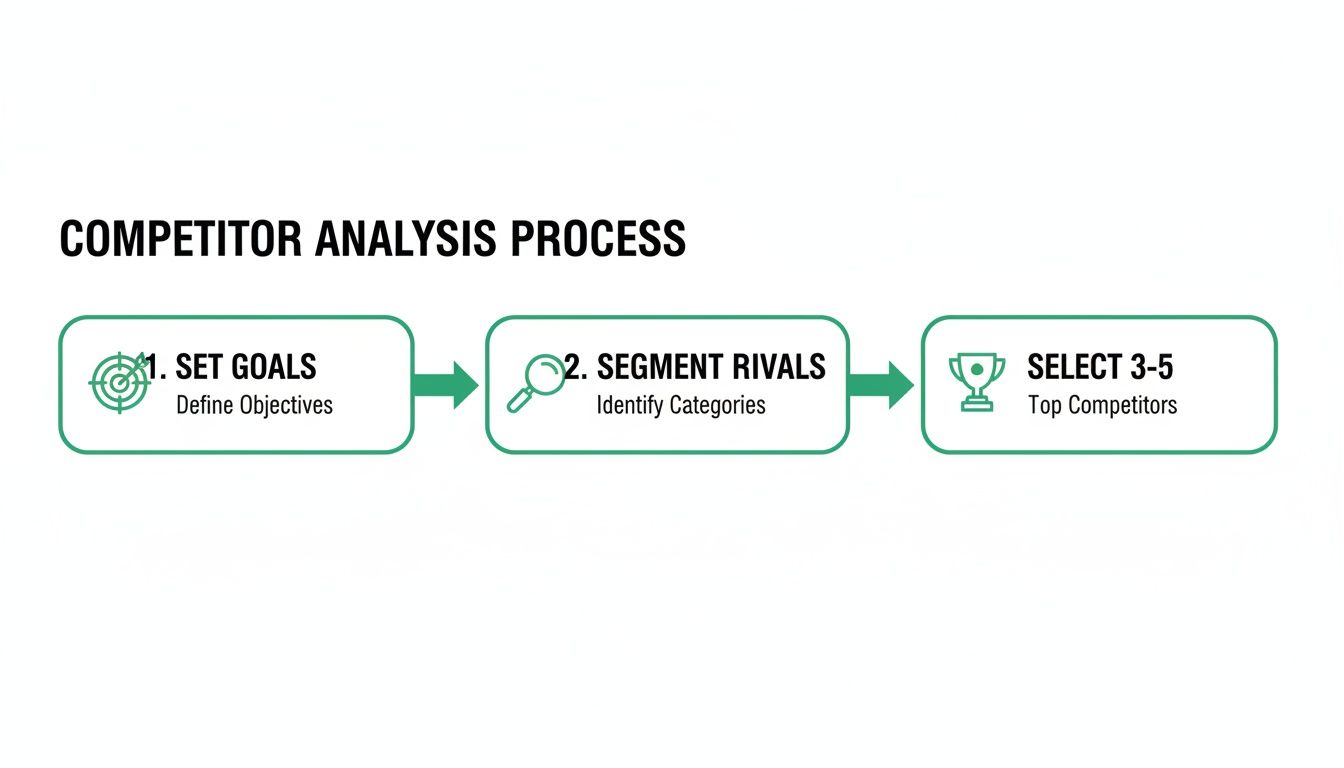
Following a structured process keeps your data collection focused on what truly matters, preventing you from becoming overwhelmed by irrelevant metrics.
Find Your Gaps with a Competitor Content Gap Analysis
One of the most valuable outcomes of this process is a content gap analysis. This method helps you find valuable topics your competitors are ranking for, but you are not. Using a tool like Semrush or Ahrefs, export the top keywords and pages for your main competitors and compare them against your own rankings. Keywords where they rank on page one and you are not visible represent your most immediate content gaps. A thorough analysis also looks for other types of gaps:
Keyword Gaps: Topics you are not targeting at all.
Format Gaps: Are they successful with video or interactive tools for topics you only cover in blog posts?
Funnel Gaps: Do they have a library of case studies or comparison pages converting bottom funnel traffic while you are focused on the top?
Effective marketing data analysis is crucial for making sense of this information.
Build Your Competitive Analysis Toolkit
No single tool can do everything. Building an efficient tech stack is essential for collecting data without excessive manual work. Your toolkit should cover classic SEO metrics, social engagement, and the newer AI visibility signals. Automating data collection allows you to focus on strategy. For a deeper look at options, explore our list of the best competitive analysis tools.
This table breaks down leading tools to help you build your analytics toolkit.
| Tool Category | Example Tools | Primary Focus | Key Metrics | Best For |
|---|---|---|---|---|
| All in One SEO Platforms | Semrush, Ahrefs | Organic traffic, keyword rankings, and backlink profiles. | Keyword Gap, Top Pages, Referring Domains, Domain Authority. | SEO managers and content strategists needing foundational SEO data. |
| Content Engagement Tools | BuzzSumo, Socialinsider | Social shares, engagement rates, and content performance. | Shares by Network, Engagement Rate, Top Performing Content. | Content marketers tracking social proof and viral content trends. |
| AI Visibility Trackers | Riff Analytics | Brand and competitor citations in AI search results. | AI Mention Share, Source Citations, Response Context. | Growth teams and AI SEO specialists monitoring generative search. |
| Market Intelligence | Similarweb | Overall website traffic sources and audience demographics. | Traffic Sources, Bounce Rate, Audience Geography. | Market researchers and strategists analyzing broad traffic patterns. |
Uncover Their Topical Authority Strategy
Finding keyword gaps is a great start, but understanding topical authority is the next level. This concept relates to who search engines and users see as the go to expert on a subject. A competitor with strong topical authority can publish new content and see it rank almost immediately. To spot it, look for content clusters. A massive pillar page on a core topic that links out to dozens of in depth supporting articles is a strong signal of a deliberate topical authority strategy.
According to a 2023 Orbit Media study, teams conducting regular competitive content audits saw 25% more growth in organic traffic year over year than those who did not. The data clearly shows that analysis leads directly to results.
Benchmarking Your Performance Against the Competition
Collecting competitor data is only the first step. To turn that data into a coherent strategy, you must benchmark your performance against theirs. This process transforms a spreadsheet of numbers into a clear picture of your actual market position.
Think of benchmarking as building a content scorecard. This scorecard measures your efforts across key battlegrounds, from SEO visibility and backlink authority to social engagement and your share of citations in AI search results.
Building Your Competitor Analysis Scorecard
A content scorecard is a living document that tracks key performance indicators for you and your top rivals. It helps you focus on the big picture of who is winning and where. Your scorecard should include a mix of quantitative metrics:
SEO Visibility: Total organic keywords, rankings in the top 10, and estimated monthly traffic value.
Backlink Authority: Number of referring domains and the overall Domain Rating or Authority Score.
Content Volume & Cadence: Total number of indexed pages and average new posts per month.
AI Search Visibility: A critical metric for 2026 is your AI mention share. Learn more about how to calculate your share of voice.
Interpreting Your Scorecard and Prioritizing Actions
Once populated with data, your scorecard will reveal patterns. You might discover a competitor has half your traffic but double your backlink authority, indicating their content earns more trust. Or a rival with low organic traffic may have a high AI mention share, a signal they are successfully optimizing for generative SEO. A benchmark study from Socialinsider.io found that brands regularly reviewing their rivals' social media habits experience significantly faster growth, underscoring the power of consistent benchmarking.
This simple prioritization framework can focus your resources where they will have the biggest impact.
| Metric | Your Score | Competitor A | Competitor B | Priority Focus |
|---|---|---|---|---|
| Organic Keywords (Top 10) | 1,200 | 2,500 | 950 | High: Close gap with A |
| Referring Domains | 800 | 750 | 1,500 | Medium: Monitor B's strategy |
| AI Mention Share | 15% | 12% | 28% | Urgent: Target B's sources |
| Avg. Engagement Rate | 2.1% | 1.8% | 3.5% | High: Analyze B's top content |
With this clarity, you can confidently decide which content gaps to fill first and which competitor tactics to adapt.
Turning Insights Into an Actionable Content Plan
You have completed the analysis and benchmarked the competition. Now it is time for the most important part: turning that analysis into a tangible plan. Data without action is merely trivia. This is where you connect your findings to your strategy to strategically outperform your rivals.
We are now moving from scorecards to a living content calendar and from raw data to detailed content briefs that empower your team to create superior work.
Crafting Your Data Informed Content Roadmap
Your analysis likely generated a long list of opportunities. The first step is to organize them into a roadmap that ties your content directly to your business goals. Sort every opportunity into three buckets:
Quick Wins: Low effort, high impact actions, like optimizing an existing page that is close to ranking.
Strategic Projects: Bigger initiatives, such as building a full content cluster or launching a new video series.
Ongoing Monitoring: Trends to watch, such as a competitor experimenting with a new format.
A Deeper Look at Your Findings for Strategic Differentiation
Your findings are the building blocks for innovation, not just imitation. The goal is not to create a carbon copy of a competitor's blog but to find their blind spots and create something genuinely different. For instance, if a rival excels with long form text guides but has no video content, you have a clear opportunity to become the go to video resource on that topic.
Your analysis of competitor content should lead to strategic differentiation. If their content is comprehensive but dry, your opening is to cover the same topics with better storytelling and a distinct personality.
Creating Content Briefs That Drive Results
Even the best plan can fail due to poor execution. Detailed content briefs translate your strategic insights into clear, actionable instructions for your creators. A world class brief based on competitive analysis should include:
Target Audience and Intent: Who you are addressing and what problem they are trying to solve.
Primary and Secondary Keywords: Pulled directly from your gap analysis.
Competitor Analysis Summary: A breakdown of what top ranking pages do well and where they fall short.
Key Talking Points: An outline of essential information your content must include.
Internal Linking Opportunities: A list of existing pages to link to, helping build topical authority.
Comparing Strategic Approaches to Content Gaps
Not all content gaps are equal. Each type requires a different strategic approach.
| Gap Type | Competitor Weakness | Your Strategic Action |
|---|---|---|
| Topical Gap | They do not cover a key industry topic at all. | Create a comprehensive pillar page to own the topic from the start. |
| Format Gap | They only use blog posts for a complex subject. | Develop an engaging video series or interactive tool. |
| Depth Gap | Their content is superficial and lacks detail. | Publish an in depth guide with original data and expert quotes. |
Optimizing for Humans and AI Crawlers
As you build your plan, remember you are creating for two audiences: human readers and AI crawlers. This is critical for boosting your AI search visibility and getting cited in generative AI answers. Use structured data like FAQ and How To schema to make your content machine readable. Use clear, factual language and answer questions directly. When AI engines can easily parse and trust your content, your LLM tracking metrics will improve.
A 2024 report from Smartling found that companies benchmarking rivals across different regions capture 28% more market share within two years, highlighting the global potential of this strategy.
Summary and FAQ for Your Competitor Content Analysis
A competitor content analysis is a continuous process of discovery and adaptation. By following the steps outlined in this guide, from identifying your rivals to creating a data-driven content plan, you can transform your content from a cost center into a powerful engine for growth.
Summary and Key Takeaways
Benchmarking is the bridge between data collection and strategic action. By creating a content scorecard and comparing your performance across SEO, backlink, and AI visibility metrics, you can pinpoint your greatest strengths and most urgent weaknesses. This data driven approach allows you to prioritize your efforts, ensuring every piece of content you create is designed to close a specific competitive gap and push your brand ahead.
Turning insights into action is what separates a useful analysis from a forgotten spreadsheet. By building a data informed content roadmap, creating killer briefs, and optimizing for both people and AI, you create a powerful, repeatable system. This approach ensures every piece of content you ship is not just designed to compete; it is designed to win.
Frequently Asked Questions
What tools are essential for a competitor content analysis?
A strong toolkit should include an all in one SEO platform like Semrush or Ahrefs for keyword and backlink data, a content engagement tool like BuzzSumo to measure social performance, and a specialized AI visibility tracker to monitor citations in generative AI search.
How do you find competitor content gaps?
Start by exporting your competitors' top ranking keywords and pages with an SEO tool. Compare that data against your own ranking content. The relevant, high volume keywords they rank for where you have zero visibility are your primary content gaps and should be your first priority.
What is the difference between a content gap and a topical authority analysis?
A content gap analysis pinpoints specific, individual keywords or topics you are missing. A topical authority analysis is much broader; it evaluates how comprehensively and deeply a competitor covers an entire subject area with interconnected content, which establishes them as a credible, expert source in the eyes of search engines.
How can I ensure my content is better than my competitors?
Focus on adding a unique layer of value they lack. This could be original data from a survey, quotes from in house experts, superior visuals, or covering the topic with a more engaging tone. Your goal is always to fill the gaps your competitors left open.
How often should I conduct a competitor content analysis?
Perform a deep dive analysis quarterly to align with strategic planning cycles. For fast moving metrics like social engagement or AI search visibility, monitor them monthly or even weekly using automated tools to stay agile without getting bogged down in constant manual audits.