Understanding the Competitive Tool Landscape
Updated January 3, 2026

Competitive analysis in 2026 is no longer a single workflow. Some teams need SEO gap data, some need AI visibility across answer engines, some need battlecards for sales, and others need market-level traffic or company intelligence. That is why this list mixes SEO suites, AI visibility tools, competitive intelligence platforms, traffic-intelligence products, and a few focused research tools instead of pretending one platform does everything well.
Generative search has also changed what “competitive” means. It is no longer enough to know who ranks for a keyword. Teams now need to know which brands are cited in AI answers, which sources those systems rely on, and where fast AI synthesis helps versus where dedicated monitoring platforms still win. A 2025 industry roundup noted that AI search interfaces pushed tools such as Riff Analytics, Perplexity, and ChatGPT into everyday competitor research workflows, while cited-research and AI visibility tracking became materially more important for marketers managing fast-moving categories, as summarized in this 2026 CI tools analysis.
Understanding the Competitive Tool Landscape
This guide evaluates competitive tools by the jobs buyers hire them for: SEO competitor research, AI visibility tracking, sales enablement, market benchmarking, content research, and company-level intelligence. Teams comparing Semrush, Similarweb, Crayon, Klue, and Riff are usually not asking “which tool has the most features?” They are asking which product fits their workflow, produces repeatable insight, and gives them data they can act on every week.
The evaluation logic in this article is straightforward: data freshness, breadth of competitor signals, usefulness of AI features, workflow fit for marketing or revenue teams, reporting quality, pricing transparency, and whether the tool supports continuous monitoring rather than one-off research. That matters because an SEO manager, a product marketer, and a sales enablement lead can all say they need a competitor analysis platform while meaning completely different things.
For this article, a competitive analysis tool in 2026 must do more than surface a few company names or summarize public pages. It needs a repeatable workflow, meaningful competitor data, and a clear business use case such as keyword gap analysis, AI answer-share tracking, battlecard creation, traffic benchmarking, or market monitoring. Tools that merely generate generic summaries without live sources, monitoring, or defensible research depth do not make the cut.
How We Picked These Competitive Analysis Tools
I used seven criteria to decide which products belonged on this list and how they should be compared:
- Data freshness: Can the tool surface new rankings, traffic shifts, web changes, citations, or company signals quickly enough to matter?
- Breadth of competitor signals: Does it cover only one layer, like backlinks, or multiple layers such as traffic, reviews, messaging, pricing, and AI citations?
- AI usefulness: Are the AI features helpful for synthesis, alerts, and research, or are they just summarization pasted on top of thin data?
- Workflow fit: Is the product better for SEO, content, product marketing, sales enablement, brand monitoring, or executive market intelligence?
- Reporting and distribution: Can teams share findings through exports, dashboards, alerts, integrations, and battlecards?
- Pricing transparency: Can buyers understand cost before talking to sales, and is the product realistic for SMB, mid-market, or enterprise teams?
- Monitoring versus one-off research: Some tools are excellent for a fast audit; others are built for always-on competitive intelligence.
I also weighted products differently depending on their category. For example, an SEO suite should be judged heavily on keyword, backlink, and gap analysis depth. A competitive intelligence platform should be judged more on monitoring, alerting, integrations, and distribution to sales or product teams. An AI-assisted research tool should help with synthesis and source review, but it should lose points if it cannot monitor competitors continuously or verify claims reliably.
One market shift shaped this refresh more than anything else: AI is accelerating research, but dedicated platforms still matter for persistent monitoring. A 2025 Gartner-cited industry summary reported that enterprise adoption of AI-powered competitor analysis tools had climbed sharply and that teams using dedicated platforms such as Crayon, Klue, and Kompyte cut intelligence cycle time substantially, as noted in this AI competitor analysis roundup. That matches what buyers now need: fast synthesis plus systems that keep watching after the initial analysis is done.
Top AI Tools for Competitor Analysis in 2026
AI has changed competitive research in two distinct ways. First, it makes synthesis much faster: you can turn scattered notes, website updates, reviews, and SERP findings into a usable brief in minutes. Second, it expands what teams track, especially across AI answer engines where citation patterns now affect discovery. The catch is that most AI tools are strongest when paired with live data sources, not used as stand-alone truth machines.
For AI visibility specifically, Riff Analytics is the strongest pick in this list because it is built around answer share, citations, and AI engine monitoring instead of retrofitting classic SEO reporting for LLM discovery. For ad hoc cited research, Perplexity is useful because it can surface sources quickly and help marketers compare claims before deeper validation. ChatGPT is still valuable for synthesis, framework building, interview prep, and turning raw findings into battlecards or briefs, but it is weaker for always-on competitor monitoring unless connected to live data. The same 2025 industry summary cited above notes that marketers were relying heavily on AI systems for ad hoc competitor work, especially where cited research and rapid synthesis mattered most, which is one reason AI-assisted research now sits alongside traditional competitive intelligence workflows in many teams' stacks in this competitive intelligence tools overview.
Where AI helps most:
- Turning messy competitor findings into concise summaries and action plans
- Spotting messaging patterns across landing pages, reviews, and docs
- Drafting battlecards, SWOTs, objection handling, and launch briefs
- Researching adjacent competitors, market shifts, and AI-answer citations faster
Where AI alone still falls short:
- Reliable historical monitoring over weeks or months
- Consistent source verification when models rely on stale context
- Structured alerting for website changes, pricing moves, or product updates
- Team workflows that require governance, permissions, integrations, and audit trails
The practical takeaway is simple: use AI assistants for speed and interpretation; use dedicated platforms for monitoring, benchmarking, and distribution. That split is especially important for marketing teams that need repeatable competitor analysis rather than a one-time brainstorm.
1. Riff Analytics: For AI Visibility and Answer Share
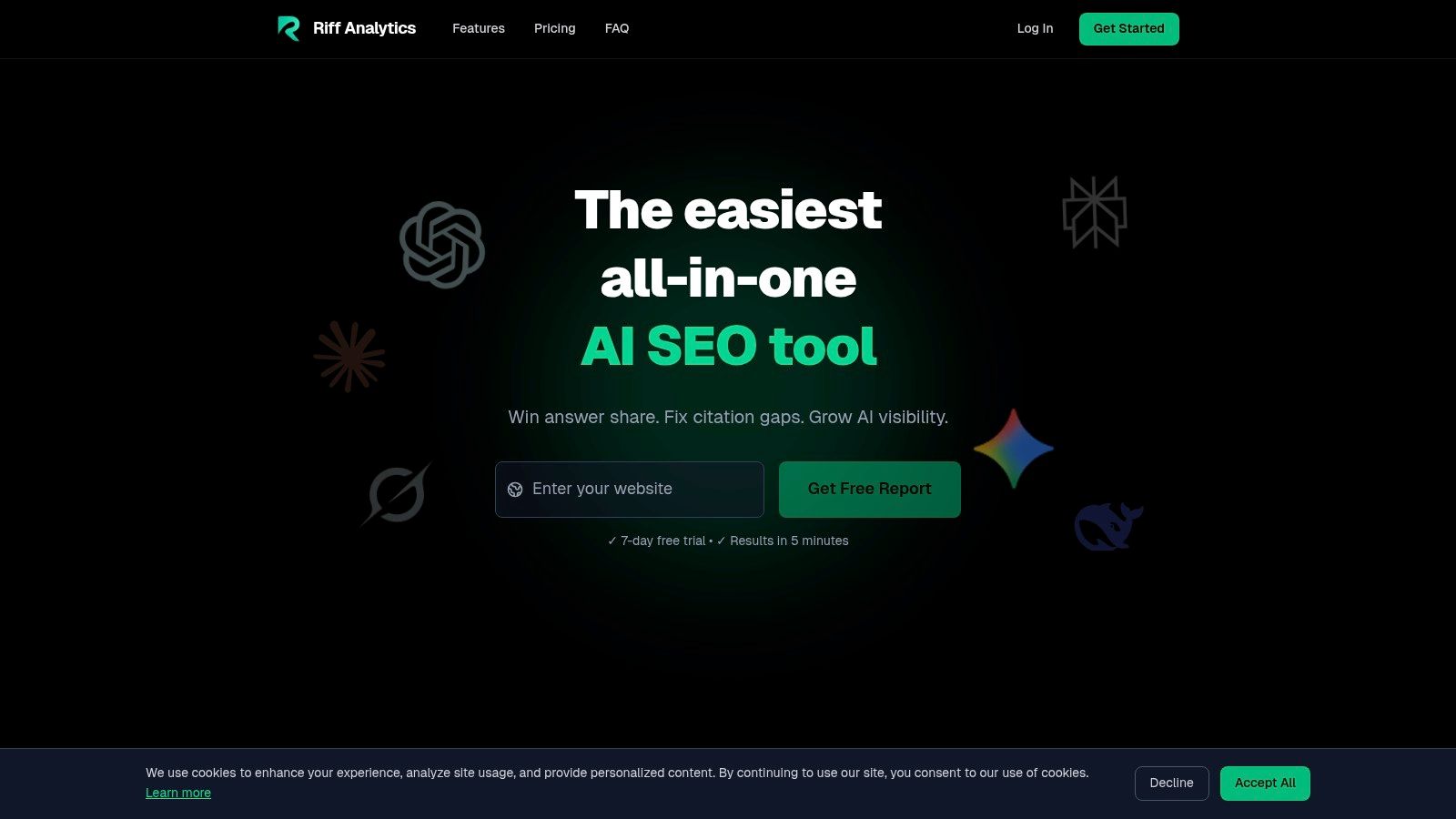
Riff Analytics stands out as one of the best competitive analysis tools for teams focused on the next frontier of search: AI visibility. While traditional SEO tools track keyword rankings on search engine results pages, Riff shifts the battlefield to generative AI responses. It provides a specialized, all in one platform designed to help you dominate “answer share” across major AI engines like ChatGPT, Google AI Overviews, Perplexity, and Gemini. This allows teams to move beyond conventional SEO and measure their brand’s direct influence within the conversational interfaces that are rapidly defining digital discovery.
For marketing and SEO teams, Riff translates a complex ecosystem into actionable data. Its core strength is its ability to not just track brand mentions but to deconstruct why your brand or a competitor was cited. The platform meticulously surfaces the exact citation sources AI engines rely on, revealing the specific web pages, articles, and data points that inform their answers. This granular insight is critical for developing a precise content strategy aimed at building authority and closing competitive citation gaps. Instead of guessing which content resonates with AI, you can see exactly what works and prioritize your efforts accordingly.
A Specialized Tool for Generative SEO Analysis
Riff is engineered for actionability, moving teams from data to implementation quickly. An SEO manager can use the platform's AI readiness audit to identify how LLMs perceive their key landing pages and pinpoint technical or content related weaknesses. Meanwhile, a content team can analyze response context to understand the sentiment and narratives surrounding their brand in AI chats, informing future editorial calendars.
- AI Engine & Competitor Tracking: Continuously monitors your brand’s presence against rivals across eight major LLM driven engines, providing a clear benchmark for your generative SEO performance.
- Citation Source Analysis: Uncovers the precise URLs and documents that AI engines cite in their responses, revealing the sources you need to acquire or create to win more mentions.
- AI-Readiness Audits: Scans your site to determine how effectively AI models can crawl, interpret, and extract information, highlighting specific areas for optimization.
- Mention Trend Dashboards: Visualizes your answer share over time, helping you measure the direct impact of your content and SEO initiatives on AI visibility.
Verdict and Pricing
Riff Analytics is the ideal competitive intelligence tool for forward thinking SEO, content, and brand teams who recognize that winning in AI search requires a new playbook. Its specialized focus on citation tracking and answer share provides a unique advantage that general purpose SEO platforms currently lack. The platform is especially valuable for B2B brands, agencies, and competitive intelligence professionals who need to quantify and improve their footprint in this emerging channel.
While full pricing information requires contacting sales, Riff offers a 7 day free trial and a complimentary AI visibility report, making it easy to test its capabilities. The lack of public pricing is a minor drawback, but the platform’s unique focus on a critical, fast growing area of digital marketing makes it a compelling choice for those serious about future proofing their strategy. To get a deeper understanding of its approach, you can learn more about AI native brand monitoring on the Riff Analytics blog.
- Website: https://riffanalytics.ai
- Best For: SEO and content teams focused on generative SEO, B2B marketers, and agencies managing AI visibility.
- Pricing: Custom plans available after a 7 day free trial.
2. Semrush: The All-in-One Marketing Intelligence Tool
Semrush is an all-in-one digital marketing and SEO platform widely regarded as one of the best competitive analysis tools available. Its strength lies in its massive dataset and integrated project workflows, allowing teams to benchmark competitors across organic search, paid ads, content, and backlinks from a single dashboard. Research shows that over 10 million marketing professionals use Semrush, highlighting its authority in the industry.
The platform excels at providing deep, actionable insights. For example, its Domain vs. Domain and Keyword Gap tools let you directly compare your site's keyword profile against up to four competitors, instantly revealing terms you're missing out on. Similarly, the Traffic Analytics feature offers estimates of competitor website traffic, user engagement metrics, and audience overlaps, which is invaluable for market research. Semrush also publishes that its keyword database spans billions of terms across many country databases, which is one reason it remains a default choice for broad SEO competitor research in its keyword database documentation.
Evaluating Competitor Strategies with Semrush
Semrush's toolkit is built for in-depth analysis. You can set up dedicated projects to continuously monitor competitors' keyword rankings, site health, and brand mentions. This proactive approach ensures you never miss a strategic shift.
- Competitive Research Toolkit: Includes in depth analysis of competitor traffic sources, keyword strategies, ad copy, and backlink profiles.
- Project Based Tracking: You can set up dedicated projects to continuously monitor competitors' keyword rankings, site health, and brand mentions.
- Content Marketing Platform: Offers tools to find content gaps and audit existing content against top ranking rival pages.
Strengths and Weaknesses
Pros:
- Extremely thorough and accurate datasets for organic and paid search.
- Strong integration capabilities and a flexible API.
- Excellent educational resources and customer support.
Cons:
- Pricing can become expensive, especially for agencies or teams needing multiple user seats and premium add ons.
- The sheer volume of tools and data can be overwhelming for beginners.
Who Should Choose Semrush?
Semrush is ideal for SEO professionals, marketing agencies, and in house teams that need a powerful, data rich solution to manage complex digital marketing campaigns. If your strategy relies heavily on understanding the nuances of your competitors' every move, from their ad spend to their content strategy, Semrush provides the necessary firepower. To dive deeper into its capabilities, you can find a guide detailing how to perform a competitive analysis in SEO using the platform's tools.
- Website: https://www.semrush.com
- Pricing: Starts at $129.95/month, with higher tier plans (Guru, Business) offering more features and larger data limits. A limited free account is also available.
3. Similarweb: A Market Intelligence Tool for Competitor Benchmarking
Similarweb is a digital intelligence powerhouse, specializing in providing a high level view of the broader online environment. Unlike tools focused purely on SEO, Similarweb excels at delivering market and traffic intelligence, making it one of the best competitive analysis tools for understanding channel performance, audience demographics, and overarching market trends.
The platform's key strength is its ability to benchmark your digital footprint against competitors across all channels, not just search. Its Traffic & Engagement metrics provide estimates of total visits, page views, and bounce rates, while the Marketing Channels analysis breaks down where competitor traffic originates, from direct and referrals to social and display ads. This top down view helps identify new market opportunities and understand your rival's complete digital strategy. Similarweb positions this workflow around digital benchmarking, audience analysis, and channel share in its digital intelligence platform pages.
Key Features of this Website Analysis Tool
Similarweb's features are designed for strategic decision making, offering a comprehensive view of the competitive environment. Its near real time data allows for agile responses to market changes.
- Digital Marketing Intelligence: Provides deep insights into competitor website traffic, engagement metrics, audience geography, and key marketing channels.
- Search Intelligence: Includes competitive keyword analysis to identify gaps, wins, and losses, helping you understand your organic and paid search footprint.
- Near Real Time Data: Offers filters for the last 7 or 28 days, allowing teams to react quickly to emerging trends and competitor tactics.
Strengths and Weaknesses
Pros:
- Excellent for high level market sizing and understanding traffic share across channels.
- Strong audience demographic and interest data.
- Near real time data filters provide fresh, actionable insights.
Cons:
- Pricing can be high, particularly for plans with extended historical data and multiple user seats.
- Mobile app intelligence can be less detailed in certain niche market segments.
Who Should Choose Similarweb?
Similarweb is the ideal choice for market researchers, business strategists, and marketing leaders who need to understand the big picture of their competitive environment. If your focus extends beyond SEO to analyzing market share, identifying key acquisition channels, and benchmarking overall digital performance, Similarweb provides the broad, market level intelligence required for strategic decision making.
- Website: https://www.similarweb.com
- Pricing: Offers custom enterprise level plans. Free tools with limited data are also available to get started.
4. Ahrefs: A Premier Tool for SEO Competitor Analysis
Ahrefs is a powerhouse SEO suite celebrated for its immense backlink and keyword databases, making it one of the best competitive analysis tools for deep dive research. Its core strength is its proprietary crawler, which fuels a frequently updated index that gives users a near real time view of a competitor's link building activities, keyword rankings, and content performance.
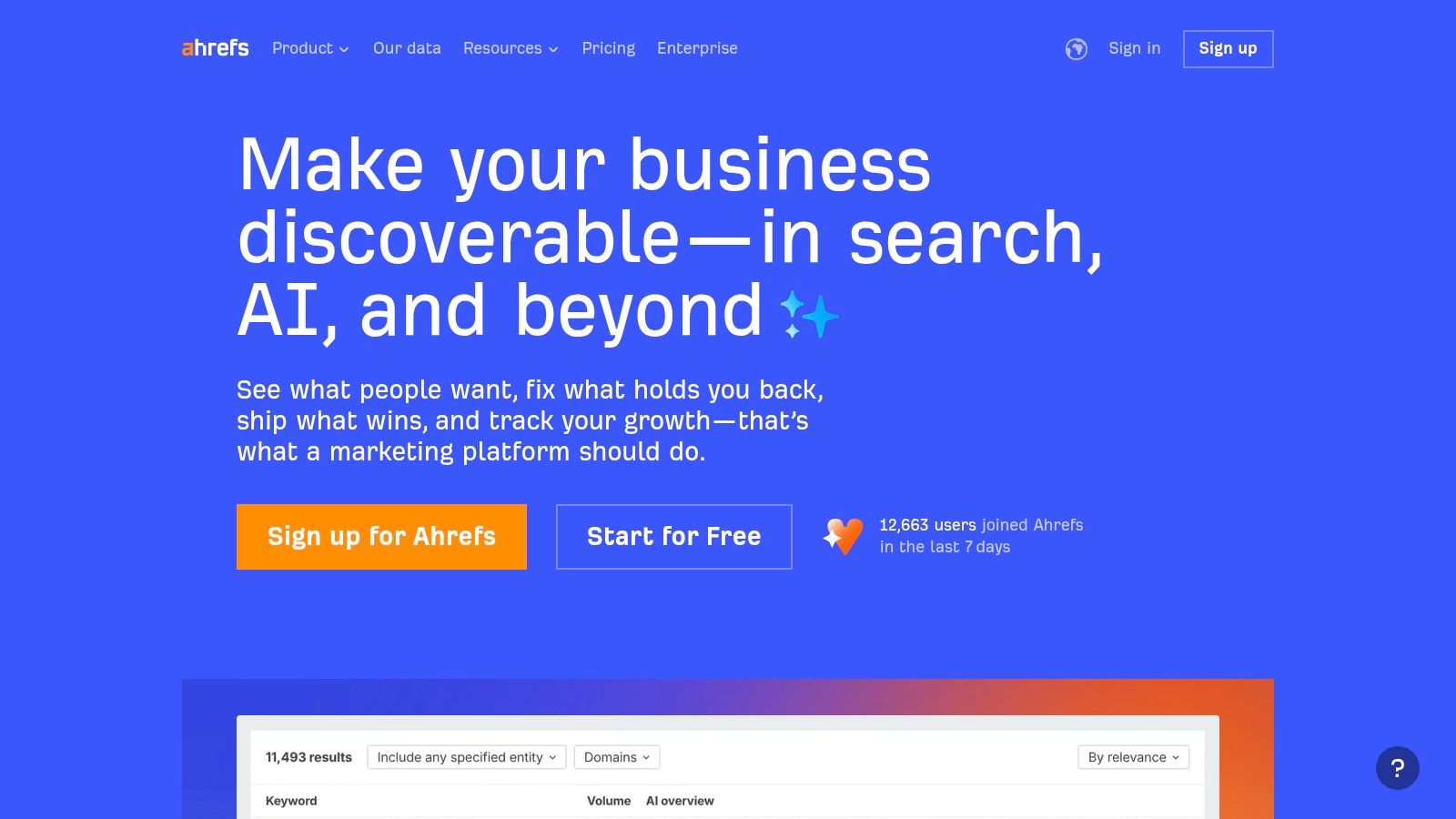
The platform is engineered for uncovering strategic gaps. Tools like Site Explorer let you dissect any competitor's website, revealing their top pages, linking domains, and organic keywords. The Content Gap feature is particularly effective, allowing you to compare your domain against multiple rivals to find valuable keywords they rank for but you do not. Ahrefs also explains its own data model and crawler scale in its site explorer overview, which helps clarify why it remains so strong for backlink-led competitor analysis.
How Ahrefs Helps Track Competitor SEO
With its comprehensive feature set, Ahrefs offers multiple ways to monitor and analyze competitor SEO efforts, from backlinks to content performance.
- Site Explorer and Content Gap: Provides head to head comparisons of backlink profiles, organic keywords, and content performance to identify strategic opportunities.
- Rank Tracker and Site Audit: Enables large scale rank tracking and technical site audits across your own properties and those of your competitors.
- Keywords Explorer: Offers deep keyword research capabilities with advanced metrics like click data and parent topic analysis.
Strengths and Weaknesses
Pros:
- Vast and frequently updated link and keyword index provides highly accurate data.
- Strong competitive gap analysis and historical trend tools for strategic planning.
- Intuitive user interface that simplifies complex data.
Cons:
- Pricing can increase significantly with higher usage limits and more user seats.
- Some advanced features, like daily rank updates, require purchasing add ons.
Who Should Choose Ahrefs?
Ahrefs is ideal for SEO professionals, content strategists, and link building specialists who need robust backlink and keyword data. It excels for teams that reverse engineer competitor success to develop stronger content and off page SEO strategies. While Ahrefs is known as the go to tool for backlink competitive analysis, you might also be interested in a comprehensive comparison of Ahrefs with other SEO tools to see how it stacks up against alternatives.
- Website: https://ahrefs.com
- Pricing: Starts at $99/month, with tiered plans (Standard, Advanced, Enterprise) offering greater data allowances and more features.
5. SpyFu: A Cost-Effective Competitor Research Tool
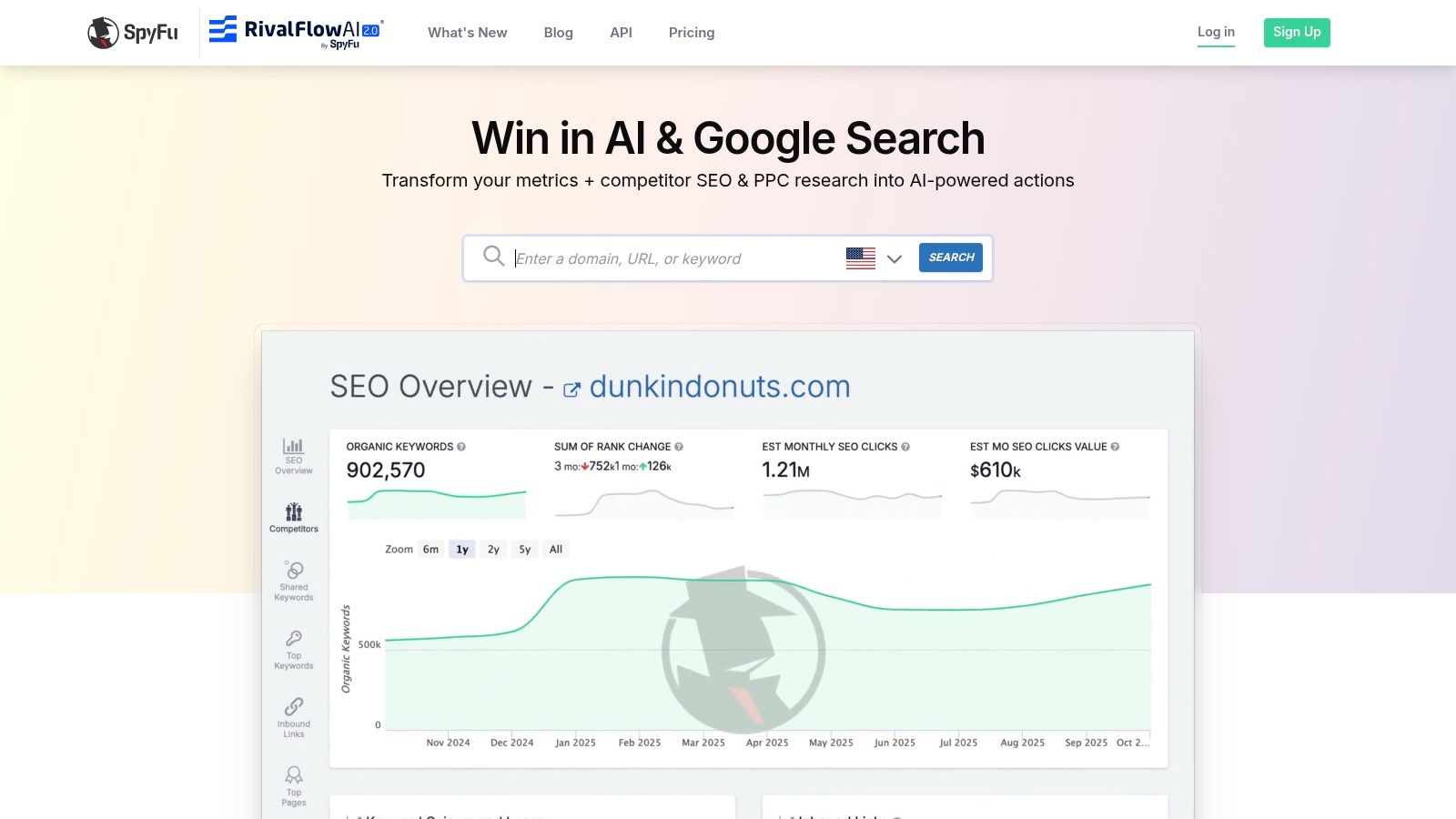
SpyFu is a highly focused and cost effective competitive analysis tool best known for its deep historical data on PPC and SEO keywords. Its primary strength lies in its ability to “spy” on a competitor’s most profitable keywords and ad campaigns, providing a playbook for users looking to reverse engineer successful strategies without a hefty price tag.
The platform makes it exceptionally easy to uncover a domain’s entire search marketing history. For instance, you can enter a competitor's URL and instantly see every keyword they've ever bought on Google Ads, every organic rank they’ve had, and every ad variation they've tested for the past 17+ years. This historical perspective is a key differentiator, offering insights into long term strategic shifts that other tools might miss.
Uncovering PPC and SEO Insights with SpyFu
SpyFu's features are designed for quick, actionable intelligence, making it simple to identify competitor weaknesses and opportunities.
- PPC Competitor Research: Exposes competitor ad spend, clicks, ad copy, and keyword choices, allowing you to learn from their tests and budgets.
- Kombat (Keyword Gap Analysis): A multi domain comparison tool that visualizes keyword overlaps and exclusive keywords between you and two competitors, pinpointing strategic opportunities.
- SEO Competitor Research: Tracks organic rankings, estimates SEO driven clicks, and analyzes inbound links to understand a competitor’s organic footprint.
Strengths and Weaknesses
Pros:
- Excellent value with a low entry price and generous "unlimited" usage on paid plans.
- Invaluable historical PPC data for reverse engineering successful ad campaigns.
- Straightforward interface that is easy for beginners to use.
Cons:
- Organic search and backlink data can be less comprehensive compared to premium suites like Semrush or Ahrefs.
- Team features and API access are reserved for higher priced tiers.
Who Should Choose SpyFu?
SpyFu is the perfect choice for small to medium sized businesses, freelance marketers, and PPC specialists who need powerful competitor insights on a budget. If your primary focus is on decoding and outmaneuvering competitor keyword strategies in both paid and organic search without the complexity of an all in one platform, SpyFu delivers exceptional value and actionable intelligence.
- Website: https://www.spyfu.com
- Pricing: Starts at $39/month, with higher tier Professional and Team plans offering additional features like API access and custom reports.
6. BuzzSumo: The Ultimate Tool for Content Competitive Analysis
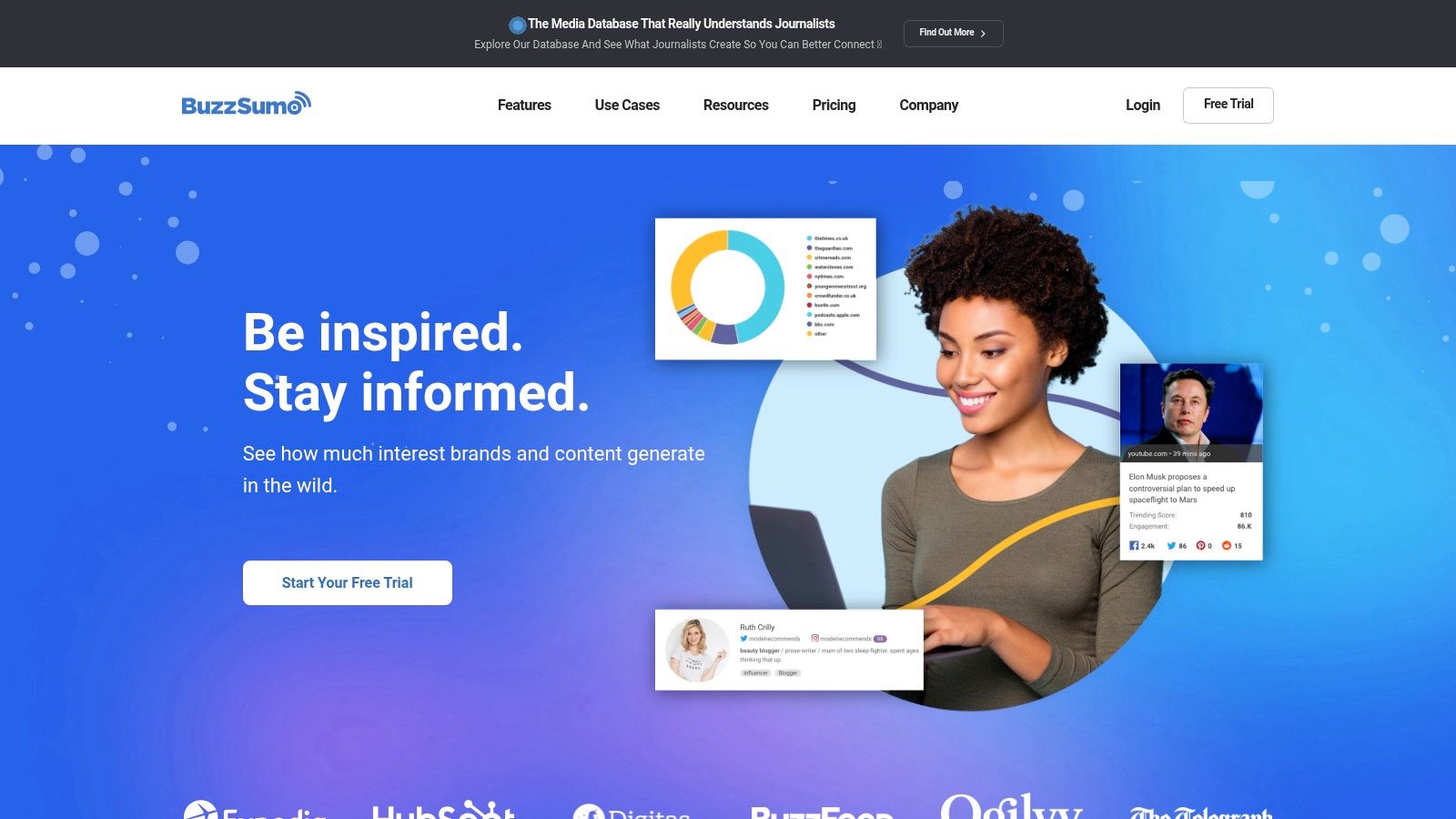
BuzzSumo is a specialized competitive analysis platform focused on content marketing and media monitoring. While other tools analyze a competitor's full SEO footprint, BuzzSumo hones in on what content resonates most with audiences, revealing the viral articles, trending topics, and top performing formats across any industry. It helps you benchmark your content performance against rivals and understand their PR and social media strategies.
The platform’s strength lies in its ability to quickly identify high engagement content. For example, the Content Analyzer shows you the articles with the most social shares, backlinks, and engagement across a specific domain or topic. This makes it one of the best competitive analysis tools for ideating content that has a proven track record of success, allowing you to reverse engineer competitor wins for your own strategy.
Core Features and Use Cases
- Content Analyzer: Discovers the most shared and linked to content for any keyword or competitor domain.
- Monitoring and Alerts: Sets up real time alerts for brand mentions, competitor coverage, and new backlinks, which is essential for proactive PR.
- Question Analyzer: Finds the most popular questions being asked on forums and Q&A sites related to your niche, revealing content gaps.
Strengths and Weaknesses
Pros:
- Excellent for content ideation and benchmarking PR performance.
- Intuitive interface makes it easy to find top performing content.
- Powerful alerts system for monitoring competitor mentions and links.
Cons:
- Not an all-in-one SEO suite; it focuses on content and social metrics, not technical SEO or rank tracking.
- Pricing may be a consideration, since plans limit user seats and restrict refunds on annual commitments.
Who Should Choose BuzzSumo?
BuzzSumo is the ideal tool for content marketers, PR teams, and social media managers who need to understand what makes content successful. If your primary goal is to create content that generates buzz, earn backlinks, and monitor your competitor’s media presence, BuzzSumo provides the focused insights you need. It serves as a powerful complement to traditional SEO platforms like Ahrefs or Semrush.
- Website: https://buzzsumo.com
- Pricing: Starts at $199/month, with higher tier plans offering more alerts, users, and data exports. A limited free plan is available for basic searches.
7. Owler: A Business Intelligence Tool for Competitor Tracking
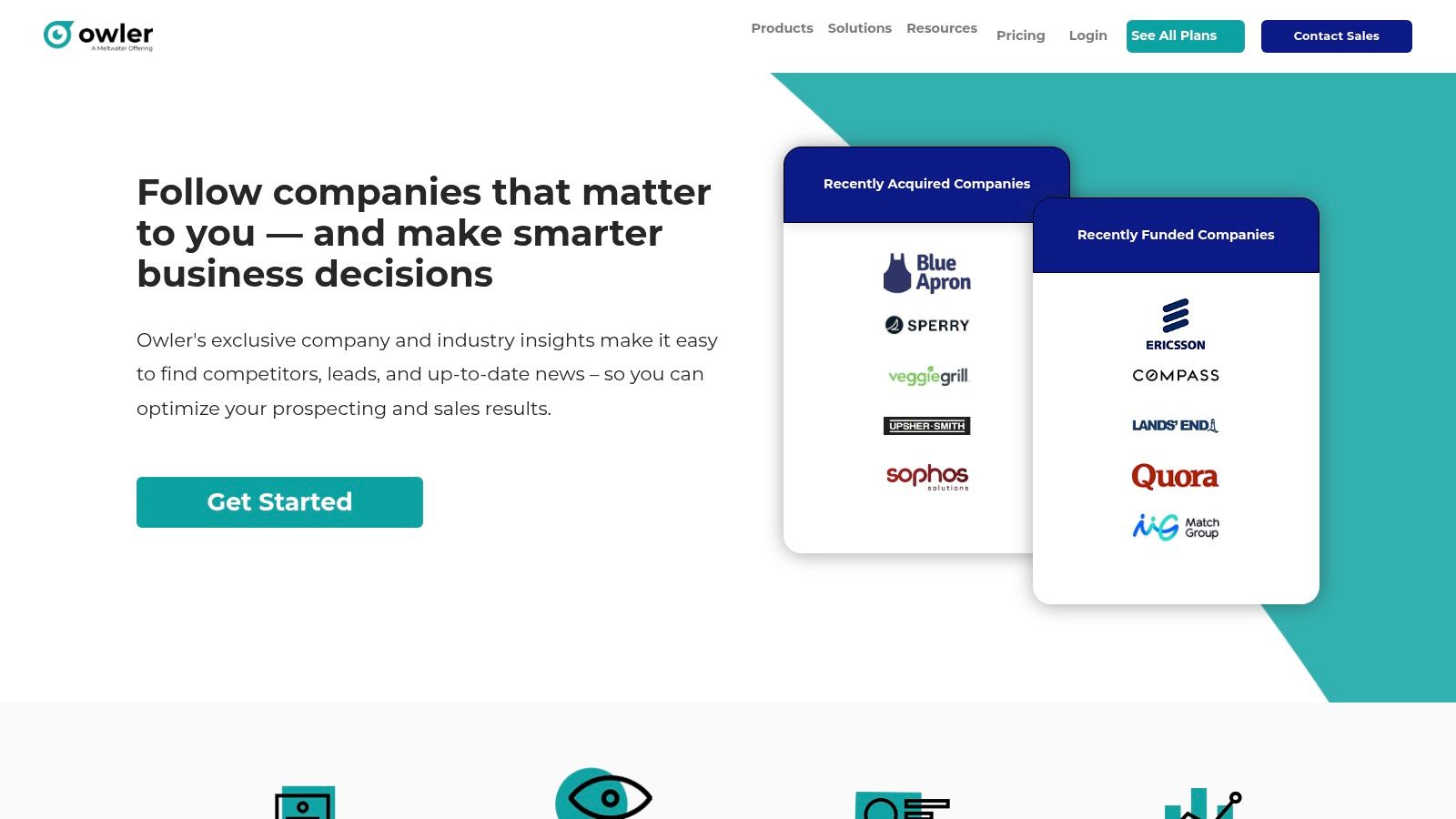
Owler is a business information and competitive intelligence platform designed to help teams track company news, events, and market movements. Its core strength lies in its crowd sourced data model and its proprietary Competitor Graph, which maps out direct and indirect rivals, giving users a clear picture of the competitive field beyond just the obvious players. This makes it an excellent tool for sales, marketing, and CI teams.
The platform delivers real time updates and news alerts, allowing you to monitor competitor funding rounds, acquisitions, leadership changes, and major announcements as they happen. This focus on corporate level intelligence distinguishes Owler from SEO focused tools, making it one of the best competitive analysis tools for understanding organizational strategy and market positioning.
Core Features and Use Cases
- Competitor Graph: Visualizes the entire competitive field, showing primary, secondary, and even unexpected competitors.
- Instant Insights: Delivers daily news alerts and real time notifications on key company events like funding, acquisitions, and product launches.
- Company Profiles: Provides detailed snapshots of companies, including revenue estimates, employee counts, and top competitors.
Strengths and Weaknesses
Pros:
- Excellent for high level corporate and market intelligence.
- The free Community plan is generous and provides significant value.
- Simple, intuitive interface makes it easy to track multiple companies.
Cons:
- Data is crowd sourced and may occasionally be incomplete or require verification.
- Pricing for advanced tiers (Pro and Max) is not transparent on the website.
- Lacks the deep SEO, content, and ad data found in other marketing platforms.
Who Should Choose Owler?
Owler is best suited for sales professionals, business development teams, and competitive intelligence analysts who need to stay informed about their competitors' corporate activities. If your primary goal is to monitor news, funding, and organizational changes rather than granular SEO or marketing tactics, Owler provides a focused and efficient solution. It's a powerful supplement to a broader competitive analysis toolkit.
- Website: https://www.owler.com
- Pricing: Offers a free Community plan. The Pro plan is listed at $49/month (billed monthly) or $420/year. Pricing for the top tier Max plan requires a sales consultation.
8. Crayon: An Enterprise Level Competitive Intelligence Software
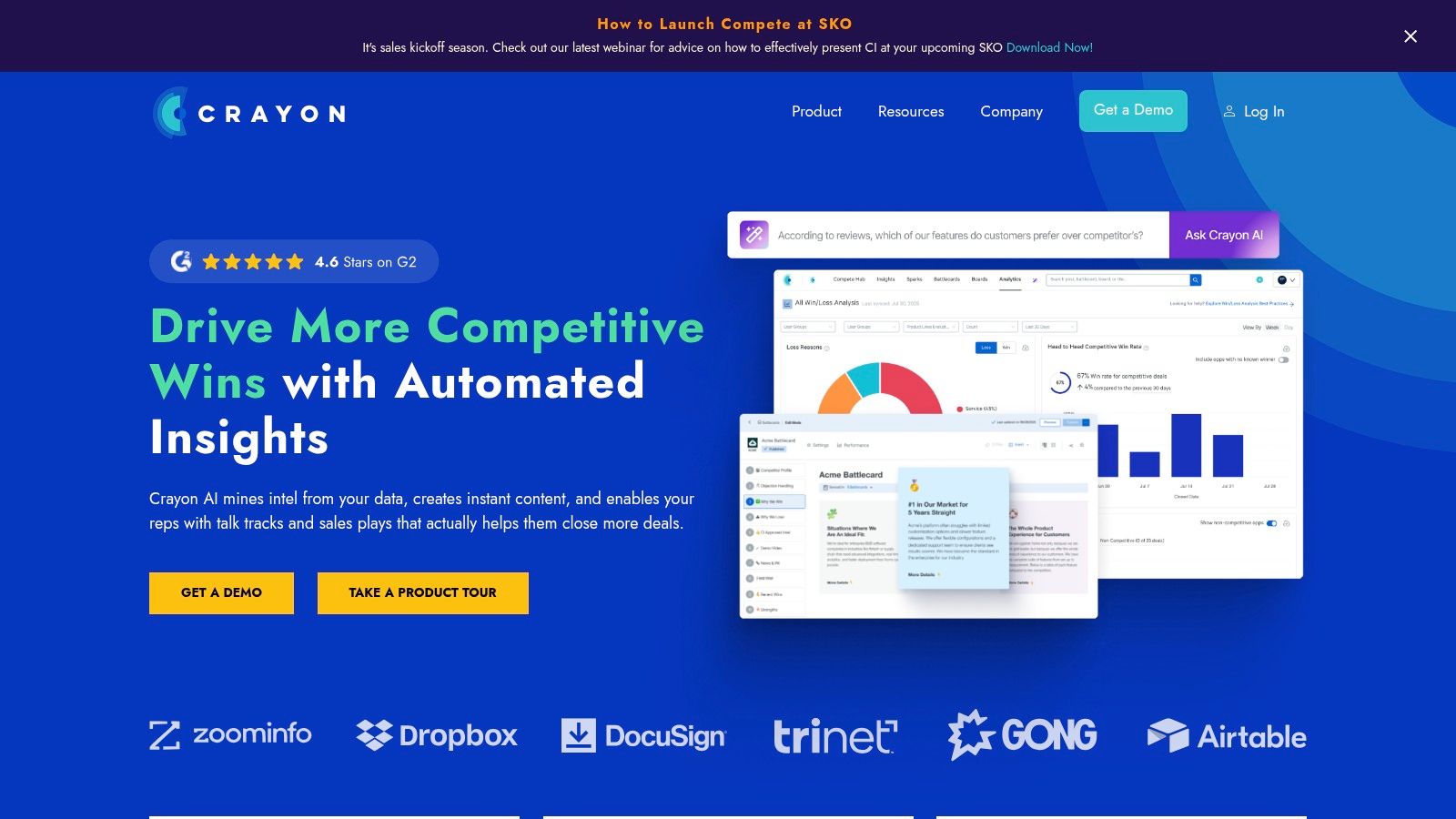
Crayon is an enterprise grade competitive intelligence platform that shifts the focus from public search data to market and sales intelligence. It automates the capture of competitor movements across their entire digital footprint, including website changes, pricing updates, product documentation, and customer reviews, making it a powerful tool for in-depth analysis.
The platform's strength lies in its ability to synthesize this vast amount of data into actionable insights for revenue teams. It uses AI powered "Sparks" to summarize key changes and automatically generates dynamic battlecards that equip sales teams with the latest intelligence, directly within their existing workflows like Salesforce and Slack. Industry reporting in 2025 highlighted Crayon’s scale in website change detection and battlecard-led enablement, with one summary noting both substantial monitoring volume and strong revenue-team outcomes in this change detection roundup.
Core Features and Use Cases
- Automated Web Monitoring: Tracks competitor websites, pricing pages, messaging, and online reviews to capture real time changes.
- AI Powered Insights: AI "Sparks" summarize competitor activity and deliver concise, relevant intelligence briefings.
- Sales Enablement Battlecards: Creates and distributes dynamic battlecards that integrate directly into Salesforce, Slack, and other enablement tools to improve win rates.
Strengths and Weaknesses
Pros:
- Excellent at aggregating a wide range of intelligence beyond standard SEO metrics.
- Strong alignment with sales and revenue teams, with features proven to improve win rates.
- Robust automation saves significant manual research time.
Cons:
- Pricing is quote based and geared towards enterprise level budgets, making it inaccessible for smaller businesses.
- Requires a dedicated onboarding and setup process to tailor data sources and workflows effectively.
Who Should Choose Crayon?
Crayon is the ideal choice for enterprise product marketing, sales enablement, and competitive intelligence teams who need to arm their revenue focused departments with timely and precise competitor data. If your organization's primary goal is to increase sales win rates by directly countering competitor moves in the field, Crayon provides the specialized tools and integrations to make that happen.
- Website: https://www.crayon.co
- Pricing: Quote based and geared to enterprise needs. Prospective customers must contact their sales team for a custom quote.
9. Klue: A Competitive Enablement Platform for Sales Teams
Klue is a competitive enablement platform that shifts the focus of analysis from marketing insights to sales execution. It specializes in collecting, curating, and distributing competitive intelligence directly to revenue teams, ensuring they have the information needed to win deals. Its unique value lies in operationalizing intel by delivering real time, digestible battlecards within the tools salespeople use every day.
The platform distinguishes itself by bridging the gap between intelligence gathering and field application. Klue’s AI assisted engine aggregates data from millions of sources, including web changes, news, and internal documents, which is then curated into actionable competitive battlecards. These assets are embedded directly into CRMs like Salesforce and collaboration tools like Slack, making competitor knowledge accessible during calls and meetings. Klue outlines this workflow around collect-curate-enable in its competitive enablement platform overview.
Core Features of this CI Tool
- AI‑Assisted Intel Collection: Automatically surfaces competitive updates from public sources like competitor websites, review sites, and news articles, as well as internal sources like win/loss notes in your CRM.
- Dynamic Sales Battlecards: Creates and maintains always current battlecards with key talking points, objection handling, and product comparisons that are accessible directly within sales workflows.
- Deep Integrations: Seamlessly connects with Salesforce, Highspot, Seismic, Slack, and Microsoft Teams to deliver intel where and when it’s needed most.
Strengths and Weaknesses
Pros:
- Purpose built for sales adoption with a focus on measurable impact and win rates.
- Excellent integrations that push intelligence directly into existing sales and enablement workflows.
- Strong enterprise case studies demonstrating tangible lifts in competitive win rates.
Cons:
- Pricing is not publicly available and is typically geared toward enterprise level budgets.
- Maximum value is achieved when implemented alongside a formal, cross functional competitive program.
Who Should Choose Klue?
Klue is the ideal competitive analysis tool for B2B enterprise and mid market companies where sales teams frequently face formidable competitors. It is best suited for product marketing, competitive intelligence, and sales enablement leaders who need not only to gather intel but also to ensure it is effectively adopted and used by the field to drive revenue. If your primary goal is empowering your sales force to win more competitive deals, Klue is purpose built for the job.
- Website: https://klue.com
- Pricing: Klue does not offer public pricing. It is sold on a custom subscription basis, typically requiring an enterprise budget.
10. Kompyte: An Automated Tool for Competitive Intelligence
Kompyte, a Semrush company, is an automated competitive intelligence platform designed to move insights quickly from discovery to action. It specializes in tracking a wide range of competitor activities across their website, PR, product reviews, and even job postings, then packaging that intelligence into actionable formats like sales battlecards. Its primary strength is speed and distribution, making it one of the best competitive analysis tools for revenue focused teams.
The platform automatically detects changes on competitor websites and in their public communications, providing near real time alerts. This allows marketing and sales teams to react swiftly to new messaging, pricing updates, or product launches. The system is built to feed this information directly into CRMs like Salesforce and communication hubs like Slack, ensuring intelligence doesn't get lost in a dashboard. If you want a practical companion read on ongoing monitoring workflows around social and market signals, this Sift AI guide is a useful reference.
Core Features and Use Cases
- Automated Competitor Tracking: Monitors changes across competitor websites, press releases, reviews, and social media with before and after change detection.
- Sales Battlecard Creation: Offers unlimited, customizable battlecards that integrate directly into Salesforce, HubSpot, and other sales enablement tools to arm reps with timely intel.
- Centralized Intelligence Hub: Consolidates all competitive insights into a single source of truth, with reports and alerts distributed via Slack, Teams, or email.
Strengths and Weaknesses
Pros:
- Extremely fast time to insights, often delivering alerts within 24–48 hours of setup.
- Excellent integration with sales CRMs and communication platforms.
- Clear packaging and pricing based on the number of competitors you track.
Cons:
- Pricing is not publicly listed and requires a sales consultation.
- Primarily focused on sales enablement and battlecards, which may be too specific for teams needing broad SEO or content analysis.
Who Should Choose Kompyte?
Kompyte is the ideal solution for B2B companies, particularly those with competitive sales cycles where up to date intel is a key advantage. Product marketing, competitive intelligence, and sales enablement teams who need to create, distribute, and maintain effective sales battlecards will find immense value. If your main goal is to arm your sales team with the latest information to win more deals, Kompyte is built for that purpose.
- Website: https://www.kompyte.com
- Pricing: Available upon request. Plans are customized based on the number of competitors tracked and required user seats.
11. Brandwatch: A Social Media Competitor Analysis Tool
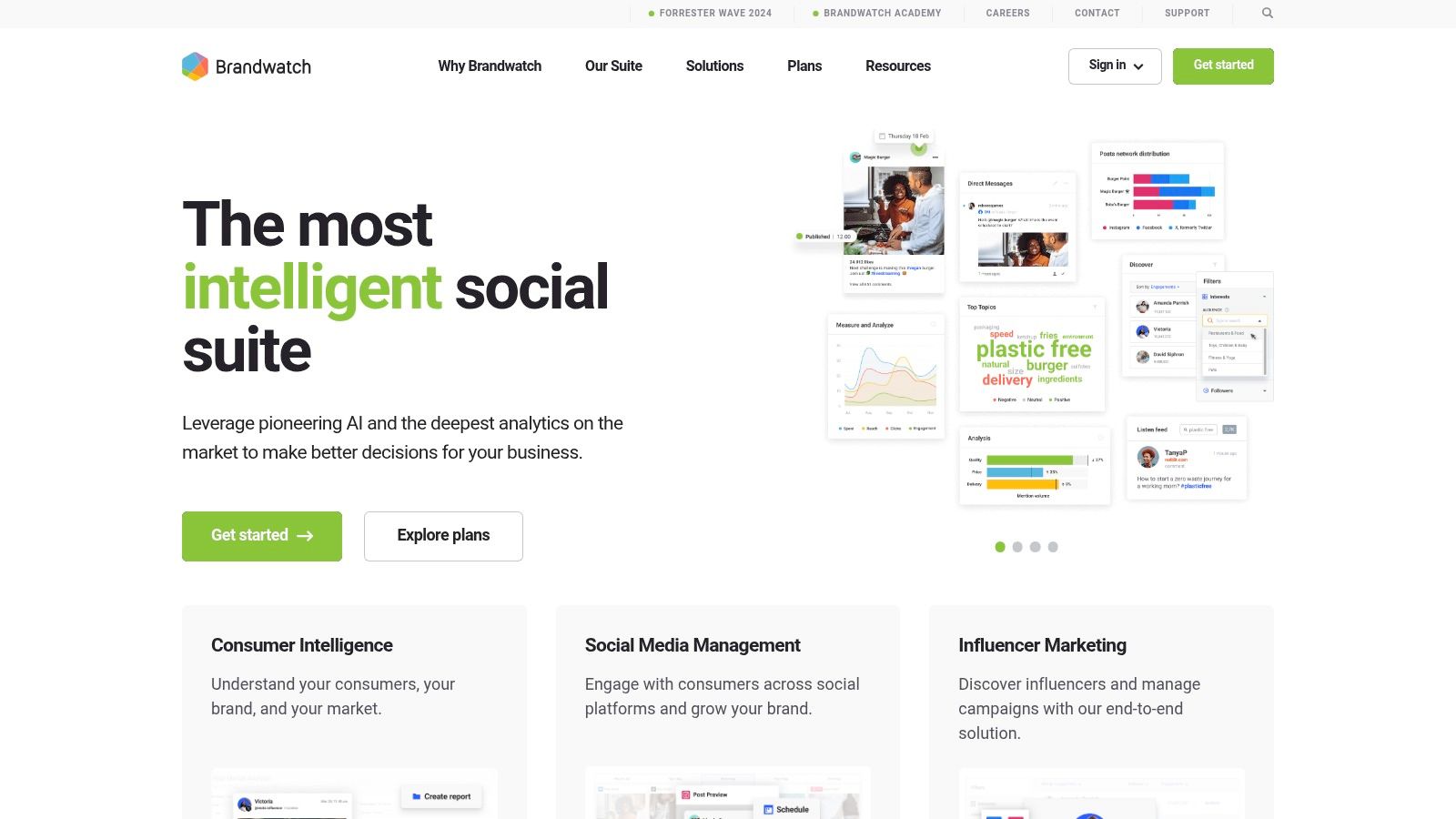
Brandwatch moves competitive analysis from search engines to the social sphere. It is a premier social listening and consumer intelligence platform that excels at benchmarking your brand’s voice, sentiment, and content performance against competitors across social media. While not a traditional SEO tool, it provides critical context on public perception and brand health.
The platform's strength is its ability to tap into billions of real time conversations, helping communications and brand teams understand not just what competitors are doing, but how their actions are perceived by the public. Tools like its Consumer Intelligence dashboards allow you to track share of voice, monitor sentiment trends, and identify key influencers talking about your rivals.
Core Features and Use Cases
- Consumer Intelligence: Offers scalable, multi network social listening to monitor competitor mentions, campaign performance, and industry trends.
- Social Media Management: Provides unified dashboards for publishing content and benchmarking key performance metrics against your top competitors.
- Influencer Marketing: Includes add on tools to discover, vet, and manage influencers who are already engaging with your competitors.
Strengths and Weaknesses
Pros:
- Exceptional depth of social data and highly sophisticated analytics for brand tracking.
- Comprehensive integration with all major social networks and various marketing platforms.
- Powerful sentiment analysis and conversation clustering.
Cons:
- Pricing is quote based and can be a significant investment, making it less accessible for smaller businesses.
- Strictly focused on social and consumer intelligence; it complements rather than replaces SEO focused competitive analysis tools.
Who Should Choose Brandwatch?
Brandwatch is the perfect choice for enterprise level brand, communications, and public relations teams whose competitive environment is defined by public conversation and brand perception. If you need to quantify brand health, track campaign impact, and understand your competitors’ social media footprint at a granular level, Brandwatch provides deep insights. For a closer look at a key metric it tracks, here is an in depth guide explaining how to calculate share of voice effectively.
- Website: https://www.brandwatch.com
- Pricing: Available upon request (quote based). It is generally considered a premium tier solution.
12. Crunchbase: A Tool for Corporate Competitive Intelligence
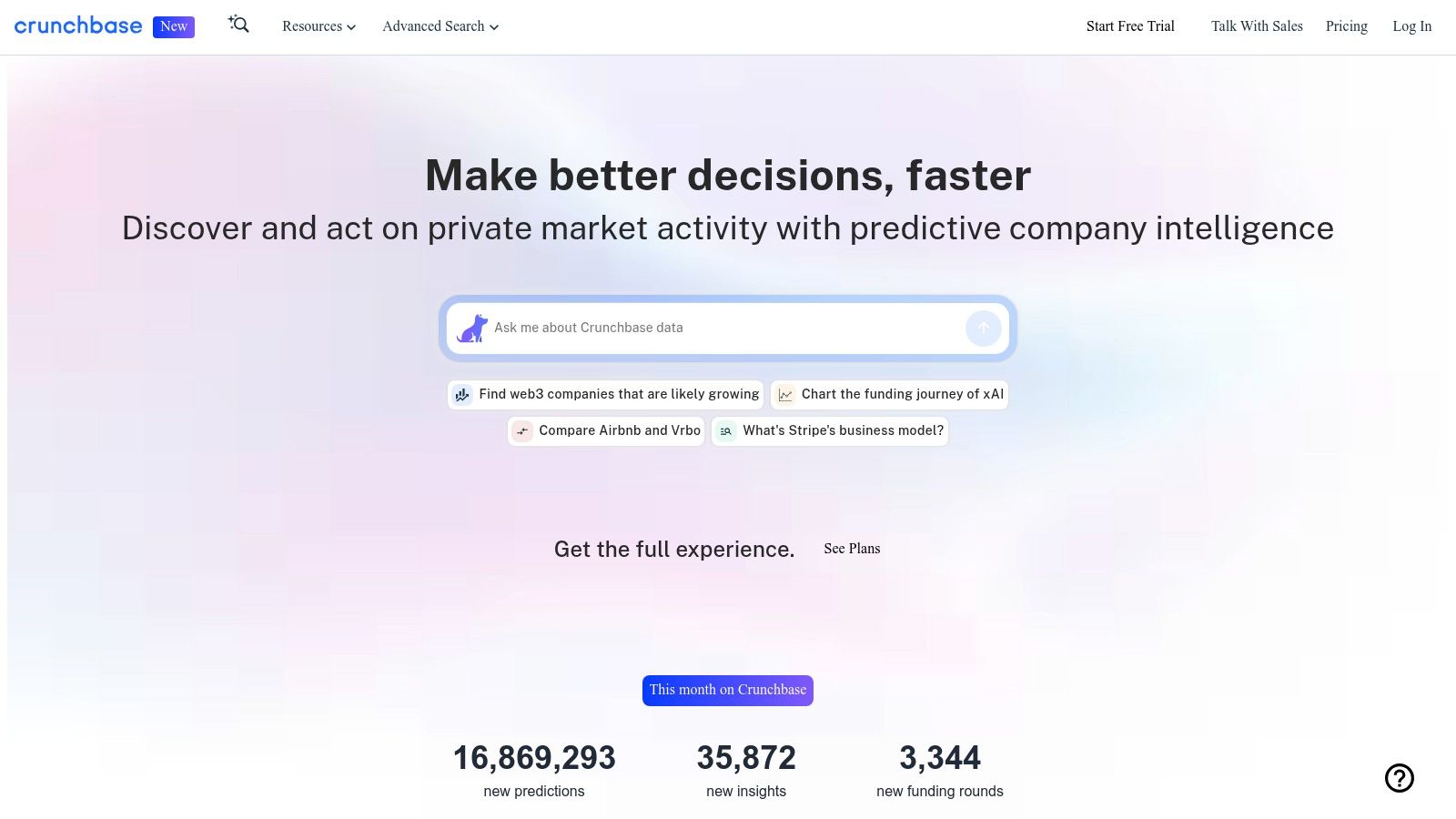
Crunchbase offers a different angle on competitive analysis, shifting the focus from website traffic and keyword rankings to corporate intelligence and market signals. It is a powerful platform for understanding the business health, funding, and growth trajectory of your competitors, providing insights that go far beyond typical SEO metrics.
By tracking company profiles, you can monitor funding rounds, key hires, acquisitions, and news mentions. This information is invaluable for go to market strategies, helping you anticipate a competitor's next big move, whether it's an expansion into a new market or a significant product launch. It provides the "why" behind their digital marketing shifts. Crunchbase positions these workflows around prospecting, market mapping, and company intelligence in its platform overview.
Core Features and Use Cases
- Company Profiles and Alerts: Get detailed information on competitor funding, investors, team size, and recent news, with alerts for important changes.
- AI Assisted Search: Use intelligent search capabilities to discover new competitors, market trends, and potential investment opportunities within your niche.
- Saved Lists and Exports: Build and monitor custom lists of competitors, partners, or acquisition targets and export the data for deeper analysis.
Strengths and Weaknesses
Pros:
- Excellent source for business and financial intelligence on private and public companies.
- Quick way to build and monitor competitor sets and adjacent market players.
- Flexible monthly Pro plan is available for short term research projects.
Cons:
- It is not an SEO tool and provides no data on web traffic, keywords, or backlinks.
- Should be used in conjunction with a dedicated SEO suite for a complete competitive picture.
Who Should Choose Crunchbase?
Crunchbase is ideal for strategists, product marketers, and business development teams who need to understand how competitors stack up at the corporate level. If your role involves market mapping, identifying investment trends, or anticipating strategic business moves rather than just tracking keyword rankings, Crunchbase provides essential, high level intelligence that other best competitive analysis tools miss.
- Website: https://www.crunchbase.com
- Pricing: Offers a free basic search. Paid plans start with the Starter plan at $29/user/month (billed annually) and the Pro plan at $49/user/month (billed annually), with custom pricing for enterprise needs.
Comparison of the Best Competitive Analysis Tools
The quick way to choose among these products is to match the tool to the workflow, not the category label. Some are true competitive intelligence platforms built for ongoing monitoring and distribution. Others are point solutions for SEO gaps, traffic research, content analysis, or AI visibility.
| Platform | Primary workflow | AI capabilities | Best team size | Pricing transparency | Biggest limitation | Best fit in practice |
|---|---|---|---|---|---|---|
| Riff Analytics | AI visibility and answer-share tracking | Citation analysis, AI-readiness audits, answer-share monitoring across major engines | SMB to enterprise marketing teams | Low | Narrower than broad SEO suites outside AI discovery | Best when AI search visibility is a core KPI |
| Semrush | SEO, paid search, and marketing intelligence | AI features support research and optimization, but AI visibility is not its core specialty | SMB, mid-market, agencies, enterprise | High | Can get expensive and complex as seats and add-ons grow | Best all-in-one SEO competitor research platform |
| Similarweb | Market intelligence and traffic benchmarking | AI-assisted analysis layered onto broad traffic and audience data | Mid-market to enterprise | Low | Less useful for deep backlink or page-level SEO diagnostics | Best for channel share, market sizing, and benchmarking |
| Ahrefs | SEO competitor research and backlink analysis | AI is secondary to the core SEO dataset | SMB to enterprise SEO teams | High | Less comprehensive for broader market or sales intelligence | Best for link, content gap, and ranking analysis |
| SpyFu | PPC and keyword competitor research | Limited AI emphasis | SMB and solo marketers | High | Weaker breadth than premium enterprise suites | Best budget pick for search-focused competitor research |
| BuzzSumo | Content research, PR monitoring, and trend spotting | AI support is not the primary reason to buy it | SMB to mid-market content teams | Medium | Not a full SEO or CI platform | Best for content benchmarking and media trend analysis |
| Owler | Company tracking and business intelligence | Limited AI depth compared with dedicated AI or CI tools | SMB to mid-market | Medium | Crowdsourced data can require validation | Best for monitoring company news and market moves |
| Crayon | Competitive intelligence and sales enablement | AI Sparks, summarization, automated insight generation | Mid-market to enterprise | Low | Enterprise pricing and setup overhead | True competitive intelligence platform for revenue teams |
| Klue | Competitive enablement and battlecards | AI-assisted intel collection and curation | Mid-market to enterprise | Low | Best value appears only with mature sales/process adoption | True competitive intelligence platform for sales execution |
| Kompyte | Automated CI monitoring and battlecards | AI support plus automated tracking and alerting | Mid-market to enterprise | Low | Sales-led use case is narrower than SEO or market research suites | True CI platform with strong monitoring-to-battlecard workflow |
| Brandwatch | Social listening and brand benchmarking | AI-driven sentiment and conversation analysis | Mid-market to enterprise | Low | Social focus means it cannot replace SEO or CI tools | Best for share of voice, sentiment, and social competitor analysis |
| Crunchbase | Corporate intelligence and market mapping | AI-assisted discovery and search workflows | SMB to enterprise strategy teams | High | No search ranking or web traffic depth | Best for company, funding, and ecosystem intelligence |
In practical terms, these tools fall into four buckets. SEO competitor research tools include Semrush, Ahrefs, SpyFu, and to a lesser extent BuzzSumo for content-specific work. Competitive intelligence platforms are Crayon, Klue, and Kompyte because they are built around ongoing monitoring, curation, alerts, and distribution to revenue teams. AI-assisted research tools include Riff for AI visibility plus general AI assistants such as ChatGPT and Perplexity for synthesis and cited research. Market and traffic benchmarking tools include Similarweb, Owler, Brandwatch, and Crunchbase, each covering a different slice of market intelligence. If you need a true competitor analysis platform for a marketing team, start by deciding whether the job is SEO, market benchmarking, sales enablement, or AI visibility; the list gets much easier once that workflow is clear.
| Platform | Core Focus | Key Features | Target Audience | Unique Selling Point |
|---|---|---|---|---|
| Riff Analytics | AI Answer Share & LLM Tracking | AI-readiness audits, citation source analysis | SEO, content, and brand teams | Specialized tracking of visibility in AI engines |
| Semrush | All-in-One SEO & Marketing | Keyword gap, traffic analytics, position tracking | SEO professionals, agencies | Comprehensive data across all digital channels |
| Similarweb | Market & Traffic Intelligence | Channel traffic breakdown, audience demographics | Market researchers, strategists | High-level market share and traffic trend analysis |
| Ahrefs | Backlink & SEO Analysis | Site Explorer, Content Gap, vast link index | SEOs, link builders | Industry-leading backlink database |
| SpyFu | PPC & Keyword Research | Historical PPC data, ad copy analysis | SMBs, PPC specialists | Deep historical data for ad campaign reverse engineering |
| BuzzSumo | Content Marketing & PR | Content analyzer, trend alerts, influencer discovery | Content marketers, PR teams | Identifies top-performing content and trends |
| Crayon | Enterprise Competitive Intelligence | Automated web monitoring, AI insights, battlecards | Enterprise revenue and CI teams | Automates intelligence gathering for sales enablement |
| Klue | Sales Competitive Enablement | Dynamic battlecards, CRM integration | B2B sales and enablement teams | Operationalizes intelligence to improve win rates |
Summary and Key Takeaways
Here are the clearest picks by use case rather than by hype:
- Best for AI visibility: Riff Analytics. Choose it when you need to track answer share, citations, and brand presence across AI engines rather than just classic rankings.
- Best all-in-one SEO competitor research: Semrush. It remains the strongest all-rounder for teams that need organic, paid, traffic, and content intelligence in one stack.
- Best market benchmarking: Similarweb. Use it when the question is market share, channel mix, audience behavior, and broader competitive positioning.
- Best sales battlecards: Klue for enablement-heavy organizations and Crayon when broader monitoring plus revenue-team intelligence is the priority.
- Best content research: BuzzSumo. It is still the most useful focused tool here for figuring out what competitor content earns attention and links.
- Best budget option: SpyFu. It gives smaller teams a practical path into competitor keyword and PPC research without enterprise pricing.
If you are building a modern stack, the strongest combinations are usually one broad data source plus one specialized layer. For example, Semrush or Ahrefs for search intelligence paired with Riff for AI visibility makes sense for SEO teams. Similarweb paired with Crayon or Klue makes sense for companies that need both market context and competitive enablement. Crunchbase or Owler can then add company-level signals when funding, hiring, or acquisitions affect go-to-market strategy.
AI changes competitive analysis in 2026 in three useful ways: it speeds up synthesis, improves alert summarization, and helps teams work through cited research faster. But AI alone is still weaker for always-on monitoring, source reliability, and historical tracking unless it is paired with dedicated platforms. The best setup is not “replace everything with AI.” It is “use AI to make analysis faster, then rely on real platforms for monitoring, benchmarking, and workflow distribution.”
Frequently Asked Questions
Which AI is best for competitor analysis?
It depends on the job. For AI visibility tracking, Riff Analytics is the strongest option in this list because it is built to measure citations, answer share, and competitor presence across AI engines. For ad hoc research with source links, Perplexity is often more useful than a generic chatbot because it can return cited material quickly. For synthesis, framing, and turning raw findings into briefs, ChatGPT is extremely useful. The mistake is expecting one AI system to do monitoring, verification, benchmarking, and strategic synthesis equally well. In practice, the best setup combines an AI assistant with a dedicated platform that has live data and alerts.
Can ChatGPT do a competitor analysis?
Yes, but only partially. ChatGPT is very good at turning notes, exported reports, reviews, pricing pages, and interview transcripts into a structured competitor analysis. It can help draft SWOTs, compare positioning, summarize objections, and outline battlecards. What it cannot reliably do on its own is monitor competitors continuously, guarantee fresh source data, or replace specialized tools for traffic estimates, keyword gaps, backlinks, or AI citation tracking. Treat it as an analyst that helps you interpret evidence, not as the evidence itself.
When should I use an AI assistant instead of a dedicated competitor analysis platform?
Use an AI assistant when you need speed: summarizing 20 pages of research, clustering messaging themes, turning findings into executive notes, or brainstorming follow-up questions. Use a dedicated platform when the work needs live data, repeatability, alerts, team workflows, or defensible monitoring over time. If your team needs to know the moment a competitor changes pricing, launches a new page, gains traffic in a channel, or starts appearing more often in AI answers, a platform is the safer choice. If your team already has the raw data and needs help making sense of it, AI is often enough.
What should marketing teams look for in competitive intelligence software?
Marketing teams should look for four things first: reliable data sources, monitoring depth, workflow fit, and reporting. Reliable data means the tool has a clear source model instead of vague AI summaries. Monitoring depth means it can watch the signals that matter to you, whether those are rankings, citations, traffic shifts, website changes, reviews, or messaging updates. Workflow fit means the platform matches the team’s real job: SEO, content, brand, product marketing, or sales enablement. Reporting matters because intelligence that stays in a dashboard rarely changes decisions. Good competitive intelligence software should help teams capture insight, verify it, and distribute it quickly to the people who need to act.
What is the difference between competitive analysis and competitive intelligence?
Competitive analysis usually refers to a specific comparison exercise, such as reviewing competitor SEO performance, pricing, or messaging. Competitive intelligence is broader and ongoing. It includes collecting, monitoring, interpreting, and distributing information about competitors and market shifts so different teams can make better decisions. In other words, analysis is often a project; intelligence is the operating system around that project.