Unlock Growth with SEO Competitive Intelligence
Updated December 22, 2025

In the digital landscape of 2025, SEO competitive intelligence is no longer about simply spying on your rivals. It is the strategic process of systematically analyzing competitors' search engine strategies to uncover their strengths, weaknesses, and the growth opportunities they have overlooked. This data driven approach turns guesswork into a clear roadmap for dominating search results, ensuring your marketing efforts are proactive, not reactive. As organic and AI driven search become more intertwined, this deep analysis is essential for capturing market share.
Why SEO Competitive Intelligence Is Your Secret Weapon in 2026
Basic keyword tracking is a relic of the past. True SEO competitive intelligence provides a panoramic view of the market, allowing you to anticipate shifts and build a resilient strategy. It informs every aspect of your digital marketing, from content creation to technical optimization. By understanding what wins for your competitors, you can refine your own tactics to achieve superior results and secure a lasting advantage.
This process feeds directly into every part of your strategy:
Content Development: Uncover the high value topics your competitors are ranking for that you have totally ignored.
Link Building: Pinpoint the authoritative domains sending juice to your rivals and make them your next targets.
Technical SEO: See how your site’s performance stacks up against the top players to find quick technical wins.
Generative SEO: Keep an eye on which competitors are showing up in AI answers and monitor how large language models (LLMs) are tracking you. This is how you stay ahead of the curve.
Understanding the Market Dynamics for Competitive SEO Insights
The broader competitive intelligence market was valued at roughly $50.9 billion in 2024 and is projected to more than double, hitting an estimated $122.8 billion by 2033. This explosive growth is fueled by intense digital competition and the rise of AI powered platforms. As businesses integrate AI into their core operations, the demand for real time strategic insights is escalating. You can discover more insights about competitive intelligence trends to learn more.
Leveraging Intelligence for a Proactive SEO Strategy
In 2026 and beyond, the focus has shifted from AI experimentation to strategic implementation. According to a recent executive survey, 46% of business leaders are now focused on scaling AI to gain a tangible competitive edge. This makes a sophisticated intelligence framework a non negotiable asset for any company aiming to lead its industry. A robust program allows you to foresee market shifts, preempt competitor moves, and identify untapped growth channels before they become saturated, ensuring your resources are allocated for maximum impact.
Building Your Competitive Intelligence Framework
A successful SEO competitive intelligence strategy starts with a solid, repeatable framework, not just random spot checks. This systematic process continuously feeds your SEO program with actionable insights. The first critical step is to identify your true SERP competitors, who are often different from your direct business rivals. From there, you must establish a system for collecting the right data to paint a complete picture of the competitive arena.
This simple cycle—analyze, strategize, and grow—is the engine that powers any successful intelligence program.
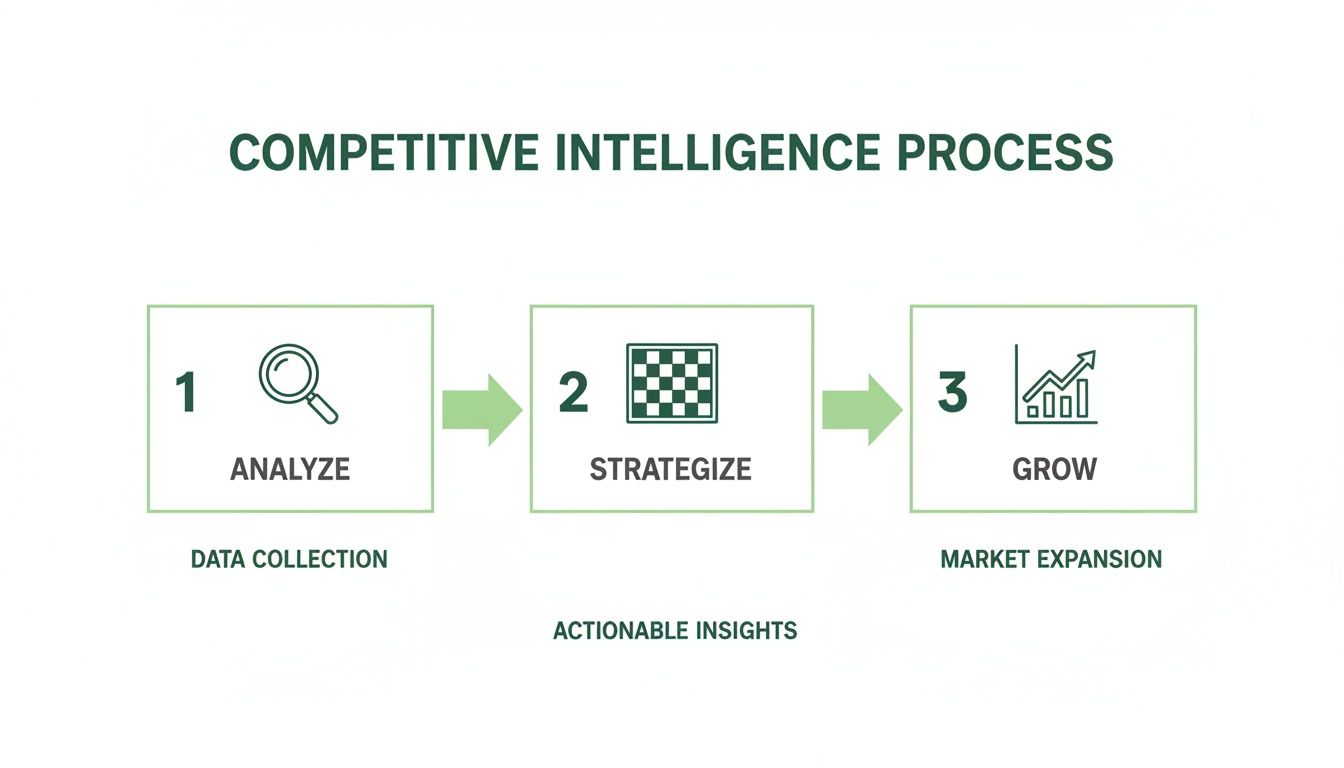
Think of it as a continuous loop. The insights you gain from one stage directly sharpen your approach in the next.
Defining Your True Competitors for SEO Analysis
Your business competitors are not always your SERP competitors. A SaaS company might compete for rankings against review sites, industry blogs, and documentation hubs, none of which sell a competing product. To identify your true search rivals, gather your top 10 to 15 target keywords. Search for them in incognito mode and list the top 5 to 10 domains that consistently appear. These are the entities winning your audience's attention and should be your primary focus.
Integrating AI Search Visibility and LLM Tracking into Your Analysis
As search evolves, your intelligence gathering must too. It is now essential to monitor signals around AI search visibility and how Large Language Models reference brands. This is where generative SEO becomes a non negotiable part of your analysis. The core principle of analyzing keywords, backlinks, and technical performance, as Shopify notes, now extends into the AI world. Start by asking popular AI engines your main business questions to see which competitors are cited. This manual LLM tracking provides a powerful leading indicator of who is winning answer share.
Comparing Tools for a Comprehensive Competitive Intelligence Workflow
To make this systematic, you need to compare metrics across both traditional and AI driven channels. Weaving together tools for each area helps you build a system that sees the whole picture. Your analysis shifts from being reactive to proactive, helping you anticipate market shifts before they even happen.
| Metric Type | Key Data Points to Collect | Recommended Tools |
|---|---|---|
| Traditional SEO | Keyword rankings, organic traffic estimates, backlink velocity, domain authority. | Semrush, Ahrefs, Moz |
| Content Strategy | Top pages by traffic, content gap analysis, keyword density, internal linking. | SurferSEO, Clearscope, AlsoAsked |
| AI Visibility | Brand mentions in AI answers, competitor citations, AI Overviews share of voice. | Riff Analytics, Perplexity, ChatGPT |
Decoding Competitor Strategies to Find Your Edge
Gathering data is just the starting line. True competitive intelligence begins when you transform that raw information into an actionable playbook. This is where you dissect your competitors' decisions, identify weaknesses, and spot the opportunities they have missed. This analytical process is what separates market leaders from the rest.
Research shows a direct link between advanced competitive analysis and superior search performance, with over 70% of top ranking websites using it to guide their strategy. Effective analysis is your secret weapon for finding content gaps and unearthing valuable keyword opportunities.
Performing a Content Gap Analysis for Your SEO Intelligence
A content gap analysis is a non negotiable part of any serious competitive intelligence workflow. It is the process of finding valuable keywords and topics your competitors rank for where you have no presence. To do this, export the keywords for your top SERP competitors and compare them against your own to isolate the terms where you have no visibility. These "gap" keywords represent untapped potential and show what your audience is searching for that you are not yet providing. Learn how to do content marketing competitor analysis to interpret the data correctly.
Evaluating Backlink Profiles for Link Building Opportunities
A competitor's backlink profile is a public ledger of their digital authority. By analyzing their most powerful links, you can build a highly targeted list for your own link building campaigns. This is a foundational step in any guide on how to do competitive analysis in SEO. Look for patterns, such as links from specific industry blogs or news sites, and pay attention to high authority domains that have linked to them multiple times. According to SEO expert Rand Fishkin, "The best content is not just about answering questions. It's about earning trust and building a relationship with your audience by consistently being the best, most reliable source of information."
Assessing Visibility in Generative SEO Results
Modern competitive analysis must include an audit of your rivals' AI search visibility. This involves tracking how often their brand and content are cited in responses from AI engines like Google's AI Overviews, ChatGPT, and Perplexity. This new frontier of generative SEO is where the next battle for visibility will be fought. Start by manually querying these platforms with your core topics to see which competitors are mentioned. This process, often called LLM tracking, will quickly reveal who is building authority in the AI ecosystem and help you adapt your content strategy to win answer share.
Choosing Your Competitive Intelligence Tech Stack
Having the right tools is non negotiable for serious SEO competitive intelligence. A well chosen tech stack transforms raw data into a strategic advantage, helping you decode competitor strategies and find gaps they have missed. The goal is to assemble a powerful toolkit by combining all in one SEO suites for a broad overview, specialized tools for deep dives, and newer trackers for AI driven search.
Building Your Core Competitive Analysis Toolkit
Your core toolkit should provide a comprehensive picture of the competitive landscape. All in one platforms like Semrush or Ahrefs are foundational, offering keyword tracking, traffic estimates, and backlink analysis in one place. Supplement these with specialized tools. For example, content intelligence platforms like Clearscope or SurferSEO allow you to dissect competitor content to understand its topical depth and semantic relevance. For more options, explore our guide on top SEO benchmarking tools.
Future Proofing with AI Search and LLM Tracking
Traditional SEO metrics no longer tell the whole story. Your tech stack must evolve to include tools that monitor your AI search visibility and perform LLM tracking. These platforms show where and how your brand and competitors are mentioned in generative AI results. This is a core part of modern generative SEO. Look into AI-powered competitor analysis tools to automate the process of querying AI models and analyzing responses, giving you a scalable way to measure your "answer share." The SEO industry is projected to hit $106.15 billion by 2030, largely fueled by AI, with 86% of SEO professionals already using AI in their workflows as of 2025.
A Tool Selection Guide for SEO Competitive Intelligence
Picking the right tools involves balancing features, accuracy, and budget. A blended stack is almost always the best approach. The best tech stack is not the one with the most tools, but the one that delivers the most actionable insights. Focus on platforms that integrate well and provide data you can trust to make strategic decisions. A smart tech stack turns the complex art of SEO competitive intelligence into a data driven science.
Turning Competitive Insights Into Winning Actions
Analysis without action is merely an academic exercise. The true value of SEO competitive intelligence is unlocked when you translate data into a decisive execution plan. This is where you close the gap between knowing what your competitors are doing and actively outmaneuvering them. The first step is to move from a long list of opportunities to a short, focused set of priorities using a practical framework.
A Framework for Prioritizing Your SEO Actions
An impact vs. effort matrix is a powerful way to categorize each opportunity and focus on what matters most.
High Impact, Low Effort (Quick Wins): These are top priorities, such as fixing a critical technical SEO issue or updating content for a high volume keyword.
High Impact, High Effort (Major Projects): These are strategic initiatives, like building a comprehensive content hub or launching a large scale link building campaign.
Low Impact, Low Effort (Fill-ins): Tackle these during downtime, like making minor on page tweaks or optimizing metadata.
Low Impact, High Effort (Time Wasters): Avoid these entirely, as they consume resources with little return.
This structured approach transforms a backlog of ideas into a clear, actionable roadmap.
Creating Content Briefs from Competitive Intelligence Data
One of the most direct ways to act on competitive intelligence is by creating superior content. A data informed content brief is your blueprint for dominating the SERPs. Your brief must include target keywords, search intent, competitor URLs, key talking points, and identified weaknesses in competitor content. This process ensures every piece of content is strategically designed to outperform what is already ranking.
Launching Technical and Outreach Campaigns Based on Analysis
Your intelligence work will also reveal technical and off page opportunities. If competitors have fast page speeds, prioritize your own site's performance. Similarly, analyze their backlink profile to identify the types of sites that link to them and find similar, higher quality domains they may have missed. This transforms a reactive tactic into a proactive strategy for building authority and setting the pace in your industry.
Summary and Final Thoughts
This guide provides a blueprint for a modern SEO competitive intelligence strategy, which is an ongoing discipline, not a one time project. Winning in 2025 and beyond requires a continuous process of building your framework, gathering data, and turning insights into decisive action. Committing to this proactive, data informed approach is your key to a lasting competitive edge. It requires you to analyze not only traditional SERPs but also the fast emerging world of generative SEO and AI search visibility. By embedding this constant loop of analysis and execution into your daily workflow, you stop reacting to the market and start shaping it.
Frequently Asked Questions
What is the first step in SEO competitive intelligence?
The first step is to identify your true SERP competitors. These are the websites that consistently rank for your most important keywords, even if they are not direct business rivals. Once identified, you can begin gathering baseline data on their organic traffic, top performing content, and backlink profiles to establish a benchmark for your analysis.
How do you track a competitor's AI search visibility?
You can start manually by querying AI engines like Perplexity or ChatGPT with industry specific questions and recording which competitors are cited in the answers. For a more scalable approach, use specialized LLM tracking tools that automate this monitoring, allowing you to measure your "answer share" and identify opportunities to become a trusted source for AI models.
Why is a competitive SEO intelligence framework important in 2026?
In 2026, the digital landscape is more complex than ever, with AI driven search fundamentally changing how users find information. A framework is crucial because it provides a systematic, repeatable process for staying ahead of these changes. It helps you anticipate market shifts, understand new competitor tactics related to generative SEO, and continuously adapt your strategy to maintain a competitive advantage.
Can free tools be used for effective SEO competitive intelligence?
Yes, you can get started with free tools. Google Search Console and Google Alerts provide valuable insights into your own performance and competitor mentions. However, for deep, scalable analysis, investing in paid tools like Semrush or Ahrefs is necessary to access the comprehensive data, historical trends, and advanced features required for a robust intelligence program.
What is the most overlooked aspect of SEO competitive intelligence?
The most overlooked aspect is often analyzing a competitor's failures. While it is tempting to focus only on their successes, there is immense value in understanding what did not work for them. Identifying failed content initiatives or abandoned keyword strategies can reveal what your shared audience does not care about, saving you significant time and resources by helping you avoid their mistakes.