Best tools for SEO agencies
Updated January 24, 2026

Agency owners do not need another vague list of software. They need a stack that helps analysts move faster, account managers report clearly, and leadership defend margins while search keeps shifting toward AI answers, stricter attribution, and more demanding client expectations.
Understanding the Modern SEO Agency Toolkit
There is no single best tool for every agency. A two-person local shop, a content-led growth agency, an enterprise technical consultancy, and a team selling AI visibility retainers will not buy the same stack—and they should not. In practice, most agencies now consolidate around 3 to 6 core tools rather than the old habit of piling on 10+ overlapping subscriptions, a shift noted in this 2026 agency tools roundup.
A lean starter stack usually combines Google Search Console, GA4, one broad SEO suite, and a crawler. A content-heavy stack adds a dedicated optimization platform like Clearscope. An enterprise technical stack layers cloud crawling and governance on top of desktop audits. An AI-visibility stack adds tooling that tracks how brands appear in answer engines, not just in classic SERPs.
The list below is organized around workflow fit, reporting value, integrations, pricing reality, and where each tool falls short. That matters more than feature checklists. A platform can look impressive in a sales demo and still create friction if seat limits are tight, reports are hard to explain to clients, or the data overlaps too heavily with tools you already own.
How I Picked These SEO Tools for Agencies
I evaluated these tools the way an agency operator would: by asking whether they improve delivery, reduce reporting friction, and help win or retain business. That means looking beyond feature pages and judging whether a tool earns a permanent place in a real client workflow.
Evaluation criteria
- Workflow fit: Can the tool support onboarding, audits, reporting, forecasting, content production, or AI visibility without creating extra manual work?
- Integration depth: Does it connect cleanly with Google Search Console, Google Analytics 4, or other systems agencies already rely on?
- Reporting value: Can account teams turn the data into something a client understands and trusts?
- Pricing reality: Is the entry price misleading once you add seats, projects, higher crawl limits, or white-label features?
- Specialization vs. overlap: Does the tool do one job meaningfully better than an all-in-one suite, or is it redundant?
Review approach
In our review, we gave extra weight to tools that solve agency-specific problems: multi-client organization, forecasting tied to outcomes, local SEO at scale, technical audits for large sites, and visibility in AI-generated answers. I also favored products with clear documentation and product pages that make capability claims easy to verify, because opaque positioning is often a warning sign for agencies trying to scale processes across teams.
What would disqualify a tool
A tool dropped in ranking if it hid key limits until checkout, offered shallow exports, forced awkward seat sharing, or duplicated another category leader without a clear agency advantage. For agency teams, we found that “all-in-one” can become a liability when the reporting is weak or the specialist depth is not there.
What to Look for in SEO Software for Agencies
The best buying criteria are boring in the right way. Agencies should prioritize software that reduces handoffs and makes client-facing output easier to produce, not just platforms with the longest feature menu.
Reporting and client communication
Good agency software should turn complex work into simple proof. That means shareable dashboards, white-label options where needed, and exports that do not require a strategist to rewrite everything manually before a monthly call.
Integrations that save real time
Google Search Console and GA4 integrations matter because they connect rankings and crawl data to clicks, sessions, and conversions. API access, Looker Studio compatibility, and CSV exports are also practical requirements once you manage more than a few clients.
Seat limits, projects, and pricing creep
Many tools look affordable until you hit user caps, historical data gates, keyword tiers, or per-location pricing. Before choosing anything, map the cost against your current client count and the next 12 months of growth.
Depth in the area you actually sell
If your agency wins business on technical audits, a crawler matters more than another keyword database. If you sell local SEO, BrightLocal will do more useful work than a general suite. If your differentiator is executive reporting and forecasting, SEOmonitor deserves more attention than a broad but generic platform.
Fit by agency model
The right stack depends on who you serve:
- Small generalist agency: one broad suite, Google’s free tools, and a crawler.
- Content-led agency: add a dedicated optimization platform.
- Enterprise SEO team: add cloud crawling and governance.
- AI-focused agency: add a platform built for answer-engine visibility.
1. Riff Analytics: An Essential Tool for AI Search Visibility
As generative AI redefines search, agencies must adapt to maintain client visibility. Riff Analytics stands out as a premier tool designed for this new frontier, making it an indispensable part of any modern agency's toolkit. It moves beyond traditional SEO metrics, focusing on a critical new KPI: "answer share." This platform empowers agencies to track, analyze, and optimize their clients' presence within AI-generated search results, including LLM tracking for engines like ChatGPT, Perplexity, and Google's AI Overviews.

What makes Riff Analytics one of the best tools for SEO agencies is its focus on actionable citation analysis. Instead of just reporting if a brand was mentioned, it pinpoints the exact sources AI engines cite in their answers. This allows agencies to identify "citation gaps" where a competitor's content is referenced and provides clear guidance on how to reclaim that digital real estate. This granular insight is a game changer for demonstrating ROI and building client strategies for 2026 and beyond.
Core Features of this Top SEO Agency Tool
- Engine Tracking: Monitors brand mentions and source citations across major AI systems, including ChatGPT, Perplexity, Claude, Gemini, Grok, and Google AI Overviews.
- Actionable Citation Gap Analysis: Reveals the specific third party sources and competitor pages that AI models are citing, providing a direct roadmap for content and digital PR efforts.
- AI Readiness Audits: Scans client web pages and provides concrete recommendations to improve their structure, clarity, and factual density, making them more likely to be used as a trusted source by AI.
- Competitor Benchmarking: Delivers clear dashboards that track mention trends and compare visibility against key competitors, helping agencies set measurable goals and report on progress effectively.
Pricing and Onboarding
Riff Analytics does not publish its pricing publicly. Agencies must start the 7 day free trial or contact the sales team to get a quote customized to their needs. A key advantage is its rapid onboarding; the platform delivers initial insights within approximately five minutes and requires no complex technical setup, allowing teams to demonstrate value to clients almost immediately.
Website: https://riffanalytics.ai
2. Semrush: A Comprehensive Platform for SEO Agencies
Semrush positions itself as an all in one visibility management platform, and for many agencies, it serves as the operational hub for client campaigns. Its true strength lies in its vast, interconnected toolset that covers nearly every facet of digital marketing, from SEO and PPC to social media and content marketing. This breadth makes it one of the best tools for SEO agencies that need to manage diverse client portfolios without juggling multiple subscriptions. Semrush is still widely treated as the market leader, with over 10 million marketers using the platform worldwide according to this 2026 agency tools review.
The platform excels at providing deep competitive intelligence. Agencies can perform a granular "gap analysis" to find keywords competitors rank for that their clients don't, or analyze backlink profiles to uncover new outreach opportunities. For instance, an agency could discover a competitor gets 30% of its traffic from a keyword cluster they haven't targeted, providing a clear, data backed strategic direction. The project based dashboard is a key feature for agency workflows, allowing teams to isolate data and manage tasks for each client separately. Semrush’s own pricing and plan details are worth reviewing closely because limits matter more than headline features once you scale. If your team also needs lead enrichment and agency-oriented contact workflows around prospecting, a complementary resource like Captapi can sit beside Semrush rather than replacing it.
Key Agency Features & Pricing for this SEO Tool
- Core Strengths: Extensive keyword database with intent filtering, comprehensive site auditing with clear issue prioritization, and versatile position tracking across different devices and geographic locations.
- Agency Use Case: Use the Client Manager and white label reporting features to create professional, branded reports. The built in lead generation widget can also be embedded on an agency's site to attract new prospects. You can explore a variety of SEO reporting tools for agencies to see how Semrush compares.
- Pricing: Plans start with the Pro tier at approximately $129.95/month, but most agencies will need the Guru ($249.95/month) or Business ($499.95/month) plans for expanded limits, historical data, and API access.
Website: https://www.semrush.com
3. Ahrefs: A Powerhouse SEO Tool for Agencies
Ahrefs has built its reputation as a data powerhouse, particularly famous for its best in class backlink index. For agencies focused on deep competitive analysis, technical SEO, and authority building, Ahrefs provides the granular data needed to execute advanced campaigns. Its true differentiator is the sheer depth and accuracy of its link intelligence, making it an indispensable tool for uncovering competitor link strategies and identifying high value outreach opportunities.
The platform is more than just a backlink checker; its Site Explorer function gives a 360 degree view of any website's organic search performance. Agencies can dissect a competitor's top pages, keywords, and paid search activity all from a single dashboard. This makes it one of the best tools for SEO agencies that need to perform in depth discovery work and craft data driven strategies for clients. The Content Explorer feature is also invaluable for identifying proven content ideas based on social shares and traffic performance.
Key Agency Features & Pricing
- Core Strengths: Industry leading backlink index for link research, powerful Site Explorer for in-depth competitor analysis, and an intuitive Keywords Explorer that supports multiple search engines.
- Agency Use Case: Use the Content Gap tool within Site Explorer to instantly find keywords competitors rank for that your client does not. The Rank Tracker is excellent for monitoring keyword performance across desktop and mobile, with options for daily updates on critical terms.
- Pricing: Plans are credit based and start with the Lite tier at $99/month. Most agencies will require the Standard ($199/month) or Advanced ($399/month) plans to get sufficient user seats, project limits, and historical data access.
Website: https://ahrefs.com
4. Screaming Frog SEO Spider: A Top Technical SEO Tool for Agencies
Screaming Frog SEO Spider is the undisputed gold standard for technical site auditing, functioning as a powerful desktop website crawler. For agencies, it is the go to tool for deep, granular analysis of a website’s architecture and on page elements. It meticulously crawls sites to find common technical SEO issues like broken links, redirect chains, duplicate content, and issues with page titles or meta descriptions, providing a raw dataset for analysis.
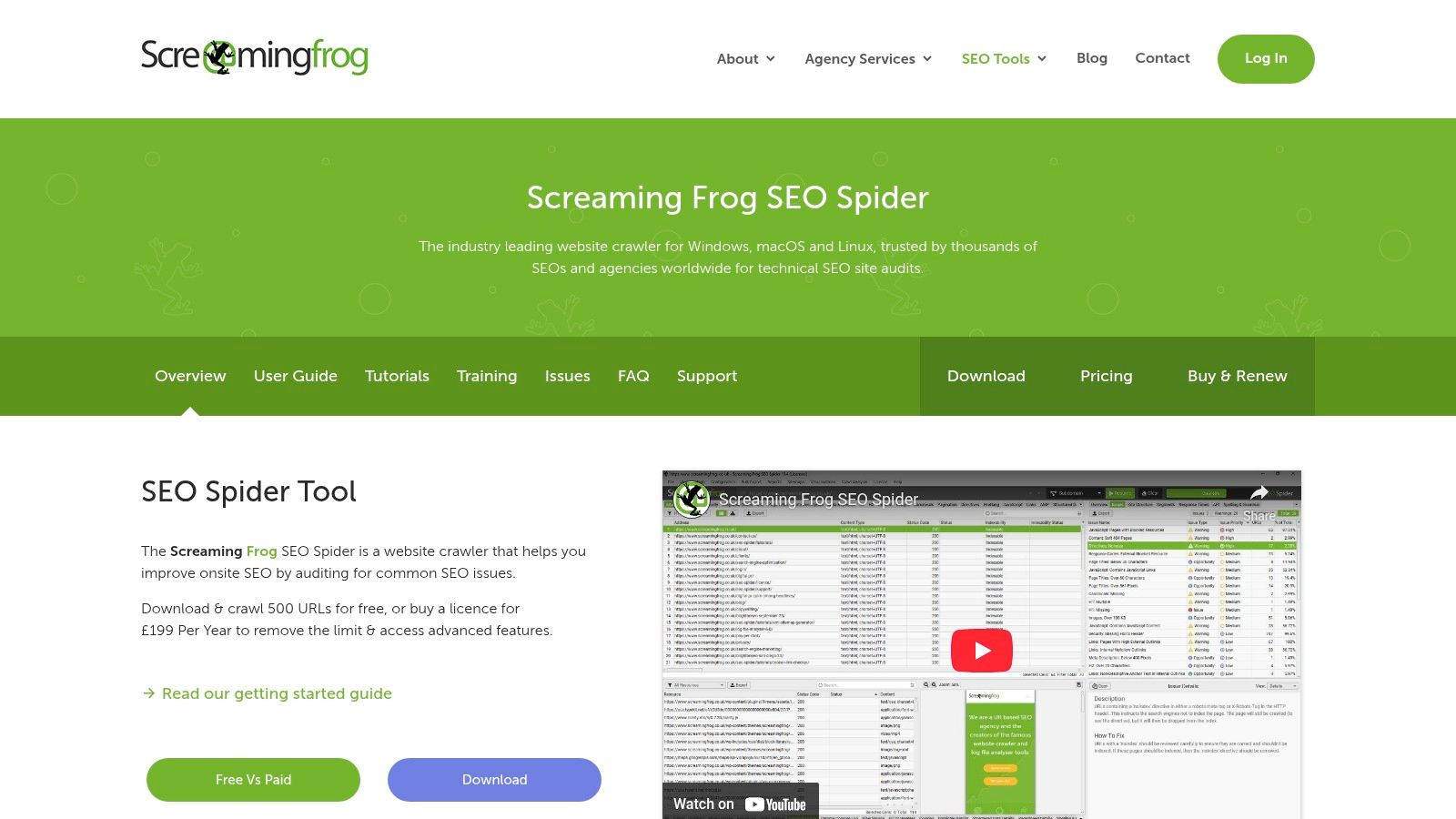
What makes it one of the best tools for SEO agencies is its notable flexibility and depth. Unlike many cloud based crawlers, Screaming Frog’s power is limited only by your computer’s hardware, allowing for massive crawls. For example, an agency could crawl a 500,000 URL e commerce site to identify every instance of non canonical product variations, a task that would be cumbersome with other tools. Agencies can also render JavaScript to audit modern websites, use custom extraction to scrape specific data points via XPath or Regex, and integrate directly with APIs from Google Analytics and Google Search Console.
Key Agency Features & Pricing
- Core Strengths: Near unlimited crawl depth (hardware dependent), advanced JavaScript rendering, custom data extraction, and extensive API integrations for layered data.
- Agency Use Case: Perform in depth technical audits for new client onboarding, identify indexation and crawlability issues, and use the Visualisations feature to create sitemaps and crawl diagrams that help clients understand complex site structures.
- Pricing: A free version is available for crawling up to 500 URLs. The paid license unlocks all features for £259 per year per user, a highly affordable price point for its capabilities.
Website: https://www.screamingfrog.co.uk/seo-spider/
5. Lumar (formerly Deepcrawl): An Enterprise SEO Agency Solution
When an agency takes on a large, complex enterprise client, standard crawling tools can struggle with the sheer scale and complexity. Lumar, formerly known as Deepcrawl, carves out its niche. It is an enterprise grade website intelligence platform designed for deep technical SEO audits and continuous site health monitoring on websites with millions of pages. Its cloud based architecture provides the scalability needed to crawl vast digital estates without overwhelming a client's server resources.
The platform moves beyond simple error flagging and offers enhanced monitoring and governance capabilities. For agencies managing SEO across multiple departments or global teams, Lumar helps enforce technical standards and prevent critical issues from being introduced during site updates or migrations. It integrates with analytics and business intelligence tools to connect technical health metrics directly to website performance and revenue, a direct link when demonstrating ROI to enterprise stakeholders. For agencies with highly technical clients, this is one of the best tools for SEO agencies available.
Key Agency Features & Pricing
- Core Strengths: High scale cloud crawling for massive websites, automated technical health monitoring with alerting, and advanced segmentation for analyzing specific site sections.
- Agency Use Case: Use Lumar to conduct detailed technical audits before a major site migration. Set up automated crawls and custom alerts to monitor core sections of a client's site, ensuring any new issues are caught and resolved before they impact performance.
- Pricing: Lumar does not offer public pricing. Access is provided through a custom quote based on the number of domains, crawl frequency, and required features, positioning it for mid market and enterprise agency clients.
Website: https://www.lumar.io
6. BrightLocal: The Go-To Local SEO Agency Tool
For agencies specializing in brick and mortar clients, BrightLocal is an indispensable local SEO command center. It consolidates the most critical local marketing tasks into a single, unified platform designed specifically for managing multiple client locations at scale. Its power lies in its focused approach, eschewing the broader SEO features of all in one tools to provide deep, actionable insights for local search performance.
The platform streamlines the often tedious work of citation management, Google Business Profile (GBP) optimization, and local rank tracking. For example, an agency managing 50 client locations can use the platform to identify and fix inconsistent NAP (Name, Address, Phone) details across 100+ directories in a fraction of the time it would take manually. This focus makes it one of the best tools for SEO agencies dedicated to dominating the local pack and map results for their clients.
Key Agency Features & Pricing
- Core Strengths: Granular local rank tracking (Local Search Grid), thorough Google Business Profile auditing, and an integrated reputation management suite for monitoring and generating reviews.
- Agency Use Case: Use the Citation Builder service to fix and create consistent NAP information across the web for new clients. Deploy the white label reporting dashboard to give clients a live, branded view of their local SEO progress, from rankings to review sentiment.
- Pricing: The platform operates on a location based model. The Single Business plan starts at $39/month. Most agencies will opt for the SEO Pro plan at $59/month for three locations or the agency focused Grow ($89/month) and Scale ($219/month) plans to manage larger client loads. Citation services are often priced separately.
Website: https://www.brightlocal.com
7. Clearscope: A Top Content Optimization Tool for Agencies
Clearscope is a premier content optimization platform that bridges the gap between human creativity and search engine algorithms. It moves beyond simple keyword density, offering an editor that guides writers to produce topically thorough content that satisfies user intent. For SEO agencies, it streamlines the content briefing and editing process, ensuring every piece produced for a client is primed to rank for its target queries.

The platform's strength is its intuitive interface and its focus on semantic relevance, a growing priority with the rise of AI search. By analyzing top ranking content, Clearscope provides a list of important terms, themes, and questions that should be covered, giving content a grade from F to A++. This simplifies quality control and makes it one of the best tools for SEO agencies aiming to scale high quality content production. The ability to give writers direct, actionable guidance within the editor saves countless hours of revisions.
Key Agency Features & Pricing
- Core Strengths: Real time content grading, detailed term recommendations based on top SERP results, and a clean, writer friendly editor.
- Agency Use Case: Use the content editor to create detailed briefs for freelance writers or in house teams. The shareable report links allow clients to review content scores and progress without needing a login, which enhances transparency and simplifies the approval workflow.
- Pricing: The Essentials plan starts at $170/month and includes 10 content reports. The Business and Enterprise tiers offer more reports, SERP analysis credits, and dedicated account management, which are better suited for agencies with higher content velocity.
Website: https://www.clearscope.io
8. SEOmonitor: An SEO Forecasting Tool for Agencies
SEOmonitor is one of the few platforms in this list that feels built around the commercial reality of agency SEO, not just rankings. Its value is not that it predicts the future perfectly; it is that it gives agencies a structured way to tie SEO plans to traffic, conversion, and revenue expectations using a repeatable framework documented in SEOmonitor’s forecasting overview and broader agency platform pages. For teams trying to defend strategy in pitches and monthly reviews, that makes it a serious contender among SEO forecasting platforms.

The practical workflow is usually straightforward. An agency starts by defining a keyword set that reflects the pages, topics, or service lines it plans to influence. From there, the team groups those keywords into campaign segments, sets ranking assumptions, and builds a forecast that estimates potential traffic and conversions based on search demand and historical performance. Once the campaign is live, the forecast stops being a sales artifact and becomes a management tool: strategists compare actual performance against projected outcomes each month, isolate where variance came from, and explain whether the gap is due to rank movement, seasonality, page rollout delays, or unrealistic initial assumptions. That monthly variance conversation stands out most, because it gives account managers a more credible story than generic "traffic is up" reporting.
How agencies use forecasting in practice
Forecasting is most useful before work starts and during stakeholder reviews. During sales, it helps turn an audit into a business case by showing what specific ranking improvements could mean in terms a client understands. During delivery, it gives the team a benchmark for whether the campaign is on pace or whether assumptions need to be reset. What stood out to us is that this works best for retainers where SEO is tied to measurable lead generation or revenue. On very small retainers, the setup can become overkill if the client mainly wants basic rankings and reporting.
Integration reality: Google Analytics and Google Search Console
SEOmonitor directly supports both Google Analytics integrations and Google Search Console integrations, which is a major reason agencies shortlist it when comparing forecasting tools. In practice, the Google Analytics connection helps teams layer in session and conversion context, while the Google Search Console connection gives them first-party query and landing-page data to validate rankings against actual search visibility. That combination matters because forecasting without reality checks becomes slideware.
There are a few setup considerations. Agencies need clean property access, sensible goal or conversion configuration, and enough historical stability for the forecasts to be useful. If tracking is messy or a site has recently migrated, forecasts can still be directionally useful, but the confidence level drops. For agency teams, we found SEOmonitor strongest when the data foundations were already in place and the client cared about business outcomes, not just rank snapshots.
Where it delivers most value
- Best fit for: Agencies selling strategy, retainers with revenue accountability, and teams that need defensible projections in proposals.
- Where it helps most: Pitching new work, setting realistic SEO expectations, and producing monthly reports that compare outcome vs. model rather than listing rankings.
- Pricing caveat: Pricing scales by tracked keywords and domains rather than users. That can be attractive for growing teams, but agencies with broad keyword sets should model the long-term cost carefully.
Website: https://www.seomonitor.com
9. Similarweb: A Market Intelligence Tool for SEO Agencies
Similarweb offers a high-level view of the entire online ecosystem, making it an essential tool for market and competitor benchmarking. While many SEO tools focus on granular SERP data, Similarweb excels at revealing the bigger picture: a competitor's total traffic, their channel mix, and audience demographics. This strategic intelligence allows agencies to frame SEO performance within the broader context of a client's market share and competitive positioning.
For SEO agencies, its power lies in identifying strategic opportunities and validating campaign direction. Agencies can analyze a competitor's top traffic driving channels to see if they are over reliant on organic search or have a strong referral program your client could emulate. The platform’s keyword and traffic share analysis helps agencies set realistic goals and demonstrate to clients where they stand in the market, moving beyond simple rank tracking to genuine market intelligence.
Key Agency Features & Pricing
- Core Strengths: Comprehensive traffic analytics across all channels (organic, paid, direct, social), competitive benchmarking for market share, and audience demographic insights.
- Agency Use Case: Use the platform to conduct initial market research for new client pitches, identifying their main digital rivals and uncovering strategic gaps. You can find more platforms in our guide to the best competitive analysis tools to complement this workflow.
- Pricing: Similarweb offers a free plan with limited data. Paid plans like Starter and Professional are available, but larger agencies will need the custom priced Team or Enterprise packages for full access to historical data and advanced SEO features.
Website: https://www.similarweb.com
10. Pitchbox: An Outreach and Link Building Agency Tool
Pitchbox is a specialized outreach and digital PR platform designed for scalable link building campaigns. For SEO agencies, it systemizes one of the most time consuming yet critical off page SEO tasks: finding relevant prospects, discovering contact information, and executing personalized outreach. Its core strength lies in combining powerful automation with quality control, making it one of the best tools for SEO agencies focused on building high authority backlink profiles for clients.

The platform streamlines the entire outreach lifecycle, from prospecting with integrated SEO metrics to monitoring email deliverability. Agencies can create highly targeted campaigns using filters from Ahrefs, Semrush, and Majestic to identify high value opportunities. For example, a team could automatically find all blogs that wrote about "project management software" in the last 90 days but did not link to their client, creating a hyper relevant prospect list in minutes.
Key Agency Features & Pricing
- Core Strengths: Automated prospect discovery with SEO data integrations, advanced email personalization and sequencing, and comprehensive team management with approval workflows.
- Agency Use Case: Manage distinct outreach campaigns for multiple clients using separate workspaces. Use the built in reporting to track key metrics like open rates, reply rates, and link acquisition, providing clear ROI to clients on link building efforts.
- Pricing: Custom pricing is provided based on agency needs. Plans are tiered by features and email volume, with the Small Agency plan starting around $550/month. Larger agencies will require higher tier plans like SEO Agency or Enterprise for increased limits and features.
Website: https://pitchbox.com
11. Google Search Console: A Foundational Free Tool for SEO Agencies
Google Search Console (GSC) is the non negotiable foundation of any SEO campaign. As a free service directly from Google, it provides indispensable first party data on how a client’s website performs in search results. It’s the ultimate source of truth for indexing status, organic impressions, clicks, and technical health, making it one of the most fundamental tools for SEO agencies to establish a performance baseline and diagnose critical issues.
Unlike third party platforms that estimate traffic, GSC shows exactly which queries drive users to a site, which pages are ranking, and how Google crawls and indexes content. For an agency, this data is gold. It’s used to verify the impact of technical fixes, identify keyword opportunities with high impressions but low click through rates, monitor Core Web Vitals, and submit sitemaps to accelerate content discovery. No other tool can provide this direct line of communication with Google.
Key Agency Features & Pricing
- Core Strengths: Direct access to Google search performance data (clicks, impressions, CTR, position), detailed index coverage reporting, and real time URL inspection for troubleshooting.
- Agency Use Case: Use the Performance report to find "striking distance" keywords on page two that can be pushed to page one. Connect GSC to Looker Studio to build powerful, automated client dashboards that visualize organic growth and technical health improvements over time.
- Pricing: Completely Free. Access is granted by verifying ownership of the website property, which is a standard step in any new client onboarding process for an SEO agency.
Website: https://search.google.com/search-console/about
12. Google Analytics 4 (GA4): An Essential Analytics Tool for Agencies
Google Analytics 4 is the foundational analytics tool for any SEO agency, moving beyond the session based model of its predecessor to a more flexible, event based framework. Its core purpose is to measure traffic and user engagement across websites and apps, providing the essential data needed to prove SEO ROI. For agencies, GA4 is not just a reporting tool but a diagnostic hub to understand how organic traffic translates into meaningful business outcomes like leads and sales.
The platform’s strength lies in its deep integration with the Google ecosystem and its powerful, customizable reporting capabilities. Agencies can build granular audiences from organic visitors, track complex conversion paths, and use the "Explorations" feature to uncover deep insights into user behavior that were previously difficult to access. This event based model allows for a much richer understanding of the entire user journey, making it one of the best tools for SEO agencies focused on data driven strategies.
Key Agency Features & Pricing
- Core Strengths: Event based data model for flexible tracking, powerful Exploration reports for custom analysis, and native integration with BigQuery for advanced data warehousing.
- Agency Use Case: Link GA4 with Google Search Console to analyze organic query performance alongside on site behavior. Use Looker Studio to build automated, white label client dashboards that pull directly from GA4 data, showcasing the direct impact of SEO efforts on client goals.
- Pricing: The standard version of GA4 is completely free and sufficient for most clients. High volume enterprise clients may require Analytics 360, which has custom, sales led pricing and offers higher data limits and service level agreements.
Website: https://marketingplatform.google.com/analytics
Comparison of the Best SEO Tools for Agencies
The table below is designed to help with selection, not just summarize categories. It highlights where each tool fits, where it disappoints, and whether it should anchor your stack or sit alongside a broader platform.
| Tool | Primary Focus | Ideal Agency Size | Strongest Use Case | Notable Limitation | Core Platform or Specialist Add-on | Pricing Model |
|---|---|---|---|---|---|---|
| Riff Analytics | AI Search Visibility | Small to mid-size agencies building AI services | Tracking answer share, citations, and AI visibility gaps | Not a replacement for classic rank tracking or technical SEO | Specialist add-on | Custom Quote, Free Trial |
| Semrush | All-in-One SEO Suite | Small to large agencies | Broad campaign management, reporting, research, and prospecting | Can become expensive as limits and add-ons expand | Core platform | Subscription (Tiered) |
| Ahrefs | Backlink & Competitor Analysis | Small to enterprise agencies | Link intelligence, competitor research, and content gap analysis | Reporting and workflow features are less agency-centric than some rivals | Core platform for some teams; specialist for others | Subscription (Credit-based) |
| Screaming Frog | Technical Site Auditing | Solo to enterprise agencies | Deep technical crawling and audit diagnostics | Desktop-based workflow is less ideal for always-on monitoring | Specialist add-on | Freemium, Annual License |
| Lumar | Enterprise Technical SEO | Mid-market to enterprise agencies | Large-scale crawling, monitoring, and governance | Pricing and complexity put it out of reach for many smaller teams | Specialist add-on | Custom Quote (Enterprise) |
| BrightLocal | Local SEO Management | Small to mid-size local-focused agencies | GBP audits, citation work, local rank tracking, and reviews | Too narrow if local SEO is only a small part of your service mix | Specialist add-on | Subscription (Per Location) |
| Clearscope | Content Optimization | Content-heavy agencies | Content briefs, topical coverage, and editorial QA | Price can feel steep if content production volume is low | Specialist add-on | Subscription (Report Credits) |
| SEOmonitor | SEO Forecasting & Reporting | Small to mid-size agencies with recurring retainers | Forecasting, pitch support, and reporting against business outcomes | Less useful if clients only want basic ranking reports | Specialist add-on with near-core value for reporting-led agencies | Subscription (Keyword/Domain) |
| Similarweb | Market Intelligence | Mid-size to enterprise agencies | Market sizing, channel mix analysis, and strategic benchmarking | Less precise for tactical SEO execution than SEO-first platforms | Specialist add-on | Freemium, Custom (Enterprise) |
| Pitchbox | Outreach & Link Building | Mid-size to large agencies | Scalable outreach, prospecting, and link building operations | High price point for agencies without a mature outreach program | Specialist add-on | Subscription (High-Tier) |
| Google Search Console | Core Performance Data | All agency sizes | First-party search data, indexing, and query diagnostics | Limited collaboration and reporting polish on its own | Foundational core layer | Free |
| Google Analytics 4 | Web & App Analytics | All agency sizes | Measuring traffic quality, conversions, and user behavior | Setup quality varies wildly across client accounts | Foundational core layer | Free |
There is heavy overlap at the top of the market. Semrush and Ahrefs both cover research, rank tracking, and competitor analysis, so most agencies should choose one as the main suite rather than paying for both by default. The exception is a team with a very specific backlink or competitor-research workflow that benefits from Ahrefs alongside a Semrush-centered reporting setup.
The smart pairings are more specialized. Local agencies usually get the best return from Semrush or Ahrefs plus BrightLocal. Content-led agencies often pair a broad suite with Clearscope. Technical agencies can start with Screaming Frog and only move to Lumar when client scale and monitoring needs justify enterprise spend.
For agencies building offers around AI search, Riff Analytics is the clearest specialist add-on in this list. For agencies selling board-level reporting or revenue-focused retainers, SEOmonitor is the stronger complement. In practical terms, buying both makes sense only if AI visibility and forecasting are both part of the service package; otherwise one of them will sit underused.
| Tool | Primary Focus | Best For | Key Differentiator | Pricing Model |
|---|---|---|---|---|
| Riff Analytics | AI Search Visibility | Agencies focused on generative SEO | Citation gap analysis for AI answers | Custom Quote, Free Trial |
| Semrush | All-in-One SEO Suite | Agencies needing a broad toolkit | Extensive feature set & reporting | Subscription (Tiered) |
| Ahrefs | Backlink & Competitor Analysis | Agencies focused on link building | Industry-leading backlink index | Subscription (Credit-based) |
| Screaming Frog | Technical Site Auditing | In-depth technical SEO analysis | Powerful desktop crawler flexibility | Freemium, Annual License |
| Lumar | Enterprise Technical SEO | Agencies with large, complex clients | Scalable cloud crawling & governance | Custom Quote (Enterprise) |
| BrightLocal | Local SEO Management | Agencies with brick-and-mortar clients | Comprehensive local SEO features | Subscription (Per Location) |
| Clearscope | Content Optimization | Agencies scaling content production | High-quality semantic analysis | Subscription (Report Credits) |
| SEOmonitor | SEO Forecasting & Reporting | Agencies focused on client acquisition | Data-driven campaign forecasting | Subscription (Keyword/Domain) |
| Similarweb | Market Intelligence | Strategic competitor benchmarking | Comprehensive traffic & channel data | Freemium, Custom (Enterprise) |
| Pitchbox | Outreach & Link Building | Agencies running scalable outreach | Integrated prospecting & automation | Subscription (High-Tier) |
| Google Search Console | Core Performance Data | All SEO professionals & agencies | Free, first-party data from Google | Free |
| Google Analytics 4 | Web & App Analytics | All SEO professionals & agencies | Event-based model & Google integration | Free |
Summary: Building Your Agency's Winning Tech Stack
If you want the short editorial verdict, Semrush is the best single-platform starting point for broad agency needs. It covers the most ground and is easiest to justify when you need one subscription to support prospecting, research, rank tracking, and reporting. Screaming Frog is the best technical add-on because it still uncovers issues that broader suites surface only superficially. BrightLocal is the best local SEO specialist. SEOmonitor is the best forecasting and reporting specialist for agencies that need to connect SEO work to business expectations. Riff Analytics is the best AI-visibility specialist for teams that want to show clients how brand presence is changing inside answer engines.
If you only have budget for 2 tools, start with one broad suite plus one specialist that matches your service model. For most agencies, that means Semrush + Screaming Frog. For local SEO, Semrush + BrightLocal is the better combination. For content-heavy work, Semrush + Clearscope is more useful than adding another keyword database. In our review, the stacks that stood out were the ones with the least overlap, not the ones with the longest software bill.
If you serve enterprise clients, the stack shifts. Keep a broad suite for visibility and market context, but expect to add Lumar for scale, Screaming Frog for ad hoc diagnostics, and GA4/GSC for first-party validation. Enterprise buyers care less about flashy dashboards and more about governance, monitoring, and explanations that survive executive scrutiny.
So what is the best tool for an SEO agency? There is no universal winner. The best choice is the platform that fits your agency’s delivery model today while leaving room to add specialists only where they produce measurable impact. A common approach is to start broad, then add technical depth, reporting clarity, local specialization, or AI visibility only when the client mix makes it pay off.
Frequently Asked Questions
1. What are the essential tools every SEO agency needs in 2026?
Every agency needs a core all in one platform (like Semrush or Ahrefs), a technical crawler (Screaming Frog), and foundational Google tools (Search Console and GA4). For future-proofing, a tool for monitoring AI search visibility and generative SEO performance, like Riff Analytics, is now also essential to track mentions in AI Overviews, ChatGPT, and other answer engines.
2. How do I choose the best SEO software for my small agency?
For a small agency, focus on tools that offer the best value and scalability. Start with the free Google tools. Then, choose one all in one platform that fits your budget and primary service (e.g., Ahrefs for link building focus, Semrush for a broader marketing focus). Add specialized, affordable tools like Screaming Frog for technical audits as needed. Prioritize tools with flexible, transparent pricing.
3. What is the difference between an all-in-one SEO suite and specialized tools?
An all in one suite like Semrush provides good functionality across many areas: keyword research, rank tracking, site audits, and competitor analysis. Specialized tools offer deep, best in class functionality in one specific area. For example, Screaming Frog offers far more granular technical audit capabilities than an all in one, and Riff Analytics provides AI citation tracking that all in ones currently lack. The best agencies use a combination of both.
4. How can SEO tools help with client reporting?
Many of the best tools for SEO agencies are designed with reporting in mind. Platforms like Semrush, BrightLocal, and SEOmonitor offer white label reporting features that allow you to create professional, branded dashboards and PDFs for clients. You can automate these reports to show key metrics like rank improvements, traffic growth, and task completion, saving your team hours and clearly demonstrating ROI.
5. Why do I need a tool for "AI Search Visibility" or "LLM tracking"?
With the rise of Google's AI Overviews and other AI engines like Perplexity, a significant portion of user queries are now answered directly by AI. Traditional rank tracking doesn't measure if your client's brand or content is being cited in these answers. Tools specializing in AI search visibility and LLM tracking are essential to monitor this new channel, identify citation gaps, and optimize content to be used as a trusted source by AI, which is a critical new frontier for SEO.