Tested SEO Reporting Tools for Agencies (2026 Guide)
Updated January 20, 2026
An SEO report is how an agency proves its value. It translates technical work like link building and on page optimization into business outcomes a client can understand. In 2026, that job is broader than it was even a year ago. Clients still want rankings, traffic, and conversions, but they also expect cleaner attribution, faster reporting cycles, white-label delivery, and clearer answers about AI search visibility.
What stood out in our review is that the market has split into three distinct categories: dedicated agency reporting platforms, all-in-one SEO suites with reporting modules, and newer tools built for AI search visibility. That distinction matters because the best fit is rarely the tool with the most features overall. It is the one that matches your workflow: multi-client dashboard management, executive-ready white-label reporting, or forward-looking AI citation tracking.
How We Picked These SEO Reporting Tools for Agencies
We did not include tools just because they can export a PDF. To make this list useful for agency buyers, we compared every platform against the same operating criteria: report automation, white-label depth, integration breadth, support for AI or LLM-era reporting, scalability across many client accounts, pricing transparency, and setup friction. A tool moved up the list if it could shorten monthly reporting work without forcing agencies into a fragile stack of spreadsheets, manual exports, and one-off dashboards.
Just as important, we looked for disqualifiers. If a platform made white-labeling hard to access, hid key reporting functions behind an unclear sales process, depended heavily on external dashboard tools for basic agency workflows, or lacked a practical way to manage multiple clients, that counted against it. In my assessment, agencies should be skeptical of anything that looks polished in a demo but still requires too much manual assembly at month end.
Our selections are based on a mix of product-page verification, pricing documentation, feature comparisons, and editorial review of how each tool fits real agency use cases. Where a platform is strongest for agencies already invested in its ecosystem, we say so. Where a tool is excellent but only if you pay for a higher tier, we say that too. That matters because modern reporting has moved well beyond rank tracking into consolidated dashboards that combine GA4, Search Console, audit, ranking, and conversion data in one client-ready layer, a shift outlined in Coupler's reporting overview.
What to Look for in White-Label and AI-Powered SEO Reporting Software
For most agencies, white-label reporting is no longer a bonus feature. It is the baseline expectation. The practical question is not whether a tool offers branding, but how far that branding goes. Some platforms only let you add a logo to PDFs. Others support custom domains, branded emails, live client portals, and role-based access. In our view, the difference between surface-level branding and a real white-label client experience is one of the biggest separators in this category.
AI-powered reporting now deserves equal attention. That does not just mean an assistant that writes a summary paragraph. The more useful versions help agencies surface anomalies, draft executive narratives, connect SEO metrics to business outcomes, and increasingly report on AI search visibility itself. Riff Analytics is the clearest example of this newer category: it can produce an AI readiness audit quickly, track mentions and citations across more than eight AI engines, and show the exact domains and URLs influencing answers, as detailed in Riff's breakdown. I think that kind of source visibility is far more valuable than generic AI text generation because it gives strategists something concrete to act on.
A good buying checklist for 2026 is simple: can the tool automate recurring reports, support a credible white-label experience, connect to the data sources you already use, scale across your client count without ugly pricing surprises, and help you explain performance in both traditional search and AI-driven discovery? If the answer is no on two or more of those, it is probably not the right reporting stack for an agency.
Key Capabilities of Modern SEO Reporting Software for Agencies
A key function for many agencies is to conduct thorough SEO audits, and the best reporting platforms now do much more than package charts into a monthly PDF. A stricter selection framework was built around the capabilities agencies rely on in 2026.
First, every tool here needed a credible reporting workflow: scheduled reports, reusable templates, and enough customization to support multiple clients without rebuilding dashboards from scratch. Second, we looked closely at white-label depth. A logo upload is helpful, but agencies with retention-focused reporting usually need custom domains, branded emails, client portals, or at least clean share links. Third, integrations mattered heavily. Tools scored better when they could pull together Google Analytics, Google Search Console, ranking data, audits, PPC, and other channel data in one place rather than forcing manual exports.
We also evaluated newer buying criteria that many older roundups ignore: AI-assisted summaries, visibility into AI search or citation sources, pricing transparency, and how realistic the setup is for a busy account team. Some platforms are powerful but only once you add API access, Looker Studio, or a higher tier plan. Others are easier to launch but less flexible at scale. In my review, the best agency options were the ones that reduced recurring operational work without hiding essential functions behind too many upgrades.
A tool would be a poor fit if it lacked multi-client controls, made white-labeling inaccessible, or required too much manual assembly to deliver client-ready reporting. We based inclusions on feature verification, pricing pages, product documentation, and comparative editorial judgment rather than generic vendor claims. That is also why some tools rank highly for a specific agency scenario rather than as universal winners. The rise of white-label automation across agency reporting platforms is well documented in Duda's agency tool roundup, and that operational reality shaped how we judged every option here.
1. Riff Analytics
Best For: Agencies pioneering AI search optimization and brand visibility reporting.
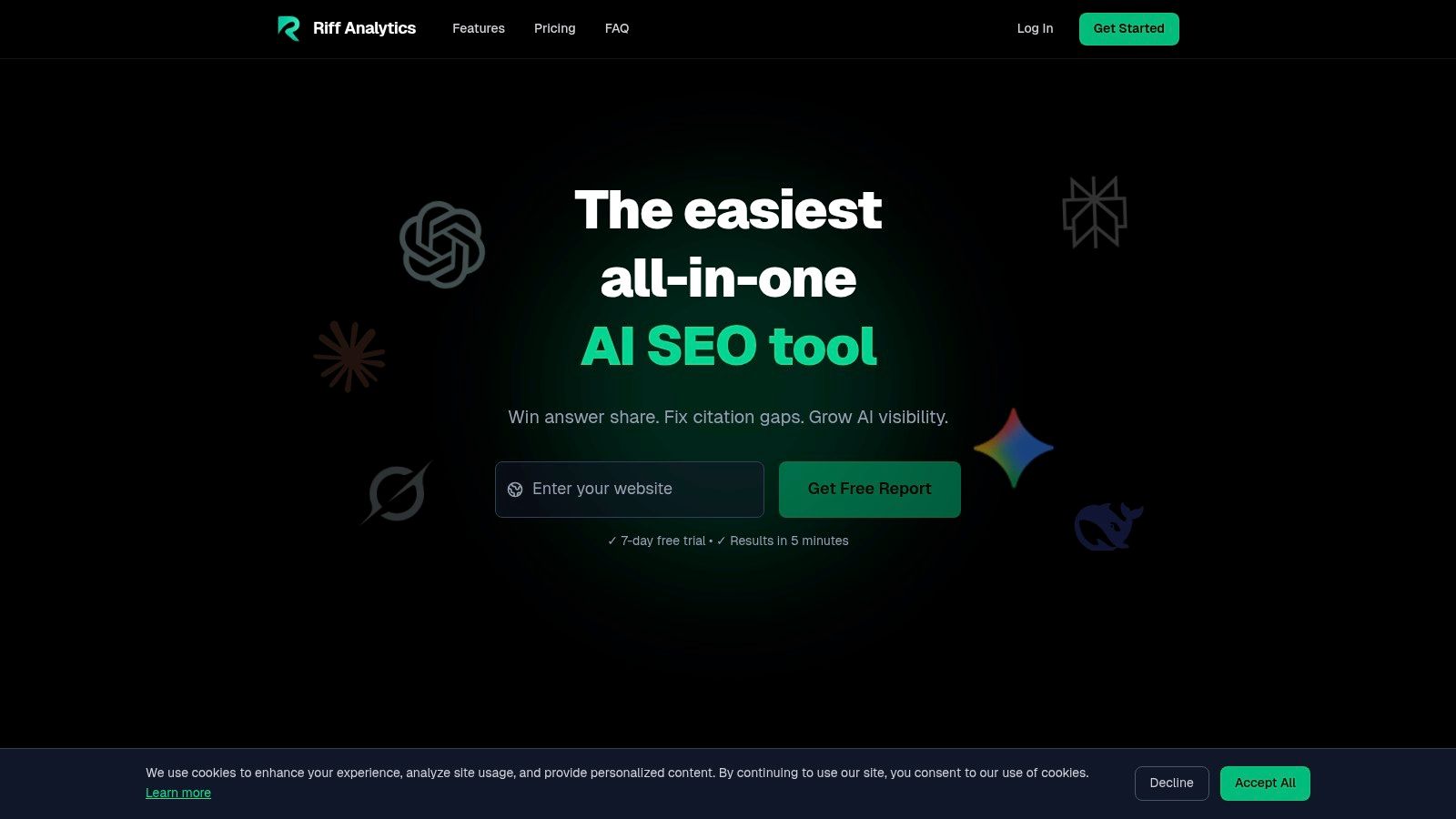
Riff Analytics positions itself as an essential platform for the next wave of search, moving beyond traditional SERPs to focus on AI visibility and brand monitoring. It is a purpose built solution for agencies that need to prove value in the era of generative AI. The platform provides a suite of tools designed to track, analyze, and improve how a client’s brand is represented across major AI engines like ChatGPT, Gemini, Perplexity, and Google's AI Overviews.
For agencies, this translates into a powerful new service offering. Instead of just reporting on keyword rankings, you can deliver concrete data on a client's "answer share" in AI driven conversations, a critical metric for future brand discovery. Riff’s ability to pinpoint the exact sources AI engines cite provides a clear, actionable roadmap for content and digital PR strategies, making it one of the most strategic seo reporting tools for agencies venturing into this new domain.
Why Riff Analytics Excels as an Agency SEO Reporting Tool
What sets Riff Analytics apart is its focus on citation gap analysis. The platform doesn't just tell you if you were mentioned; it shows you why by revealing the underlying sources. It also highlights where your competitors are being cited, providing a prioritized to do list for your team. This capability allows you to build a data backed strategy to earn citations from the high authority sources AI models trust.
The platform is designed for rapid implementation, delivering an initial AI readiness audit in minutes without requiring complex technical setup. This speed to insight is invaluable for agencies needing to quickly assess a new client's AI footprint or report on campaign progress.
Key Features:
- Multi Engine Tracking: Monitors brand mentions and citations across a wide array of AI platforms, including ChatGPT, Perplexity, Claude, Gemini, and Google AI Overviews.
- Citation Source & Gap Analysis: Identifies the exact URLs and domains that AI engines rely on for information and surfaces opportunities where competitors are being cited.
- Competitive Benchmarking: Offers side by side comparisons to track your "answer share" against key rivals, helping you prioritize optimization efforts.
- AI Readiness Audits: Provides fast, actionable reports on how AI engines perceive and interpret your website content, requiring no technical expertise.
Pricing: Riff Analytics offers a 7 day free trial. Detailed pricing for paid plans is available after signing up or by contacting their sales team.
Visit Website: Riff Analytics
2. Semrush – My Reports Suite
For agencies already embedded in the Semrush ecosystem for keyword research and rank tracking, the My Reports Suite is a logical and powerful extension for client communication. This platform excels at consolidating data from its vast suite of tools into a single, cohesive narrative, making it one of the most integrated SEO reporting tools for agencies. Its primary strength lies in its convenience; you can pull data from Position Tracking, Site Audit, and Backlink Audit directly into a client ready document without juggling multiple platforms.
The drag and drop builder is intuitive, allowing for quick customization. You can schedule reports to be sent daily, weekly, or monthly, automating a significant part of your client management workflow. The integration with 35+ external sources, including Google Analytics and Google Search Console, means you can present a comprehensive view of a campaign’s performance, blending Semrush’s competitive insights with first party data. In practice, Semrush is strongest when your agency already uses it as the primary SEO stack; if not, the reporting layer can feel less compelling on its own.
Understanding Semrush Pricing and Agency Use Cases
Pricing: Access to My Reports is available on all Semrush plans. However, advanced features like full white labeling (removing all Semrush branding) and API access require the Agency Growth Kit add on. The base functionality allows creating branded reports with your logo.
- Key Features:
- Drag and drop report builder with 250+ widgets.
- Integrations with Semrush tools and key third party platforms (GA4, GSC, Google Business Profile).
- Automated scheduling and delivery via email or shareable links.
- White labeling and custom domain options are available.
- AI powered summaries to generate executive level report narratives.
Agency Tip: Use the AI summary feature to create a quick first draft of your monthly executive summary. Then, edit it to add your agency’s specific strategic insights and recommendations. This saves time while ensuring each report, from a high level overview to a detailed SEO audit report sample, feels personalized and actionable. The integrated workflow makes Semrush a standout choice for agencies seeking efficiency.
Website: Semrush My Reports
3. AgencyAnalytics
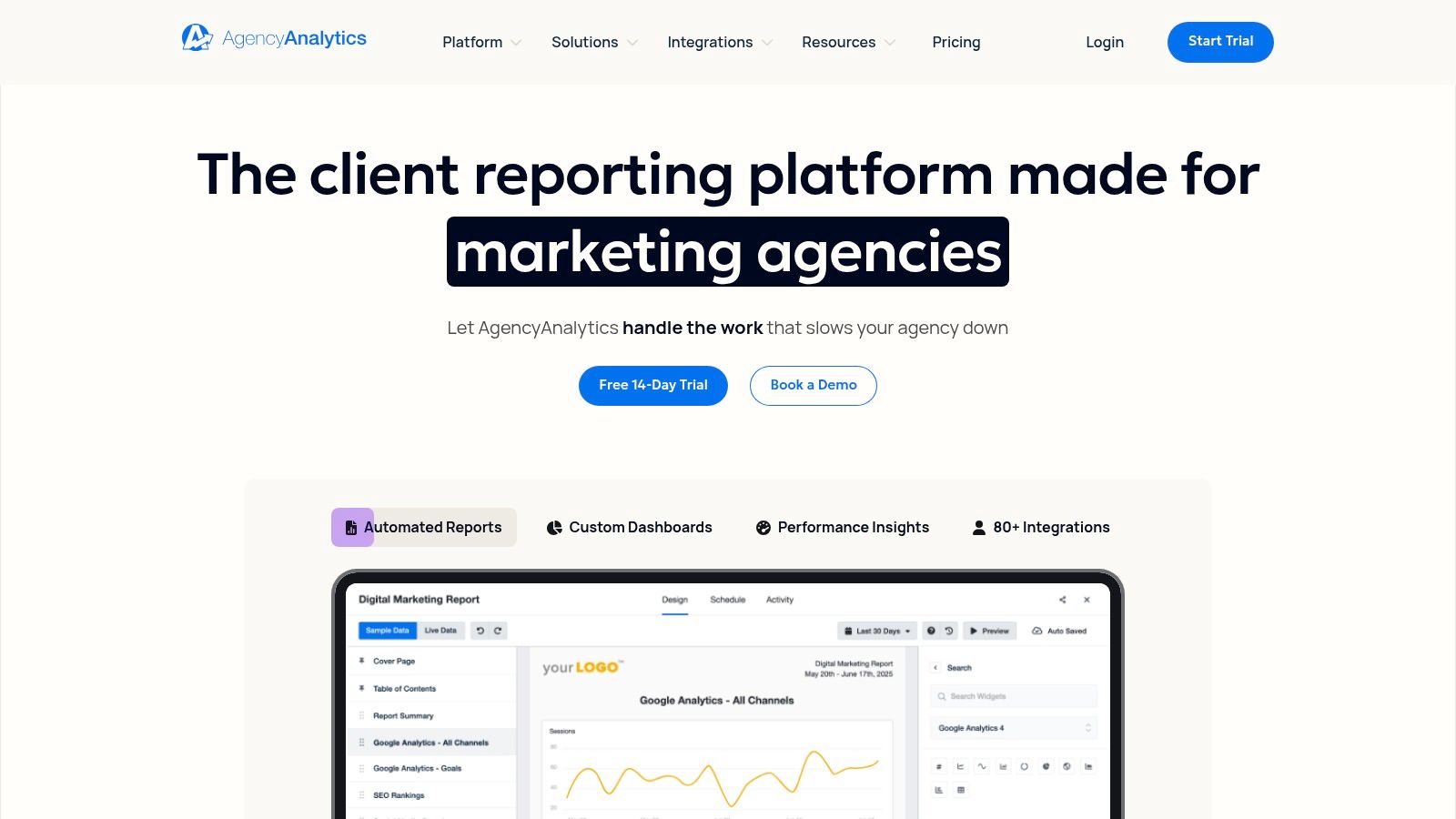
AgencyAnalytics is built from the ground up with a single audience in mind: marketing agencies. This singular focus makes it one of the most scalable SEO reporting tools for agencies managing multiple clients. Instead of being an all in one SEO platform with a reporting add on, its core product is the reporting dashboard itself. That distinction matters, as every feature is designed to simplify client management, from automated report scheduling to a fully white labeled client portal where clients can log in and see their campaign progress at any time.
Its true power lies in its extensive integration library, allowing you to pull data from over 80 platforms covering SEO, PPC, social media, and email marketing. This creates a unified dashboard that tells the complete digital marketing story, not just the SEO chapter. The platform simplifies the complexities of managing numerous client accounts, credentials, and data sources into one cohesive and professional looking interface.
Evaluating This Agency Focused Reporting Platform
Pricing: AgencyAnalytics uses a per client pricing model. Plans like the Freelancer, Agency, and Enterprise tiers include a set number of client campaigns, with the ability to add more for an additional fee. This structure can be cost effective for growing agencies but requires careful budget management as you scale.
- Key Features:
- 80+ native integrations (including Google Analytics, GSC, Ahrefs, Moz, and social platforms).
- Fully white label client portals with custom domains, branding, and branded emails.
- Client facing features like task management and goal tracking.
- Role based permissions to control what clients and team members can see.
- Multi account connections to manage multiple client profiles under one integration.
Agency Tip: Use the client portal feature to reduce back and forth emails. Set up a custom dashboard with key metrics and give your clients their own login. This not only empowers them with on demand access to their data but also positions your agency as transparent and technologically advanced, enhancing client retention.
Website: AgencyAnalytics
4. SE Ranking
SE Ranking has carved out a significant niche as an all in one SEO platform, particularly favored by agencies looking for a powerful yet cost effective solution. Its strength lies in offering a broad set of tools, including rank tracking and site audits, with a reporting module designed for agency workflows. This makes it one of the most balanced SEO reporting tools for agencies that need extensive functionality without the enterprise level price tag. The platform simplifies creating detailed, white label reports that integrate data from its native tools seamlessly.
The reporting functionality is straightforward yet flexible, allowing agencies to build custom reports covering keyword rankings, competitor analysis, backlink profiles, and technical site health. Integrations with Google Analytics 4 and Google Search Console are standard, providing a complete picture of performance. The value proposition is particularly strong for growing agencies, as the generous keyword and project limits on its plans allow for scaling client work efficiently. My takeaway is that SE Ranking is one of the easiest tools to justify for agencies that want an all-in-one system without paying enterprise premiums, though some advanced reporting flexibility only opens up on higher tiers.
Using This Reporting Tool for Agency Growth
Pricing: SE Ranking is known for its value oriented pricing. Reporting features are available across all plans, but advanced capabilities like API access and the Looker Studio connector are reserved for the Pro and Business tiers. A 14 day free trial is available without a credit card.
- Key Features:
- Comprehensive white label report builder with scheduling.
- Integrations with Google Analytics 4, Search Console, and Looker Studio.
- API access for custom dashboards and data pipelines (Pro/Business plans).
- Includes Share of Voice and an “AI Results Tracker” for monitoring AI search visibility.
- Agency Pack add on for lead generation and client management tools.
Agency Tip: Leverage the Looker Studio connector on the Pro plan to build highly customized, interactive dashboards for your most important clients. This allows you to blend SE Ranking’s competitive data with other sources, creating a unique reporting asset that showcases your agency’s data driven approach and helps justify your retainers. This advanced reporting elevates your service beyond standard PDFs.
Website: SE Ranking
5. Moz Pro
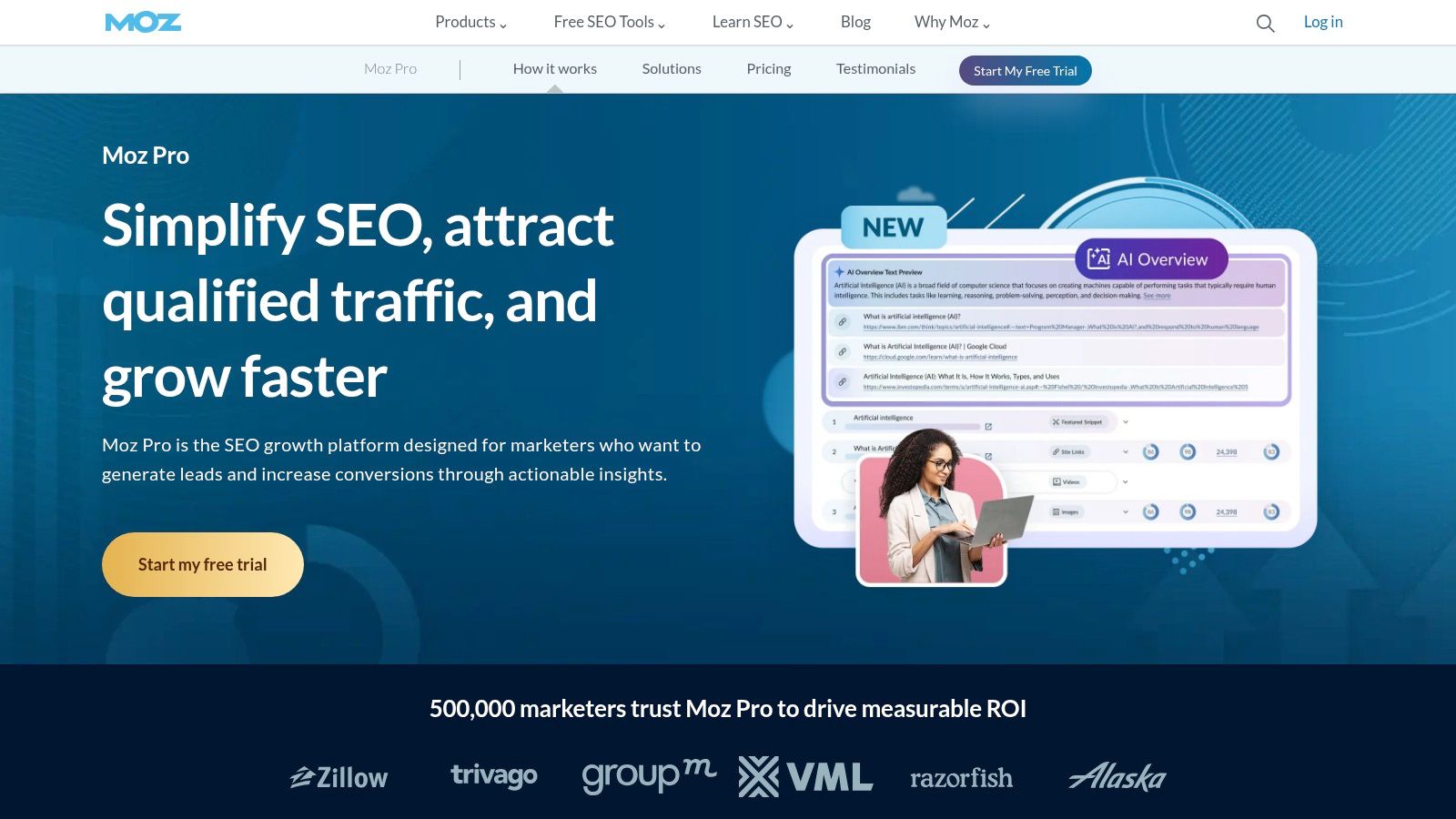
For agencies seeking an established and straightforward SEO platform, Moz Pro offers a full set of tools that simplifies campaign management and reporting. It’s particularly effective for teams that need a reliable, all in one solution without an overly complex interface. Moz excels at presenting core SEO data like rankings, site health, and link metrics in a digestible format, making it one of the most accessible SEO reporting tools for agencies onboarding new team members or managing clients who prefer clear, concise updates.
The platform's strength lies in its user-friendly campaign dashboards and scheduled reporting features. You can easily set up campaigns to track keyword performance, monitor site crawls for technical issues, and analyze backlink profiles using their proprietary metrics like Domain Authority. This efficient method helps agencies produce professional, branded client reports quickly, concentrating on key performance indicators without overwhelming stakeholders with raw data. One caveat is that Moz is better suited to classic SEO reporting than highly customized multi-channel reporting, so agencies wanting one dashboard for SEO, paid media, CRM, and revenue data may outgrow it.
A Solid Reporting Software Choice for SEO Agencies
Pricing: Moz Pro offers tiered plans (Standard, Medium, Large, Premium) based on the number of campaigns, keywords tracked, and pages crawled. Branded reports are available on most plans, making it accessible for growing agencies. Add on packs for more campaigns or keywords are available for teams that need to scale beyond their plan limits.
- Key Features:
- Campaign dashboards with scheduled and branded PDF reports.
- Rank tracking across major search engines and multiple locations.
- Link Explorer featuring Domain Authority and the newer Brand Authority metric.
- On Page Grader and Site Crawl tools to identify technical SEO issues.
- Scalable plans with options to add more campaigns and keywords as needed.
Agency Tip: Use Moz’s Link Explorer not just for your clients but also for competitor analysis. The Domain Authority metric is a well understood industry benchmark that can help you frame competitive landscapes for clients. By tracking competitor DA alongside your client's, you can create a powerful narrative about progress and authority building in your reports. This helps when you want to understand how to do competitive analysis in SEO and demonstrate tangible value.
Website: Moz Pro
6. Ahrefs
While not a dedicated report builder in the same vein as some others on this list, Ahrefs earns its spot for the sheer quality and depth of data it provides for agency level reporting. Agencies rely on its industry leading backlink index and detailed keyword data to power their strategic insights. The platform excels at competitive analysis, backlink audits, and content gap analysis, providing the raw data that forms the foundation of a compelling client narrative. For many agencies, Ahrefs is the primary source of truth for off page SEO and competitor intelligence.
The primary reporting workflow involves exporting data from its core tools like Site Explorer, Keywords Explorer, and Rank Tracker. This raw data is then often visualized in external tools. For agencies with the resources, Ahrefs offers a powerful API and a native Looker Studio (formerly Data Studio) connector, allowing for the creation of fully custom, automated dashboards that blend its deep competitive data with other sources. That flexibility is powerful, but I would only recommend Ahrefs as a reporting centerpiece if your team is comfortable building the presentation layer elsewhere; otherwise it can feel like a data source more than a finished agency reporting solution.
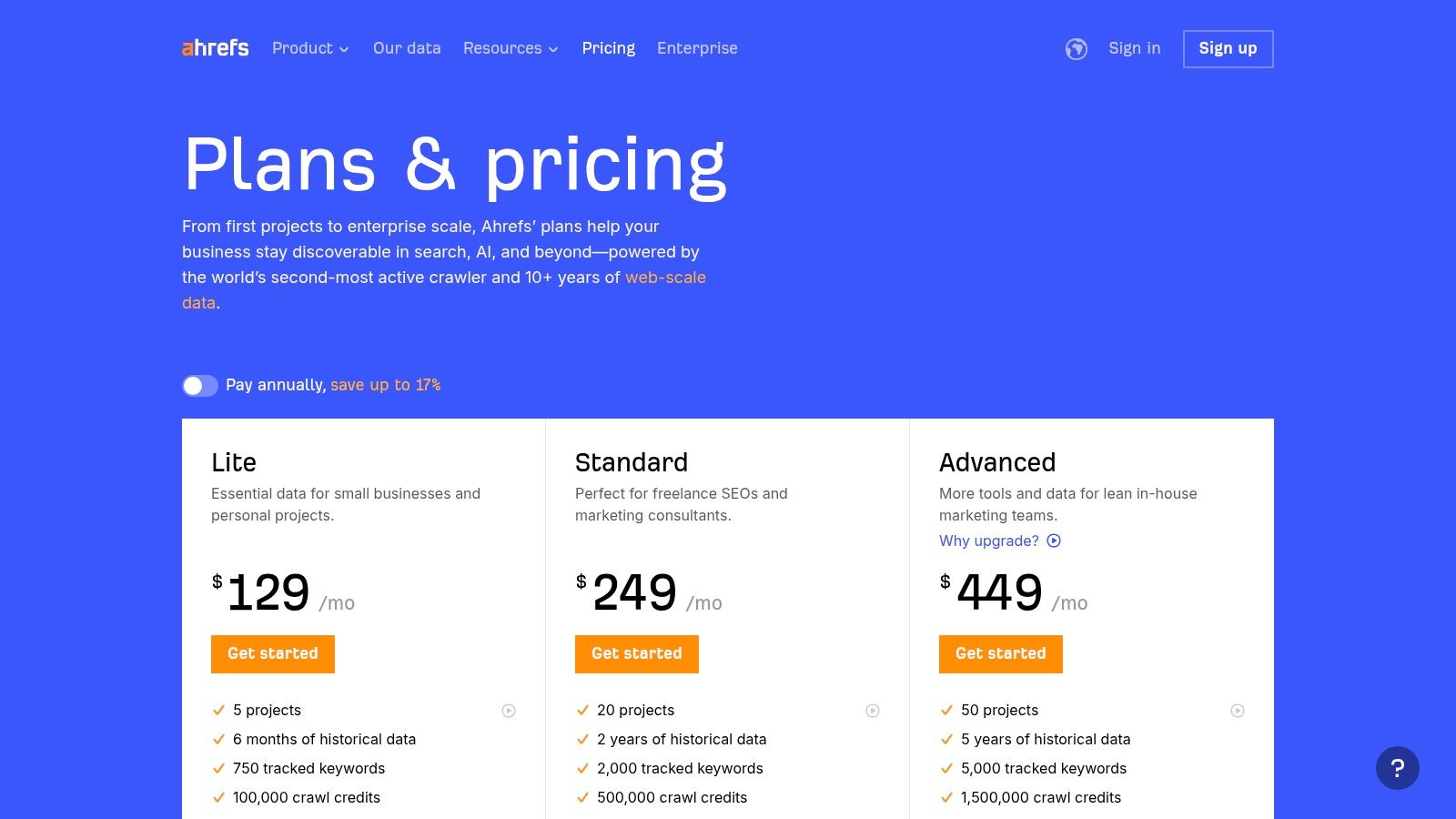
Data Rich SEO Reporting Software for Agencies
Pricing: Ahrefs operates on a tiered subscription model, starting with the Lite plan. Access to the Looker Studio integration and API, useful for advanced agency reporting, is available on the Standard and higher plans. Costs can increase with additional user seats and usage credits.
- Key Features:
- Industry leading backlink index and competitive analysis via Site Explorer.
- Comprehensive keyword research tools with accurate difficulty scores.
- In depth Site Audit for technical SEO health checks.
- Rank Tracker for monitoring keyword performance across multiple locations.
- Data exports, API access, and Looker Studio connector on higher tier plans.
Agency Tip: Use the Looker Studio connector to build a live dashboard that pulls in Ahrefs' Domain Rating (DR), referring domains, and organic keyword data. Combine this with GSC and GA4 data to show clients a direct correlation between your link building efforts and their bottom line results, like improvements in their keyword rankings and visibility report. This elevates your reporting from static data points to a dynamic performance overview.
Website: Ahrefs pricing
7. Databox
For agencies that need to report on more than just SEO, Databox serves as a central business intelligence hub. It excels at consolidating disparate data sources, from SEO tools like Ahrefs and Semrush to PPC platforms, social media, and CRM data, into unified dashboards. This makes it one of the most versatile SEO reporting tools for agencies looking to present a complete marketing performance narrative. Its core strength is its vast connector library and flexibility, allowing you to pull metrics from virtually any part of your client's marketing stack into a single, cohesive report.
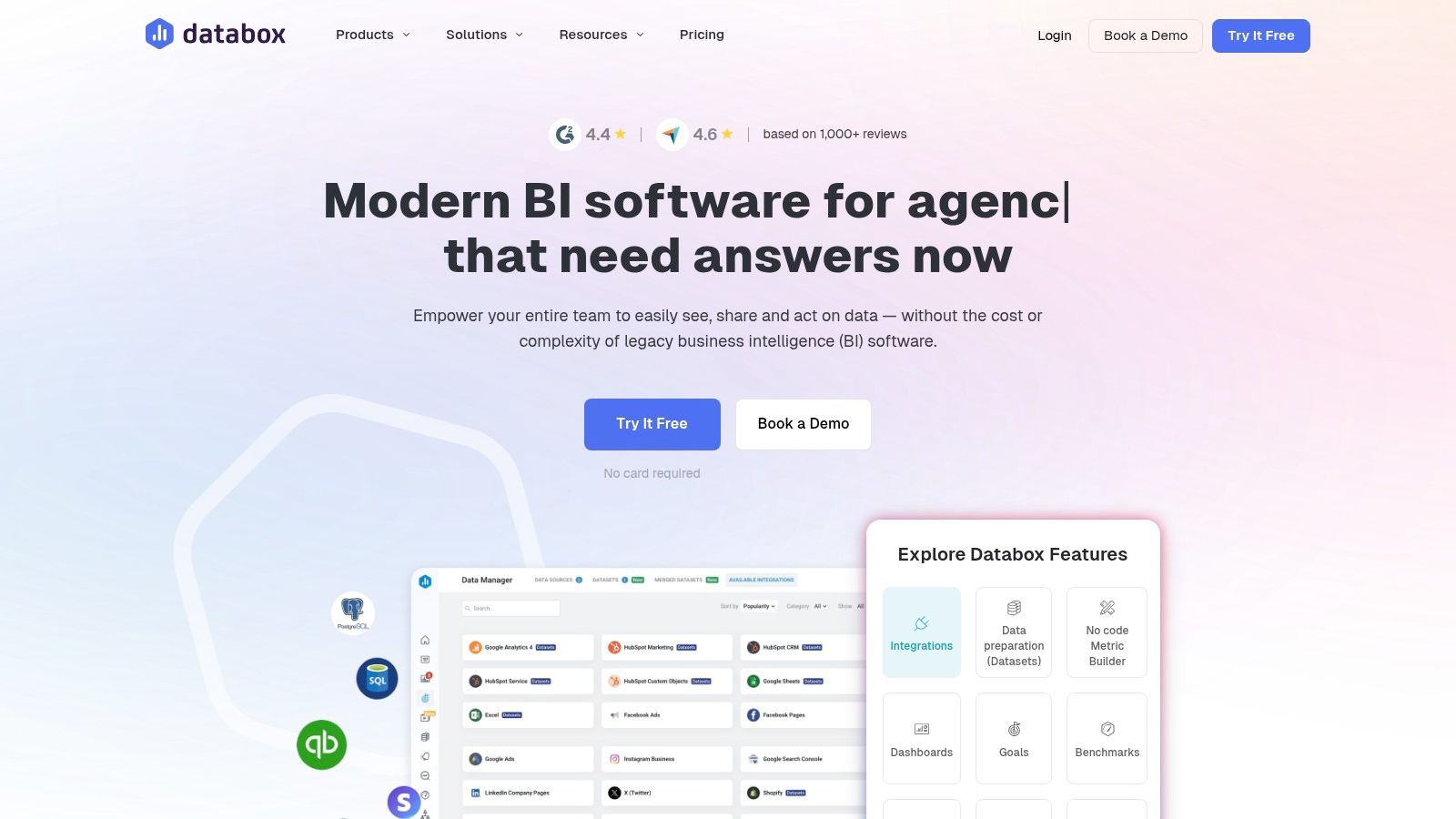
The platform is built with agencies in mind, featuring a dedicated partner program and comprehensive client account management capabilities. You can create templated dashboards and deploy them across multiple client accounts, saving significant setup time. With features like AI powered summaries and goal tracking, Databox helps translate raw data into business insights, automating an important part of the client communication process and allowing your team to focus on strategy rather than report creation. The tradeoff is that deeper branding and some agency niceties can raise total cost once you add advanced options, so it suits agencies that need cross-channel reporting breadth.
A Versatile Dashboard Tool for Agency Reporting
Pricing: Databox has moved to a fully paid model, with plans tiered based on the number of data source connections and users. White labeling and other advanced features are available as add ons to the core plans, allowing agencies to scale their investment as their client base grows.
- Key Features:
- 130+ native integrations with marketing, sales, and analytics platforms.
- Pre built report and dashboard templates for quick setup.
- AI powered summaries to generate report highlights automatically.
- Agency partner program with simplified client management.
- White label options including custom domains and branding.
- Automated alerts and performance benchmarks.
Agency Tip: Use Databox to create a "master marketing dashboard" for each client that combines top of funnel SEO metrics (organic traffic, keyword rankings from Semrush) with bottom of funnel business metrics (leads, conversions from HubSpot). This provides clients with a clear, full funnel view of how SEO efforts directly impact their business goals, demonstrating ROI far more effectively than a standalone SEO report.
Website: Databox
8. Whatagraph
Whatagraph excels at creating visually appealing, cross channel marketing reports with minimal friction. Designed for agencies that need to blend data from SEO, SEM, and social media, it streamlines the process of building client facing dashboards and documents. Its primary advantage is speed, you can use pre built templates and connect over 50 data sources to generate a polished report in minutes, making it one of the most efficient SEO reporting tools for agencies focused on multi channel campaigns.
The platform emphasizes ease of use and powerful white labeling capabilities. Agencies can set up custom branded client portals, automate report delivery, and give clients live access to dashboards. This self service approach empowers clients while reducing the administrative burden on your team. Whatagraph's focus on consolidating data from platforms like GA4, GSC, Google Ads, and Meta into a single view is ideal for demonstrating the overall impact of your marketing efforts.
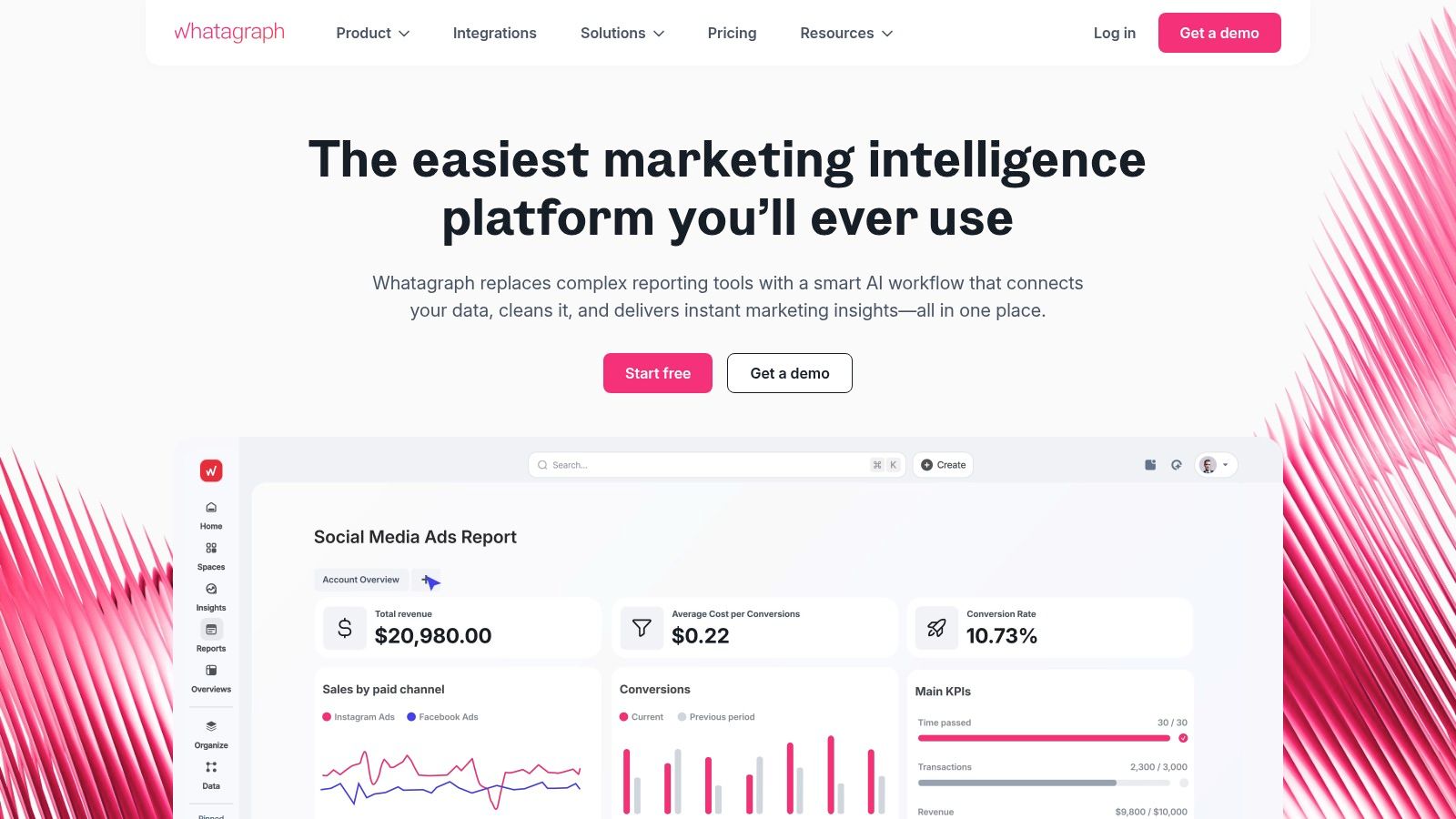
Cross Channel Reporting Software for Digital Agencies
Pricing: Whatagraph uses a custom pricing model based on the number of users and data sources. Plans are tiered to support freelancers, growing agencies, and large enterprises. Pricing is displayed in EUR, which is a consideration for US based buyers due to exchange rate fluctuations.
- Key Features:
- 50+ integrations, including GA4, GSC, Google Ads, Meta, and LinkedIn.
- Automated report scheduling and multi client management dashboards.
- Advanced white labeling with custom domains, colors, and logos.
- Live, shareable report links and client portals for easy access.
- AI powered narrative generation to assist with report summaries.
Agency Tip: Use the client portal feature to offer a premium, transparent reporting experience. Instead of just sending a static PDF, provide clients with a live, branded dashboard where they can track progress in real time. This not only improves client satisfaction but also reinforces the value your agency provides daily, not just at the end of the month. The platform’s reliable live chat support ensures any setup issues are resolved quickly. For teams building broader reporting packages around channel performance, it also helps to stay aligned with bigger market shifts outlined in SleekPost's guide.
Website: Whatagraph
9. DashThis
DashThis is a dashboard first reporting tool engineered for simplicity and speed. It stands out with a pricing model based on the number of dashboards rather than data sources or users, making it a predictable and scalable choice for growing agencies. Its core strength is turning complex marketing data into clean, easy to understand visual reports with minimal setup. For agencies needing to quickly create and automate client facing dashboards without a steep learning curve, DashThis is one of the most efficient SEO reporting tools for agencies available.
The platform excels at rapid deployment. You can connect to over 30 data sources, pull in key metrics, and have a client ready dashboard in minutes using pre built templates. This focus on ease of use and automation allows account managers to spend more time on strategy and less time on report assembly, streamlining the entire client communication process. The practical limitation is that agencies with highly custom reporting logic or complex data transformation needs may eventually want something more flexible, but for fast repeatable reporting DashThis is hard to beat.
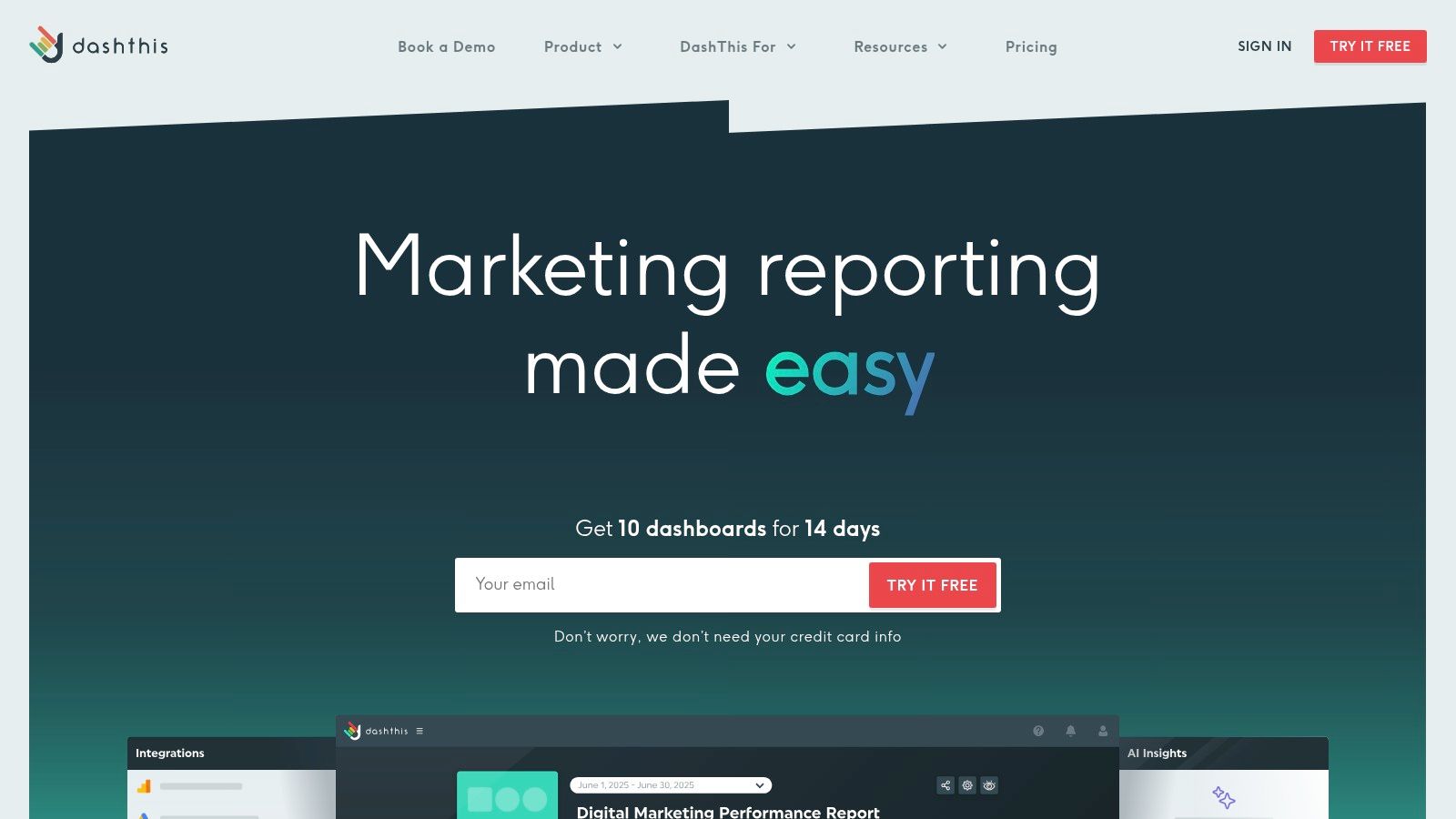
Streamlined Dashboard Software for Agency SEO Reports
Pricing: DashThis offers several tiers, starting from the Individual plan. Pricing is transparently based on the number of dashboards you need per month, with all plans including unlimited data sources and users. Full white labeling features are included in the Professional plan and higher tiers.
- Key Features:
- 30+ native integrations including GA4, GSC, Google Ads, and major social media platforms.
- Unlimited users and data sources on all plans.
- Automated email dispatches and shareable report links.
- Pre built report templates and the ability to clone dashboards for new clients.
- Full white labeling options, including custom domains and email addresses.
Agency Tip: Use the report cloning feature to standardize your agency's reporting framework. Create a master SEO report template that includes all your core KPIs from GSC and GA4. When you onboard a new client, clone the template, connect their data sources, and have a branded report ready in under five minutes. This ensures consistency and saves dozens of hours per month.
Website: DashThis
10. BrightLocal
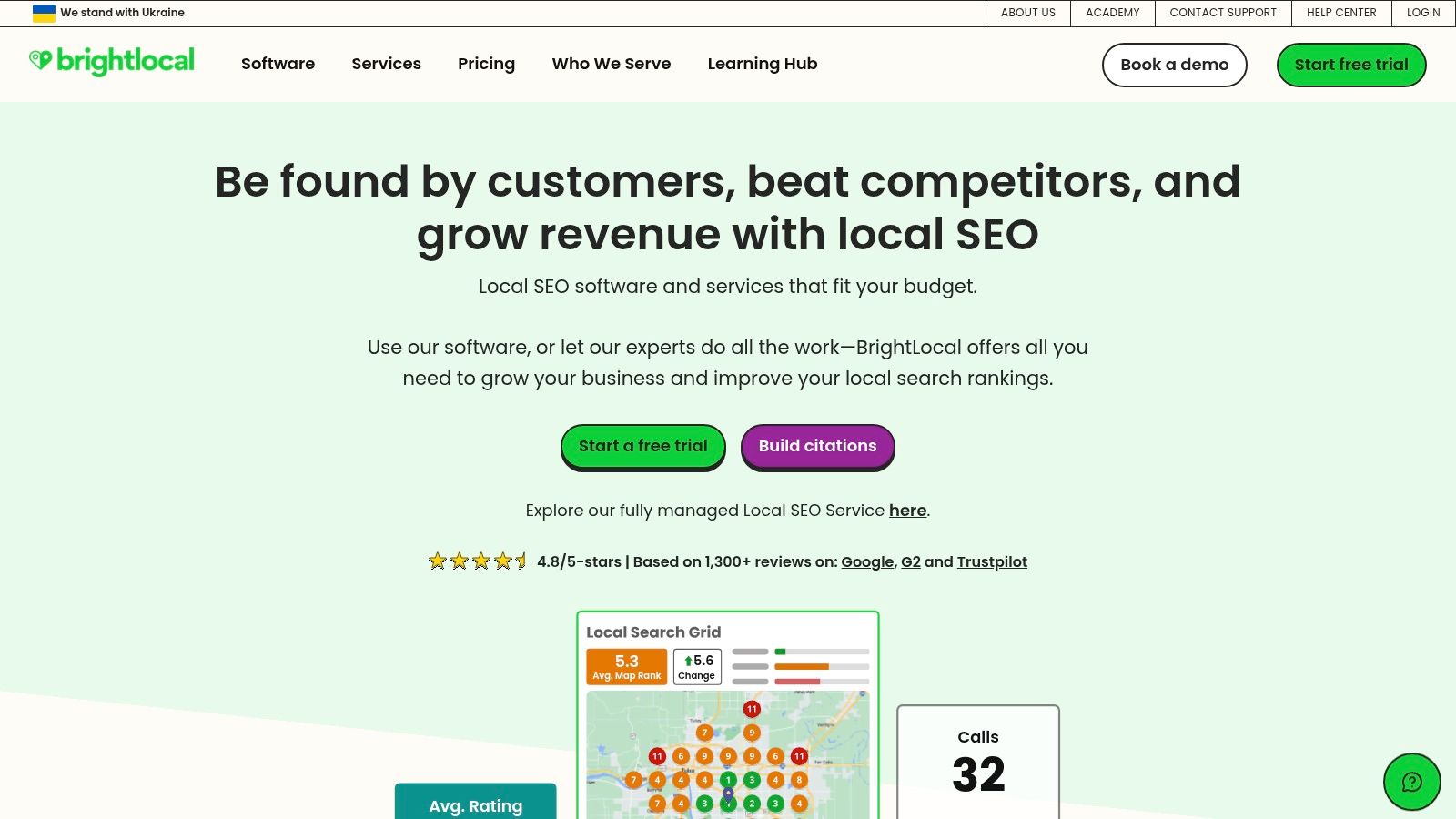
For agencies managing clients with physical locations, BrightLocal is an indispensable platform specializing in local SEO. It consolidates all the critical data points for local search performance, from Google Business Profile insights to citation accuracy and review management. Its primary strength lies in its purpose built design, with each tool focused on the specific challenges of multi-location businesses, making it one of the most effective SEO reporting tools for agencies focused on the local market. It streamlines everything from rank tracking in specific zip codes to executing citation building campaigns on demand.
The platform allows you to create detailed white label reports that clearly demonstrate value to clients whose success is tied to foot traffic and local online visibility. Instead of patching together data from various generic SEO tools, BrightLocal provides a unified dashboard that tells a clear story about a business's local digital footprint. This focused approach saves significant time and gives clients metrics that directly correlate with local business growth.
The Top Local SEO Reporting Tool for Agencies
Pricing: BrightLocal's pricing is location based, with plans scaling according to the number of clients you manage. There are also separate credits or pay as you go options for services like the Citation Builder, offering flexibility without long term commitments for one off projects.
- Key Features:
- Local rank tracking, local search grid, and Google Business Profile reporting.
- On demand Citation Builder and data aggregator submission services.
- Comprehensive review monitoring and management tools.
- Local SEO audit tools to quickly identify opportunities.
- Fully customizable white label reports and multi location dashboards.
Agency Tip: Use the Local Search Grid feature in your monthly reports to visually demonstrate to clients exactly where they rank in their service area, block by block. This tangible proof of progress is far more impactful than a simple average ranking number and clearly justifies the investment in local SEO. The platform's on demand citation service is also perfect for new client onboarding to quickly clean up and build foundational local signals.
Website: BrightLocal
11. Swydo
Swydo carves out a niche as a reporting and monitoring platform built for scalability. Its core appeal for agencies is the transparent, volume based pricing model tied to data sources, not users or reports. This makes it a cost effective solution for growing teams that need to provide unlimited access without worrying about per seat license fees. It’s positioned as a dedicated reporting layer, excelling at aggregating data from key marketing channels into clean, automated client facing dashboards and reports.
The platform emphasizes efficiency and reliability, offering strong automation features, report delivery health checks, and KPI alerts to keep account managers ahead of performance changes. While it doesn't have the deep, native SEO research tools of an all in one suite, its ability to import data from Google Sheets and create custom metrics allows for significant flexibility. For agencies prioritizing a pure, powerful, and predictable reporting engine, Swydo is one of the most practical SEO reporting tools for agencies available. The catch is that you need your SEO data sources figured out elsewhere first, which makes Swydo better as a reporting layer than as a central SEO operating system.
Scalable Client Reporting Software for SEO Agencies
Pricing: Swydo offers a simple, scalable pricing model based on the number of data sources connected. All plans include unlimited users, reports, and dashboards, making it financially predictable as your team grows.
- Key Features:
- 30+ integrations with major marketing platforms.
- Google Sheets import and custom metric creation.
- AI powered report summaries to speed up narrative writing.
- Client KPI tracking with automated email alerts for performance shifts.
- Fully white labeled client portals with custom domains.
Agency Tip: Leverage the client portal and custom domain feature to create a branded, self service analytics hub for each client. Set up custom KPI alerts to notify both your team and the client of significant ranking drops or traffic surges. This proactive communication builds trust and demonstrates value beyond the standard monthly report, turning your reporting platform into a real time performance monitor.
Website: Swydo
12. NinjaCat
For larger agencies managing high client volumes and complex data ecosystems, NinjaCat stands out as an enterprise grade reporting and data platform. It is engineered for scale, moving beyond simple report generation to offer a centralized marketing Data Cloud. This approach allows agencies to ingest, govern, and warehouse data from numerous sources, making it a leading seo reporting tool for agencies focused on data governance and security. Its core strength is automating template driven reporting at a massive scale, ensuring consistency and efficiency across hundreds of client accounts.
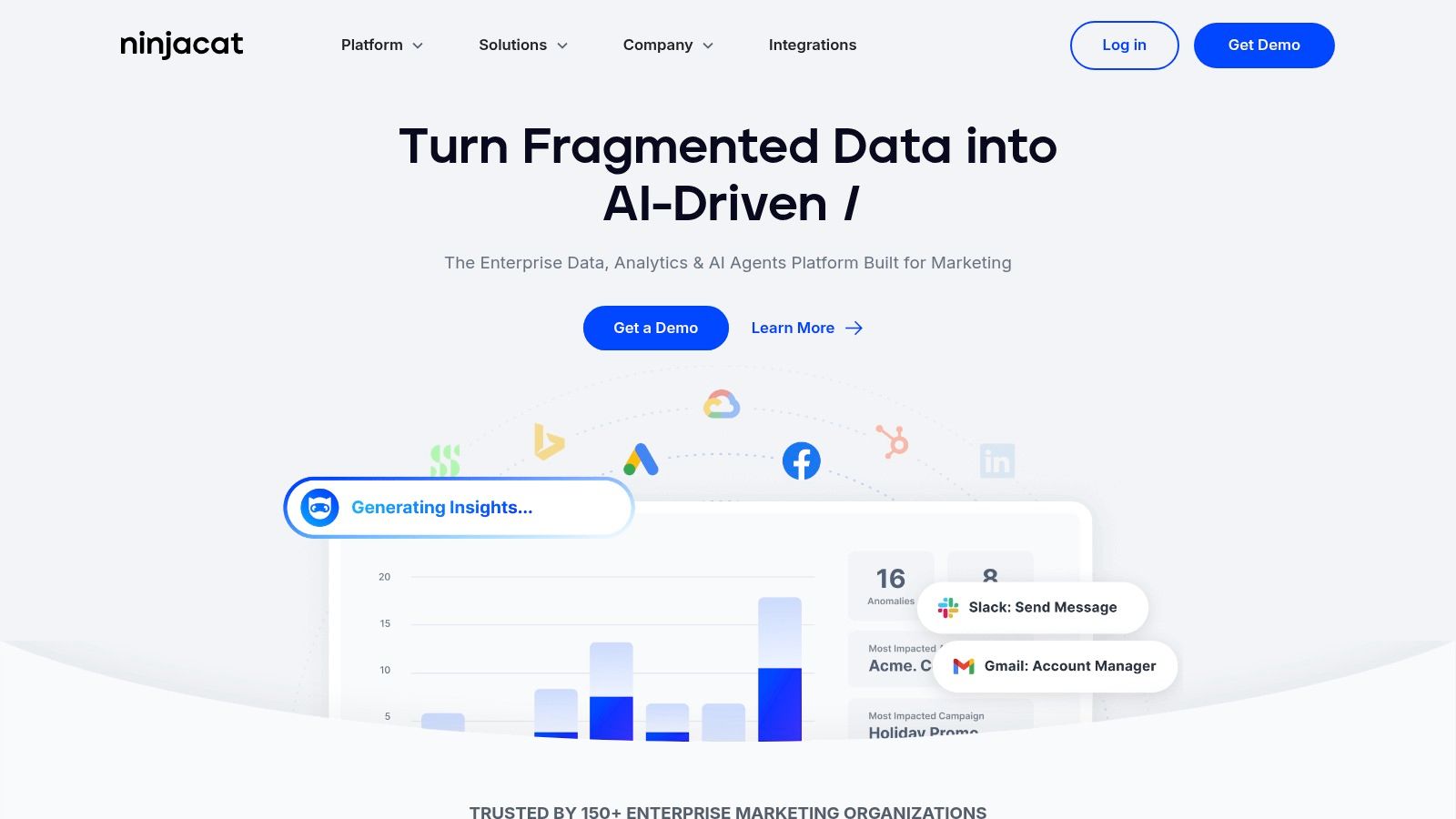
The platform is built to handle the security and compliance needs of enterprise clients, offering features like SSO and advanced data governance. NinjaCat's AI Insights Generator adds narrative context to data heavy reports, helping to translate complex metrics into understandable client facing stories. While its extensive capabilities are powerful, they come with a higher barrier to entry compared to self serve tools, requiring a sales assisted onboarding process. In short, this is a better fit for established agencies with mature operations than for smaller firms looking for a quick self-serve rollout.
An Enterprise Reporting Platform for Large Agencies
Pricing: NinjaCat does not offer public self serve pricing. Access is provided through custom quotes and a sales assisted onboarding process designed for the agency's specific needs and scale. This model is typical for enterprise level software.
- Key Features:
- Centralized marketing Data Cloud with governed models and warehouse options.
- Automated, template driven reporting and dashboards designed for high volume use.
- AI Insights Generator to create narrative context for reports.
- Extensive connectors for SEO stacks with cost aware API usage management.
- Enterprise grade security features, including SSO options.
Agency Tip: Leverage NinjaCat’s template system to establish a standardized reporting framework across all your SEO clients. Create a master template with core KPIs and then use its customization features to add client specific goals and metrics. This ensures brand consistency and operational efficiency, freeing up your team to focus on strategic analysis rather than report creation. It is ideal for agencies that need to enforce strict data governance and reporting standards.
Website: NinjaCat
Comparing the Top SEO Reporting Software for Agencies
Choosing the right tool requires balancing features, target audience, and cost. This table provides a high level comparison to help you quickly identify the best fit for your agency's unique needs, from AI search visibility tracking to traditional all in one SEO management.
| Tool | Primary Focus | Best For | Key Integrations | White Labeling |
|---|---|---|---|---|
| Riff Analytics | AI Search & Citation Visibility | Agencies pioneering generative SEO services. | Tracks 8+ AI Engines | Yes |
| Semrush | All in one SEO Platform | Agencies already using the Semrush ecosystem. | GA4, GSC, Google Ads | Yes (Add on) |
| AgencyAnalytics | Agency Specific Reporting | Scaling agencies needing a central dashboard. | 80+ (Ahrefs, Moz, etc.) | Yes |
| SE Ranking | All in one SEO (Value) | Growing agencies needing a cost effective suite. | GA4, GSC, Looker Studio | Yes |
| Whatagraph | Cross Channel Visual Reports | Agencies managing multi channel campaigns. | 50+ (Social, PPC, etc.) | Yes |
| Databox | Business Intelligence Dashboard | Agencies needing to unify all marketing data. | 130+ (CRM, SEO, etc.) | Yes (Add on) |
For pure white-label client reporting, AgencyAnalytics, Whatagraph, and DashThis are usually the easiest fits. AgencyAnalytics is the most agency-native of the group, especially if you want a client portal and multi-client controls built into the core experience. Whatagraph produces the most presentation-ready cross-channel reporting for agencies that need SEO, paid, and social in one polished package. DashThis is the simpler operational choice for smaller teams that want predictable pricing and fast report cloning. The tradeoff is that some white-label depth across this category is tied to higher plans or custom pricing, so agencies should confirm exactly which branding features are included before committing.
If your team already runs campaigns inside an all-in-one SEO suite, Semrush and SE Ranking make more sense than adding a separate reporting product too early. Semrush is best when you want reporting tightly connected to its research and audit stack, but its fullest agency features are not all included at base price. SE Ranking is often the better value option for growing teams, especially if you want one platform for rankings, audits, competitor tracking, and client reporting. Ahrefs belongs in this conversation too, but mostly as a data engine feeding external dashboards rather than as a complete out-of-the-box agency reporting environment.
For AI-powered reporting, the field splits again. Many tools now offer AI-written summaries, which can save account managers time but do not change reporting strategy. Riff Analytics is different because it reports on AI search visibility itself, not just narrative generation. BrightLocal remains the best specialized option for local SEO agencies, while NinjaCat is the stronger fit for enterprise reporting, where security, governed data models, and scale matter more than self-serve simplicity. Smaller agencies usually get more value from speed and clarity, while larger agencies benefit more from customization, governance, and deeper connector infrastructure.
Summary: Choosing Your Agency's Next SEO Reporting Tool
The easiest way to narrow this market is to match the tool to your agency model rather than chase a single winner.
- AI-search-forward agencies: Pick Riff Analytics if you want to report on answer share, AI citations, and source visibility instead of stopping at traditional rankings.
- Agencies that need strong white-label portals: Pick AgencyAnalytics for the most agency-centric client reporting workflow and scalable portal experience.
- Budget-conscious growing agencies: Pick SE Ranking if you want one platform that covers core SEO operations and reporting without enterprise pricing.
- Local SEO agencies: Pick BrightLocal when GBP reporting, local grids, citations, and reviews are central to client retention.
- Cross-channel performance agencies: Pick Whatagraph or Databox if your client reporting needs to connect SEO with paid, social, CRM, and revenue metrics.
- Enterprise teams and large agency groups: Pick NinjaCat when governance, scale, and templated reporting infrastructure outweigh the need for a fast self-serve setup.
What changed in 2026 is that buyers are no longer evaluating reporting tools on scheduled PDFs alone. Agencies now need AI summaries that save time without hallucinating context, citation and source visibility for AI search reporting, client portal experiences that feel polished enough to replace recurring email requests, and first-party data integrations that connect SEO work to leads, conversions, and revenue. That is why modern agency reporting software has shifted from static rank reporting to consolidated performance dashboards and automated white-label delivery.
If you need a practical shortlist process, do this over one week. On day one, define your non-negotiables: white-label depth, required integrations, budget ceiling, and client volume. On days two and three, shortlist three tools based on your agency type. On day four, build the same sample client report in each one. On day five, compare how much manual cleanup each report still needs before it is client-ready. On day six, test client-facing elements like portals, branded links, and scheduled delivery. On day seven, make the final choice based on which tool saves the most recurring work while producing the clearest story for clients.
When evaluating options, it can be beneficial to explore resources that list various Marketing SaaS companies, as many SEO reporting solutions fall under this broader category. This can provide a wider perspective on available technologies.
Frequently Asked Questions
What should be included in an agency SEO report?
An agency SEO report should include key performance indicators (KPIs) like organic traffic growth, keyword ranking improvements (especially for target terms), conversion rates from organic search, and backlink acquisition. For 2025 and beyond, it is also critical to include metrics on AI search visibility, such as brand mentions and citations in generative AI answers.
How do I create a white label SEO report?
Most dedicated SEO reporting tools for agencies, such as AgencyAnalytics, Whatagraph, and DashThis, offer comprehensive white labeling features. This typically involves uploading your agency's logo, using a custom color scheme, and sometimes even hosting the report on a custom domain. This creates a professional, branded experience for your clients.
Why is AI search visibility important for SEO reporting in 2026?
As more users turn to AI engines like Google's AI Overviews and Perplexity for answers, appearing in these results is important for brand discovery and authority. Reporting on "answer share" and tracking which sources AI models cite (LLM tracking) demonstrates a forward looking strategy. It proves your agency is adapting to changes in user behavior and positioning clients for future success beyond traditional SERPs.
Can I automate my agency's client reporting process?
Yes, automation is a primary benefit of using modern SEO reporting software. Platforms like Semrush, Swydo, and AgencyAnalytics allow you to build report templates, connect data sources, and schedule them for automatic generation and delivery (e.g., the first Monday of every month). This saves countless hours and ensures consistent, timely communication.