A Guide to Answer Engine Optimization
Updated December 2, 2025
Answer engine optimization is the practice of creating and structuring your content so that AI models like ChatGPT, Perplexity, and Google's Gemini trust it, use it, and cite it as a source. In a world where search is shifting from a list of links to a direct conversation, this is how your brand stays visible. By 2026, mastering this approach will be the foundation of any successful digital strategy, ensuring your expertise is featured directly in the AI generated answers users receive.
What Is Answer Engine Optimization and Why It Matters

Imagine a search engine that doesn't just give you a list of websites to sift through but instead provides a single, synthesized answer. That world is already here, and answer engine optimization (AEO) is the playbook for it. We are witnessing a fundamental shift from users 'searching for websites' to 'asking for answers.' Traditional SEO was a race to the top of a ranked list. AEO is about becoming the trusted source an AI uses to build its answer in the first place. This distinction is critical for future success. If you want to dig deeper, we break it down in our guide comparing AI SEO vs. traditional SEO.
Understanding the New Goal of Generative SEO
The heart of answer engine optimization is becoming citable. AI tools are designed to find, combine, and present the most credible information they can find online. When your content is well structured, factually sound, and clearly sourced, you send a powerful signal to these models: you are an authority worth trusting. This makes your information far more likely to be woven into a generated response, putting your brand at the center of the new conversational search. It is a close cousin to what some call Generative Engine Optimization (GEO), where the goal is not just to attract traffic but to shape the answer itself.
The Inevitable Rise of AI Answers
This is not some far off prediction. Research from Gartner suggests that by 2026, search engine volume will drop by 25%, with the traffic shifting to AI chatbots and other virtual assistants. AEO is not here to replace SEO. It is the next critical evolution of it. It forces you to focus on the signals that build trust with an AI, such as factual accuracy, structured content, and clear sourcing. When you prioritize these elements, you are preparing your content to be found, understood, and featured by the next generation of search. This is how you future proof your brand.
How Answer Engines Find and Synthesize Information
Let's pull back the curtain on how AI models like ChatGPT and Gemini actually come up with their answers. Think of a Large Language Model (LLM) as the world's most efficient research assistant with access to a near infinite digital library. It doesn’t “think” like a human. Instead, it reads, synthesizes, and presents information at incredible speed, pulling from the most credible sources it can find online. By 2026, understanding this process will be table stakes for any serious digital strategy. This new reality brings a much higher risk of "zero click" interactions, where a user gets what they need from the AI and never bothers to visit your website.
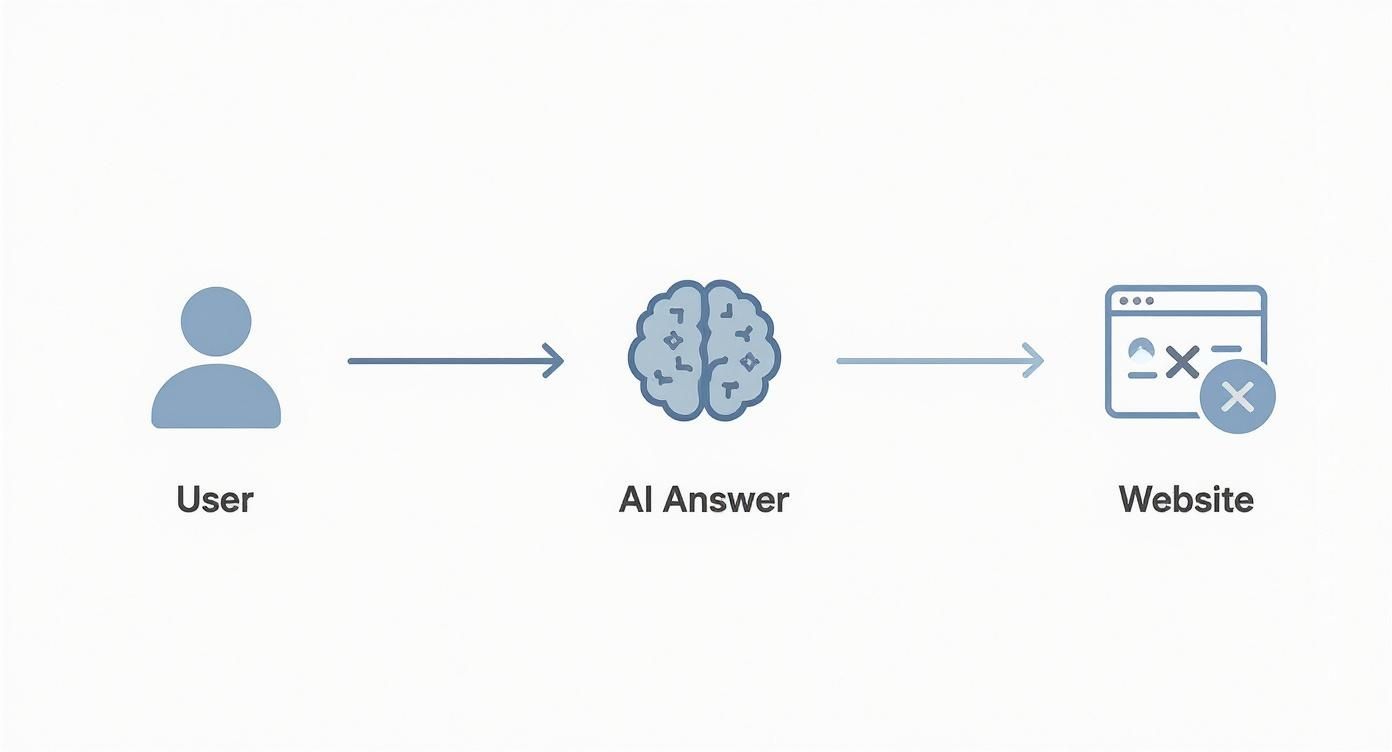
As you can see, the user’s journey can end with the AI, which makes getting cited directly in the answer more valuable than ever.
The Key Signals for Answer Engine Optimization Success
So, what signals do these AI models look for when deciding which sources to trust and cite? While the algorithms are a black box, they consistently favor content that is verifiable, authoritative, and easy for a machine to understand. The AI is always looking for the most reliable building blocks to construct its answers. For what we now call generative SEO, the focus shifts from gaming a ranking algorithm to feeding a synthesis algorithm.
How AI Search Differs from Traditional SEO
The core difference is the final product. Traditional SEO is a race to become the best link on a long list. Answer engine optimization is a competition to become the source material for a definitive answer. This demands a fundamental shift in how we create and structure our content. As one recent guide put it, "AEO goes a step further by positioning content as the definitive answer to specific questions." This means you have to anticipate what users will ask and provide a concise, direct answer upfront, backing it up with supporting details.
| Feature | Traditional SEO | Answer Engine Optimization (AEO) |
|---|---|---|
| Primary Goal | Achieve top ranking for a target keyword. | Become a cited source in a generated answer. |
| Content Focus | Long form, keyword optimized pages. | Factual, well structured, and easily citable information. |
| Technical Focus | Site speed, mobile friendliness, crawlability. | Schema markup, structured data, clear attribution. |
| Measurement | Organic traffic, click through rate, bounce rate. | LLM tracking, share of citation, brand mentions. |
Ultimately, AEO just demands a higher standard. You have to create content that isn’t just discoverable but is truly worthy of being cited by an AI.
How to Create Content That AI Search Engines Cite

Getting your content cited by AI engines isn't about chasing algorithms. It’s about building a library of verifiable, authoritative information that a machine can easily understand and trust. By 2026, the brands that win will be the ones who master creating content for AI consumption, prioritizing clarity, accuracy, and structure over old school keyword tactics. The playbook for AI search visibility is surprisingly practical. It boils down to using content formats that AI models like ChatGPT and Perplexity are built to extract and synthesize.
Choosing Content Formats for Optimal Answer Engine Performance
Some content types are naturally better suited for answer engine optimization because they are structured and factual. AI models are trained to parse these formats with incredible efficiency to find direct answers. To dramatically improve your chances of being cited, focus on creating comprehensive guides, original research and data reports, and detailed how to articles. This approach lines up perfectly with the principles of E-E-A-T (Experience, Expertise, Authoritativeness, Trustworthiness). To learn how to blend these new tactics with what you're already doing, check out our guide on how to integrate AI SEO with existing SEO workflows.
Structuring Your Content for AI Prompts and Visibility
Beyond just picking the right format, the way you structure the content itself is critical. Your goal is to make it simple for a machine to understand context and pull out key facts. A great place to start is by putting a concise summary or a direct answer right at the top of your article. This "answer first" approach caters directly to how both humans and AI scan for information. The market has already proven this works. Recent data shows a 145 fold jump in referral traffic from ChatGPT since mid 2024, showing that clear, citable content gets rewarded.
The Technical Framework for AEO Content Strategy
Technical signals provide the scaffolding that helps AI interpret your content with precision. While a clean site architecture and fast load times still matter, structured data is the most important technical element for generative SEO. Structured data, or Schema markup, is code you add to your site to give search engines explicit information about what your content is. It acts like a set of clear labels. For AEO, the most impactful types of schema include FAQPage, HowTo, and Article. Implementing these helps AI systems parse your information correctly, which seriously increases the odds it will be used in a generated answer. As AI powered answers become the norm, understanding optimizing for voice search is also a key piece of the puzzle.
Measuring Success in Your Answer Engine Optimization Efforts
How do you know if your answer engine optimization strategy is actually working? If you're still just watching organic traffic and keyword rankings, you're only seeing half the picture. Success in 2026 and beyond depends on a new scoreboard built for the age of AI answers. The old model was simple: rank higher, get more clicks. But that model shatters the moment an AI gives the user a direct answer. Your new goal isn’t just to earn a click. It's to become a cited source and shape the AI's response. That means we need new ways to measure visibility and impact.
Rethinking KPIs for Generative SEO and AI Visibility
The single most important new metric is share of citation, sometimes called "answer share." This KPI tells you how often your brand is credited as a source in AI generated answers for your core topics. It's a direct reflection of your authority and visibility inside platforms like ChatGPT, Perplexity, and Google's AI Overviews. Another critical piece of the puzzle is LLM tracking. This goes way beyond spotting brand mentions. It’s about monitoring how large language models interpret and use your content. For a deeper dive, check out our complete guide to building an AI SEO analytics stack.
Valuing Qualified Traffic from Answer Engines
While "zero click" searches are a real concern, any traffic you do get from an answer engine citation is pure gold. These aren't people starting a search from scratch. They've already seen the AI summarize your expertise and are clicking through with a specific purpose in mind. According to a recent industry study, traffic from AI citations can convert at rates 12 to 18% higher than traditional organic search traffic. This proves the value of reaching a pre qualified audience. You can dig into more data that proves why answer engine optimization is crucial.
A Practical Workflow for Measuring AEO
Tracking these new metrics demands a different toolkit and a fresh workflow. Following an updated workflow makes it far easier to build a powerful business case for AEO and show a tangible return on investment.
| Aspect | Traditional SEO Workflow | Modern AEO Workflow |
|---|---|---|
| Primary Tools | Google Analytics, SEMrush, Ahrefs | Riff Analytics, Perplexity, Manual AI Prompts |
| Core Metrics | Keyword Rankings, Organic Traffic, CTR | Share of Citation, Contextual Mentions, Brand Sentiment |
| Reporting Focus | Page performance and click volume. | Brand authority and influence on AI answers. |
| Success Signal | A #1 ranking on a SERP. | Being the primary cited source in an AI response. |
Measuring success with AEO means shifting your focus from clicks and traffic to citations and influence.
Your AEO Strategy Checklist and Next Steps
Let's move from theory to action. This is the part that really matters, turning everything we've talked about into a tangible plan. By 2026, having a clear answer engine optimization playbook won't just be an advantage; it will be essential for survival. This checklist boils down the core principles into a framework you can start using today. Your immediate job is to make your content so factually reliable that AI models have no choice but to cite it. Start with your most important pages. Audit them for accuracy and clarity, making sure every single claim is verifiable and backed by solid evidence. This is the foundation of trust in generative SEO.
A Framework for Boosting Your AI Search Visibility
Once your content is rock solid, it's time to focus on the technical and structural signals that help AI systems parse your information. This is how you deliberately turn your website into a trusted resource. You can't improve what you don't measure. Use a tool like Riff Analytics to start monitoring your "share of citation" for the topics you care about most. Get your content creators up to speed. Teach them how to write for AI citation, focusing on clarity, directness, and evidence. Remember, answer engine optimization doesn't replace your existing SEO work. It enhances it.
Summary and Frequently Asked Questions
Answer engine optimization is about becoming the trusted source for AI generated answers. Success is no longer measured in clicks alone but in share of citation, brand authority, and the quality of traffic you receive. By focusing on factual accuracy, structured content, and clear expertise, you can position your brand to win in the new era of conversational search.
What is the difference between AEO and traditional SEO?
Traditional SEO aims to rank high in a list of links to earn clicks. AEO aims to become the cited source material within an AI generated answer itself. It prioritizes authority and clarity to influence the answer, not just attract a click.
How can a small business improve its answer engine optimization?
Small businesses can compete by focusing on niche expertise. Create highly accurate, well structured content that answers specific questions better than larger, more generic competitors. AEO rewards the best answer, not always the biggest brand.
What tools are essential for answer engine optimization?
You need specialized tools for LLM tracking and question research. Platforms like Riff Analytics monitor your share of citation in AI answers, while tools like AnswerThePublic help you find the conversational questions people are actually asking.
Will answer engine optimization replace SEO?
No, it builds upon it. Strong technical SEO, domain authority, and high quality content are still essential prerequisites. AEO is the next layer of strategy that ensures this foundation is prepared for AI driven search engines.
Ready to stop guessing and start winning your answer share? Riff Analytics is the AI visibility platform that shows you exactly how often you're being cited in ChatGPT, Perplexity, and Google AI Overviews. Audit your site, track competitors, and get the data you need to dominate the new era of search. Start your free trial at https://riffanalytics.ai.