A Modern Guide to Share of Voice Calculation (2025 Update)
Updated December 1, 2025

What is share of voice? In simple terms, it's your brand’s visibility compared to competitors. Think of it as your slice of the conversation pie in your market. As we head into 2025 and 2026, a precise share of voice calculation is no longer a simple marketing metric. It has evolved into a critical benchmark for gauging your influence across traditional search, social media, and the new landscape of AI-driven answers. A strong calculation shows you where you stand and whether your marketing efforts are truly making an impact.
Understanding the Share of Voice Calculation in a New Era
In a world of fragmented digital channels and AI search, understanding your Share of Voice (SOV) is more critical than ever. It's not just a vanity metric; it’s a powerful indicator of your market penetration and a predictor of future growth. A brand dominating the SOV in organic search for key topics can influence buying decisions long before a customer even thinks about a specific product. This is why we need to get practical with the calculation. If your brand's visibility is low, it’s a direct signal to reassess your strategy, whether that involves content creation, paid media, or social engagement.

The Core SOV Calculation Formula
At its heart, the basic formula for Share of Voice is a simple ratio, usually expressed as a percentage. It represents your brand's presence relative to the competition within a defined channel.
(Your Brand's Metrics ÷ Total Market Metrics) × 100
For example, if your brand gets 500 social media mentions in a month and your three main competitors get a combined 1,000, your total market mentions are 1,500. Your SOV is (500 / 1,500) x 100, which equals 33.33%. This simple yet powerful formula can be adapted to all sorts of channels, from organic search impressions to PPC clicks.
Why This Metric Matters for Your 2026 Share of Voice
Looking ahead, a clear share of voice calculation will only become more important, especially with the rise of new discovery platforms. Generative SEO and tracking your brand inside LLM answers are becoming essential parts of a modern visibility strategy. We're already seeing that brands actively monitoring their presence in AI generated answers are better positioned to capture emerging audiences. This evolution requires a more sophisticated approach. While we're focused on Share of Voice, a related concept gaining traction is Share of Visibility, which aims to measure your presence across all digital channels combined. To dive deeper into this modern challenge, our guide on AI brand visibility explained offers crucial insights.
How to Collect Data for Your Share of Voice Calculation
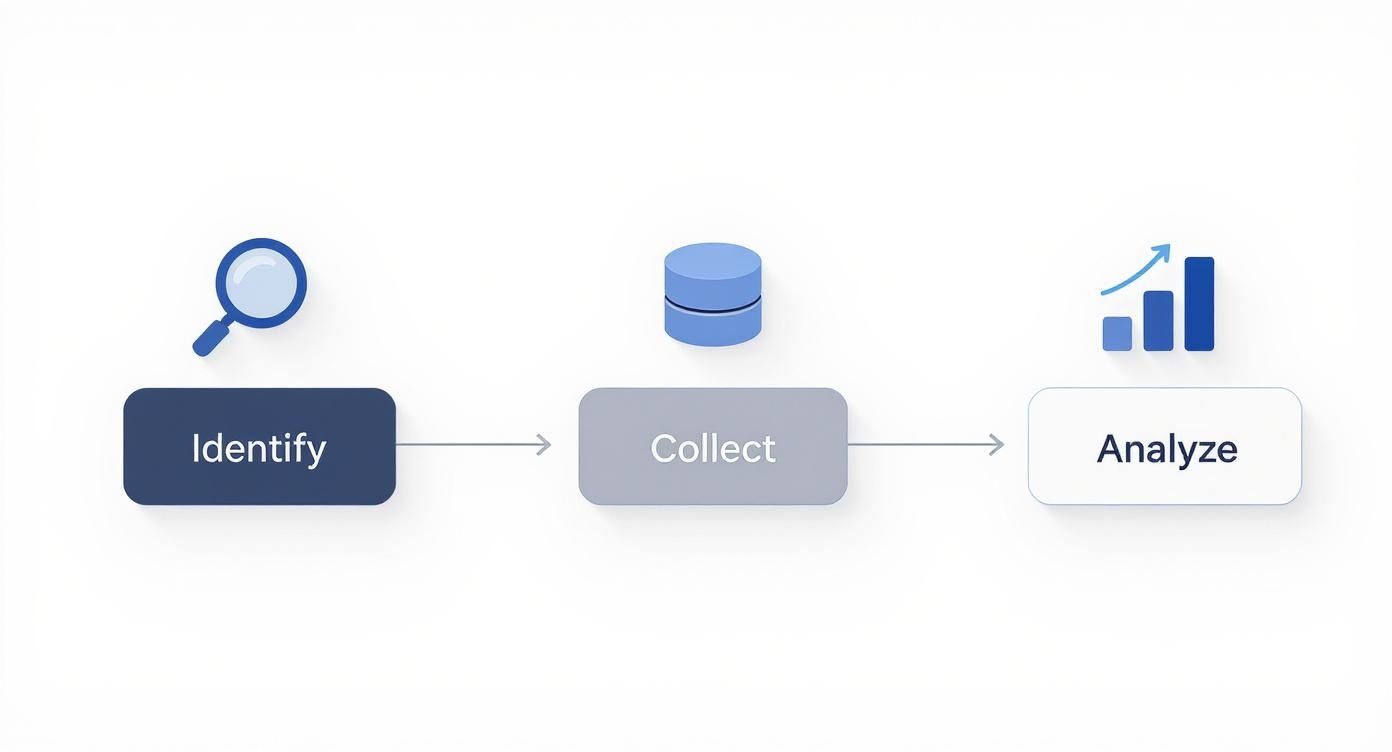
An accurate Share of Voice calculation starts with the right ingredients. Before you can measure anything, you need solid, reliable data that actually reflects how people find things today. This goes way beyond old school metrics like ad spend or counting simple social media shout outs. To get a true picture of your visibility in 2025, you have to focus on what's driving discovery now. That means organic search performance, sure, but it also includes your brand's footprint in the new world of generative AI search. The goal isn't to boil the ocean; it's to be strategic and collect the data that makes your final calculation genuinely insightful.
Defining Metrics for Your Organic Search Calculation
For organic search, Share of Voice is all about how often you show up in search results compared to your rivals. The foundational data points here are impressions and click through rates across a shared set of high value keywords. Earning a higher share of organic impressions for keywords with real search volume is a powerful indicator of market authority. According to Meltwater, a leading media intelligence platform, measuring SOV in organic search involves looking at "how often you appear in search engine results pages (SERPs) compared to competitors." This data shows you exactly which keyword battles you're winning and where competitors have an edge. It gives you a clear roadmap for your content and SEO work, pointing to the specific topics where you need to build more authority.
Expanding Your Data Sources for a Modern SOV Calculation
A complete Share of Voice calculation now has to account for visibility across a much wider set of channels. This includes social media conversations, media mentions in online publications, and the new frontier of AI search visibility. To pull this all together, you'll need a mix of tools, including some of the many free social listening tools available. On top of that, LLM tracking is quickly becoming non negotiable. Monitoring your presence in AI generated answers is critical for any forward looking strategy. We have a whole guide on this, which you can find here: how to monitor brand mentions in ChatGPT and Perplexity.
A Step by Step Guide to Performing a Share of Voice Calculation
Alright, you've gathered your data. Now comes the fun part: turning those raw numbers into a clear percentage that shows exactly where you stand. This is where the share of voice calculation moves from a data gathering chore to a strategic look at your market presence. The core formula is simple, but the metrics you plug into it will change depending on the channel you’re focused on, whether that's social media, PPC, or organic search. The key is to apply the formula consistently so you can start to see what your results are telling you about your brand’s position.
Executing the Organic Search SOV Calculation
For most brands in 2025, organic search is the main event. In the digital world, share of voice is increasingly tied to who owns the search results for the most valuable keywords. It’s a pretty straightforward calculation. For instance, if your website brings in 15,000 organic searches a month for your target keywords and the total market search volume for those terms is 100,000, your organic search share of voice is 15%. But remember, not all keywords are created equal. Ranking number one for a keyword with 10,000 monthly searches is a world away from topping the results for a term with only 100. This is why weighting your calculations by search volume is so important. The folks at Brandwatch have some great insights on these weighted visibility calculations.
Calculating Share of Voice for Social Media and PPC
The same basic formula works just as well on other channels. On social media, you’re usually tracking brand mentions. Let's say your brand was mentioned 500 times this month. Your top competitors, combined, were mentioned 2,000 times. Your total market is 2,500 mentions. Your SOV would be:
(500 / 2,500) x 100 = 20%
For PPC, it’s even easier. The metric you need is Impression Share, a figure you can pull directly from platforms like Google Ads. It tells you the percentage of times your ads were shown out of the total eligible impressions, giving you a crystal clear measure of your paid visibility.
A Comparative Table for SOV Calculation Workflows
The metrics and tools you'll use depend heavily on the channel. Each one tells a slightly different part of your brand's story. This table breaks down the essentials for each workflow.
| Channel | Primary Metric | Common Data Sources | Example Tools |
|---|---|---|---|
| Organic Search | Impression Share, Click Share | Google Search Console, SEO Platforms | SEMrush, Ahrefs |
| Social Media | Brand Mentions, Hashtag Usage | Social Media Platforms, Listening Tools | Brandwatch, Talkwalker |
| PPC | Impression Share | Google Ads, Microsoft Advertising | Native Platform Reports |
| AI Search | Mentions in LLM Responses | Manual Prompts, AI Visibility Platforms | Riff Analytics, BrightEdge |
As you can see, the game has changed. A modern SOV measurement absolutely has to account for mentions in generative AI answers. To get ahead of this curve, check out our list of the top 10 AI brand visibility tools for 2025.
Turning Your Share of Voice Calculation Into Strategy
Getting your Share of Voice percentage is just the start. The real magic happens when you turn that number into a strategic weapon. The raw figure tells you where you stand, but the story behind that number shows you exactly where to go next. Think of your SOV metrics as a roadmap. A low score isn't a failure; it's a bright, flashing light showing you where to focus your marketing efforts. A high score isn't just a reason to celebrate; it’s a clear signal of what’s working, giving you a strength to lean into even harder.

Analyzing the Nuances of Your SOV Calculation
To make your SOV truly strategic, you have to segment the data. A single, top level percentage can be dangerously misleading. You need to break down your share of voice calculation by different variables to uncover the real story. For example, imagine a competitor has a massive overall SOV. Before you panic, look closer. What if 70% of their mentions are from furious customers complaining about terrible service? Suddenly, their dominance looks less like a threat and more like a golden opportunity for you to highlight your stellar customer support. This kind of advanced analysis helps you decode competitors' strategies and spot market trends before they become mainstream. You can learn more about the future of share of voice measurement on Britopian.com.
Connecting SOV Calculation Insights to Marketing Actions
Every SOV scenario demands a specific response. Your goal should be to create a playbook that links common findings from your share of voice calculation to concrete marketing actions. This turns SOV from a passive report card into an active tool for making better choices. To make this practical, here’s a table that connects common SOV findings with actionable strategies.
| SOV Finding | Potential Implication | Recommended Action |
|---|---|---|
| High Social SOV, Low SEO SOV | You generate buzz but lack a sustainable search presence. | Repurpose top social posts into evergreen blog content targeting core keywords. |
| Competitor Dominates a New Topic | A rival is making a calculated play for a new market segment. | Analyze their content and create a superior, more comprehensive asset to win back traffic. |
| High SOV but Low Engagement | People talk about you, but not with you. Your message isn't resonating. | Shift from broadcasting to engaging. Run a poll, host a Q&A, and reply to comments. |
This table is just a starting point. By using your share of voice calculation to drive these kinds of decisions, you move beyond just measuring your position and start actively shaping it.
Common Mistakes in Share of Voice Calculation
Getting an accurate Share of Voice calculation can feel like a superpower. It gives you a clear, honest view of the competitive landscape. But even experienced marketers fall into simple traps that skew the data, leading to flawed strategies and wasted resources. Avoiding these common pitfalls is the key to creating a reliable metric you can actually build a strategy on. The most frequent error? Obsessing over the raw number of mentions while completely ignoring the sentiment and context behind them. A true share of voice calculation must differentiate between positive, neutral, and negative conversations.
Using an Inaccurate Competitor Set in Your Calculation
Your calculation is only as good as the competitor list you build. Tracking only your two largest rivals will give you a dangerously inflated sense of security, blinding you to a smaller startup that’s quietly stealing market share. Conversely, comparing your local business to global giants will produce a discouragingly tiny SOV that offers no practical insights. A much better approach is to maintain two distinct lists: direct competitors and emerging competitors. Reviewing and updating these lists quarterly ensures your analysis stays relevant.
Ignoring Channel Specific Context and LLM Tracking
Another classic mistake is applying a one size fits all approach across different channels. A mention on a highly respected industry news site carries far more weight than a fleeting comment on social media. Similarly, visibility in AI search and LLM tracking requires completely different metrics than traditional organic search. According to the media intelligence experts at Meltwater, "Share of voice measurement is a great place to start as you ramp up your digital marketing. It gives you a better idea of where you stand in the market and can help you set the right goals moving forward." To get this right, you need to create a weighted system that assigns more value to high impact mentions. This ensures you're making fair comparisons and not letting low quality chatter drown out the signals that truly matter.
Summary and Final FAQs About Share of Voice
Calculating your share of voice is a straightforward process once you've defined your channels, competitors, and key metrics. The most important thing is consistency. Regular measurement is what gives you the trend data you need to track progress and react to what your competitors are doing. With your first SOV percentage in hand, you're ready to dig into the story behind the number and turn that insight into a real strategy.
Frequently Asked Questions
How does share of voice calculation differ for B2B vs B2C brands? For B2B brands, the calculation often focuses on niche industry keywords, trade publications, and professional networks like LinkedIn. For B2C, the scope is broader, tracking high volume consumer keywords, social media trends across platforms like TikTok and Instagram, and mainstream media mentions.
What is a good share of voice percentage to aim for in 2025? There is no single magic number. A "good" SOV is relative to your market size and goals. A market leader might aim for 40% or more, while a new challenger brand could see 10% as a major victory. A more useful goal is to achieve "excess share of voice" (eSOV), where your SOV is higher than your market share, as this often predicts future growth.
How do I factor generative SEO and AI search into my SOV calculation? This requires what is now called LLM tracking. You must monitor how often your brand appears in answers from AI engines like ChatGPT and Perplexity for your key queries. The calculation is your brand's total mentions divided by the total competitor mentions for a specific set of prompts, adding a critical layer to modern visibility analysis.
How often should I perform a share of voice calculation? For most industries, a monthly calculation provides a good balance, allowing you to track campaign impact and competitor moves. For very stable B2B markets, a quarterly check in may be sufficient. The key is consistency to ensure data is comparable over time.
Ready to master your brand's visibility in the new era of AI search? Riff Analytics tracks your mentions across every major AI engine, showing you exactly where you stand and how to win more answer share. Start your free trial today and get your first AI visibility report in minutes. Find out more at https://riffanalytics.ai.