How to Do Competitive Analysis in SEO to Outrank Your Rivals in 2026
Updated December 8, 2025

An SEO competitive analysis is the process of identifying your search engine rivals and systematically dissecting their strategies to find opportunities for your own brand. In simple terms, you figure out what's working for them in Google, why it's working, and how you can do it better. As we head into 2025 and 2026, with AI Overviews and generative search reshaping the landscape, this process is no longer just a best practice; it is a fundamental requirement for survival and growth.
When done right, the insights from a thorough competitive review become your most powerful strategic advantage, turning guesswork into a clear, data driven action plan.
Why a Strong SEO Competitor Analysis Is Your Secret Weapon
Let's be honest, doing SEO in a crowded market can feel like you're operating blindfolded. A solid competitive analysis is what takes that blindfold off. This is not about just copying your rivals. It's about reverse engineering their success to build a smarter, more resilient strategy that anticipates market shifts.
To really nail this, it helps to start by understanding the broader concept of comparative analysis, which is the strategic foundation for all of this. It helps you spot opportunities your competitors have completely missed while also defending your turf from up and comers.
In an era where AI search visibility and generative SEO are flipping the script, knowing your competition is more critical than ever. A proper analysis shows you more than just what keywords they rank for. It reveals why they rank, giving you the kind of insight that lets you make confident decisions.
Your Path to Outranking Rivals with SEO Analysis
The core of any successful SEO competitor analysis is a simple, repeatable process. First, you identify who you are really up against. Then, you dissect their entire digital footprint. Finally, you build a concrete plan to outperform them. This systematic approach keeps you focused on actions that actually move the needle.
This visual breaks down the essential workflow into three clear stages.
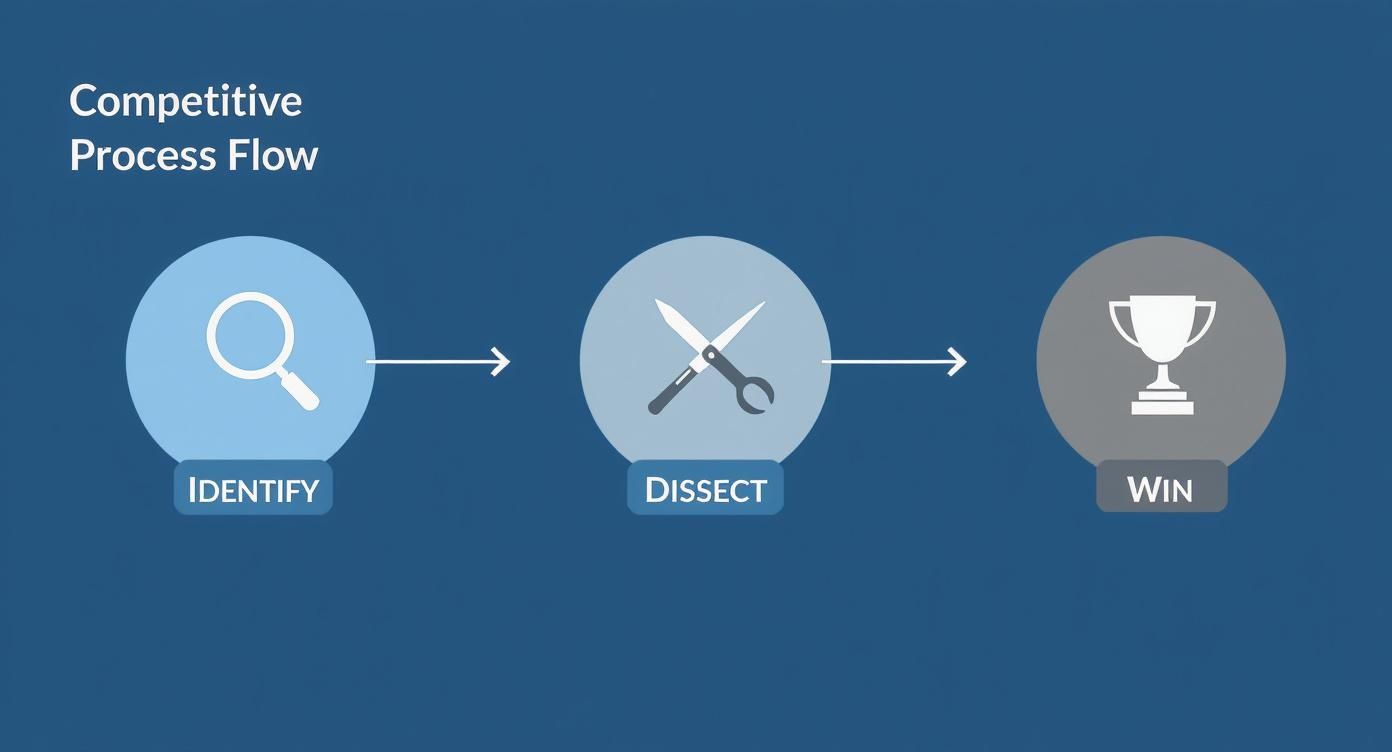
Ultimately, this three stage process turns a mountain of raw data into a clear, actionable game plan for winning in search. By seeing exactly how your competitors built their visibility, you can pinpoint the tactics you need to improve your own. This can be anything from finding gaps in their content to calculating your market presence. To get a handle on that, check out our guide on how Share of Voice calculation provides a clear benchmark of where you stand.
This guide will walk you through a practical framework, moving you beyond surface level metrics and turning competitor intelligence into real, tangible growth.
Identifying Your True SEO Competitors
Before you dive into any analysis, you have to answer one simple question: who are you actually up against? The answer is almost never who you think it is. Your biggest business rival might not be your biggest problem in the search results. A solid SEO competitive analysis depends entirely on identifying the right players. This usually means a mix of your direct business rivals and a bunch of websites you have probably never even heard of.
Differentiating Direct Competitors from SERP Competitors
The key is to know the difference between your direct competitors and your SERP competitors. Direct competitors are easy. They sell the same stuff you do. If you sell running shoes, they sell running shoes. Simple.
SERP competitors, on the other hand, are any domain, blog, or publication that ranks for the keywords you want, no matter what they sell. For example, a small e commerce shop selling handmade leather bags might assume its competitors are other bag makers. But when they check the rankings for a query like "how to care for leather," they'll find the top spots are owned by a high authority lifestyle blog or a major publication like GQ. Ignoring these SERP competitors is a huge mistake.
A Process for Uncovering Your Real SEO Competition
Okay, so how do you move beyond assumptions and find these competitors with data? Start by brainstorming a list of your most valuable "money" keywords. These are the search terms people use when they're close to making a decision. Think beyond just your product names and get into the head of your customer. What problems are they trying to solve?
Once you have a seed list, it is time to let the tools do the heavy lifting. Platforms like Ahrefs or Semrush are perfect for this. Pop in your domain and look at their "Competing Domains" report. This will give you a quick, data backed list of websites that rank for a similar set of keywords.
How to Categorize Your SEO Competitors for Analysis
To keep your analysis organized, it helps to categorize the competitors you find. This clarifies where you should focus and what you should be looking for. Your list will likely fall into three main groups:
- Direct Competitors: The obvious rivals selling similar products or services to the same audience.
- Indirect Competitors: They solve the same customer problem but with a totally different solution. A meal kit delivery service, for example, is an indirect competitor to a local grocery store.
- SERP Competitors: The broad category of anyone ranking for your target keywords. This includes media sites, affiliate blogs, forums, and even informational hubs like Wikipedia.
The battle for attention online is brutal. With organic search driving nearly 53% of all website traffic, getting seen is everything. It's even more intense when you realize the top three organic results get around 68.7% of all clicks. Finding the right competitors is the very first step toward claiming a piece of that traffic. You can dig into more of these numbers in these SEO statistics on AIOSEO.
To make this practical, use a simple framework to guide your analysis for each competitor type.
| Competitor Type | Primary Goal | Your Action Plan |
|---|---|---|
| Direct Competitors | Track product keywords, pricing pages, and bottom of funnel content. | Analyze their entire sales funnel and look for conversion optimization tactics you can borrow. |
| Indirect Competitors | Monitor broader, problem aware keywords and informational content. | Identify audience pain points they address that you might be completely ignoring. |
| SERP Competitors | Analyze their top ranking content, backlink sources, and on page SEO. | Reverse engineer their content strategy to build something far more comprehensive and valuable. |
With a clear, categorized list, you are ready to move from just identifying competitors to actually analyzing them. This foundational work ensures the rest of your efforts are focused, strategic, and far more likely to get results.
A Guide to Analyzing Competitor Content and Keywords

Once you know who you are up against, the real investigation begins. This is where you dig for gold, analyzing what your competitors are creating and which keywords they're winning. This process, often called a keyword gap analysis, is fundamental to any competitive SEO strategy. It’s about more than just finding a list of terms; it’s about reverse engineering your rival’s content playbook to find opportunities they have missed or topics they've only scratched the surface of.
How to Pinpoint Keyword Gaps in Your Competitor's SEO
The first practical step is to plug your domain and your top two or three competitors into an SEO tool. The goal is to generate a list of keywords where they rank on page one, but your site is either nowhere to be found or is languishing on page three or beyond. This process immediately flags content opportunities. For example, a project management software company might discover a competitor ranks highly for "best Gantt chart templates" while they have no content on the topic at all. That is a crystal clear signal to create a resource that addresses that user need.
Performing a Content Audit for a Deeper SEO Analysis
Just finding keyword gaps is not enough. You also need to perform a qualitative content audit to understand why your competitors are succeeding. Go beyond a simple list of terms and examine the types of content they produce, its depth, and its on page optimization tactics.
Ask yourself these critical questions:
- What content formats are they using? Are they leaning on long form blog posts, creating free tools, producing video tutorials, or publishing original research?
- How deep is their content? Are their articles comprehensive guides, or are they ranking with shorter, more focused pieces?
- What’s their on page strategy? Look at their use of headings, internal linking, and structured data to see how they are signaling relevance to search engines.
Understanding these details is everything. According to HubSpot, content exceeding 2,500 words often generates the most organic traffic and backlinks, reinforcing the need to analyze not just what topics competitors cover, but how comprehensively they cover them.
Evaluating Competitor Visibility in AI Search Engines
As we move further into 2026, a crucial new layer of analysis involves AI search visibility. Generative SEO and Large Language Model (LLM) tracking are becoming standard practice. It’s no longer just about traditional rankings; it’s about who is being cited in Google's AI Overviews and other answer engines. When analyzing your competitor’s content, check if their articles are being used as sources in AI generated answers for your target queries. This indicates their content is seen as authoritative, clear, and factually accurate by these new systems.
Platforms like Riff Analytics are designed specifically for this, showing you where you and your competitors are being mentioned in LLM responses. You can also explore our guide on other SEO benchmarking tools to expand your toolkit. By understanding their entire content playbook, from keyword selection to AI citations, you can identify their weak spots and build a superior content strategy.
Auditing Competitor Backlinks and Technical SEO Performance
Great content is the price of entry, but it’s only half the game. Authority and technical performance are what separate content that exists from content that wins. This is exactly why you have to dig into your competitor’s backlink profile and technical setup. Authority, which is mostly built through backlinks, is how search engines measure trust. A strong backlink profile can push an average piece of content right past a superior one. At the same time, a technically clean website gives users and search engine crawlers a smooth ride, which directly helps rankings.
How to Unpack a Competitor’s Backlink Profile
When you dive into a competitor's backlinks, you are looking for quality, not just a big number. A site with a thousand junky links is almost always weaker than one with a hundred editorially earned links from respected industry sources. The goal here is to reverse engineer their link building strategy to create a better one for yourself.
Start by looking at the authority of the domains linking to them. Tools like Ahrefs and Moz offer metrics like Domain Rating (DR) or Domain Authority (DA) that give you a quick estimate of a site’s clout. It's critical to understand how to check backlink quality to gauge their actual influence.
A study by Backlinko found that the number one result in Google has an average of 3.8x more backlinks than positions 2 through 10. This shows a direct line between a solid backlink profile and top rankings, making this analysis a must do.
A Technical SEO Analysis of Your Competitors
A competitor’s technical performance can hide some massive opportunities. A technically shaky website, no matter how amazing its content, is like a race car with flat tires. By spotting these flaws, you can get ahead just by making sure your own site runs like a well oiled machine.
The first place I always look is site speed. Page load time is a confirmed ranking factor. Use Google's PageSpeed Insights to check their key pages against the Core Web Vitals. If their site is a slowpoke, especially on mobile, you have a clear shot to win by delivering a faster, better user experience.
Then, investigate their use of structured data or schema markup. Structured data is what helps search engines really understand your content, and it’s the key to getting those eye catching rich snippets in the search results. If they are not using it, you can make your own listings pop by implementing it properly. Don't forget to look at their site architecture and internal linking. A messy site is a golden opportunity for you to win with a clean, user friendly structure.
Using AI for a Smarter SEO Competitive Analysis
Let's be honest: manual data crunching is a dead end. The future of competitive analysis is not about working harder; it is about working smarter and faster with AI. By 2026, this won't be an edge; it will be the standard for any serious SEO workflow. This is about automating the tedious work to uncover insights that were previously buried too deep to find, allowing us to predict where the market is headed next.

Performing an AI-Enhanced Competitor Review
An AI driven workflow kicks off by automatically crawling competitor sites and scraping the SERPs. From there, it can instantly cluster thousands of competitor keywords by user intent, telling you if a rival is chasing informational eyeballs or transactional wallets. This is how you analyze topical depth and content quality at scale.
Over 86% of SEOs have already brought AI into their day to day work. A solid 60% are using tools like ChatGPT to brainstorm content and build killer content briefs directly from competitor data. You can find more insights on applying AI in SEO over at Single Grain.
Leveraging AI for Content and Trend Analysis
One of the best uses for AI right now is generating data backed content briefs. Instead of spending hours manually picking apart the top ranking pages, AI can synthesize their structures, key topics, and FAQs into a single, comprehensive outline for your writers.
According to HubSpot's 2024 State of AI report, 43% of marketers say their top use case for generative AI is creating content. This shows a clear trend toward using AI not just for analysis, but for direct content production based on that analysis. This process ensures your content is engineered from the start to be more helpful and thorough than anything your competitors have published.
LLM Tracking and Generative SEO Analysis
The game changed with AI Overviews and other answer engines. LLM tracking is how we monitor this space. It is the practice of tracking how often and in what context your brand gets mentioned in responses from models like ChatGPT and Gemini compared to your competitors.
Platforms like our own, Riff Analytics, were built specifically for this. They help you measure your AI search visibility and pinpoint which sources the AI engines are citing as authoritative. If a competitor is constantly getting sourced for a key topic, you know exactly where you need to build more credibility. This kind of generative SEO analysis is absolutely critical for future proofing your strategy.
Comparing AI Analysis Workflows and Tools
There are a few ways to bake AI into your process, from simple prompts to full blown specialized platforms. The right approach really depends on your team's skills and budget.
| Workflow | Description | Primary Tools | Best For |
|---|---|---|---|
| Manual + Generative AI | Manually exporting data from tools like Ahrefs, then feeding it into an AI assistant for summary and analysis. | Ahrefs/Semrush + ChatGPT, Gemini | Small teams or anyone just dipping their toes into AI powered analysis. |
| Scripting & Automation | Using custom Python scripts to scrape data and automate analysis, often plugging the results into an internal dashboard. | Custom Scripts, Google Colab | Teams with developers who need highly specific, custom insights. |
| Specialized AI Platforms | Using dedicated tools built for AI search visibility, LLM tracking, and automated competitive intelligence. | Riff Analytics, SurferSEO | Teams laser focused on winning in AI search and scaling up their analysis. |
By weaving these AI powered methods into your work, your competitive analysis stops being a reactive, backward looking report and becomes a dynamic, forward looking strategy engine.
Building Your Actionable SEO Game Plan
All the data in the world is useless without a clear plan. This is where we turn all those spreadsheets and notes into a prioritized roadmap that actually drives growth. The goal is to move from broad observations to specific, concrete tasks. We're going from "Competitor X has strong backlinks" to "Begin outreach to 10 high authority publications in the finance industry to build our domain authority." This is where the magic happens.
How to Prioritize SEO Opportunities from Your Analysis
To sidestep analysis paralysis, I always lean on a simple ‘impact versus effort’ model. This framework forces you to think strategically about where to invest your team's time and budget for the best possible return.
Just categorize your findings into a simple matrix:
- High Impact, Low Effort: These are your quick wins. Think optimizing an existing page for a keyword a competitor ranks for that you completely missed. Jump on these immediately.
- High Impact, High Effort: These are the big, strategic projects. We're talking about building out a massive guide to fill a huge content gap or launching a targeted link building campaign from scratch.
- Low Impact, Low Effort: Nice to haves. Knock these out when you have a bit of downtime.
- Low Impact, High Effort: Avoid these like the plague. They're resource drains that won't move the needle.
Creating Your SEO Competitor Analysis Action Plan
Your final output needs to be a clean, documented plan. This is what ensures your analysis translates directly into better search visibility. For a deeper look at tracking your progress, check out our guide on creating a keyword rankings and visibility report.
Here’s a simple structure I use to keep everyone organized and accountable:
| Action Item | Area of Focus | Priority (Impact/Effort) | Owner | Deadline |
|---|---|---|---|---|
| Create a guide on "generative SEO" | Content Gap | High/High | Content Team | Q3 |
| Fix broken internal links | Technical SEO | High/Low | SEO Manager | Next Sprint |
| Implement FAQ schema on service pages | Technical SEO | High/Low | Dev Team | Next Sprint |
| Target links from industry blogs | Backlink Gap | High/High | Outreach Team | Q3 |
Summary and Final Thoughts on Your SEO Competitor Analysis
A successful SEO competitive analysis is a systematic process of identifying your true search rivals, dissecting their content and backlink strategies, and auditing their technical performance. By leveraging SEO tools and emerging AI platforms, you can uncover keyword gaps, content opportunities, and technical weaknesses. The ultimate goal is to transform this mountain of data into a prioritized action plan based on an impact versus effort model. This turns your analysis from a simple research project into a dynamic, ongoing strategy that drives tangible growth and helps you outrank the competition in a constantly evolving search landscape.
Frequently Asked Questions
1. How do I start an SEO competitive analysis if I'm a beginner? Begin by identifying 3 to 5 direct business competitors. Use free tools like Google Search in incognito mode to see who ranks for your main product or service keywords. Then, focus on one area first, such as analyzing their top 10 blog posts to understand what topics resonate in your industry.
2. What are the most important metrics to track in a competitive analysis? Focus on a few key metrics to avoid overwhelm: organic keywords they rank for that you do not, the number and quality of their referring domains (backlinks), their Domain Authority or Domain Rating score, and their site speed via Google's PageSpeed Insights.
3. How does competitive analysis change with AI search and SGE? The focus expands from just ranking in the top 10 blue links to being cited as an authoritative source within AI Overviews. This means your analysis must now include LLM tracking to see which competitors are being featured in AI generated answers and why their content is considered factual and trustworthy by these systems.
4. How often should you perform a competitor analysis in SEO? Conduct a comprehensive deep dive analysis annually to set your overarching strategy. Follow this with quarterly check ins to monitor shifts in competitor tactics, track new content, and spot emerging keyword trends. For highly competitive niches, a monthly review of your top 3 rivals is recommended.