A Guide to Perplexity AI SEO: How to Get Cited in 2026
Updated December 16, 2025
What is Perplexity AI SEO? In simple terms, it's the practice of optimizing your content to be so clear, factual, and authoritative that Perplexity cites your website as a source in its direct answers. As we look toward 2025 and 2026, this is no longer a niche tactic but a core component of digital strategy. Instead of just ranking in a list of links, the goal is to become part of the AI's synthesized knowledge, establishing your brand as a primary source of truth.
This shift moves beyond traditional keyword rankings to a new era of AI search visibility. The focus is on proving your authority, factual accuracy, and clarity to algorithms. The ultimate prize? Ensuring your brand’s expertise is woven directly into AI powered search results and gaining highly qualified traffic from users seeking deeper information.
Welcome to the New Era of AI Search

Imagine asking a complex question and receiving a single, consolidated answer immediately. There is no need to sift through pages of blue links. Instead, you get a clean summary, complete with citations showing exactly where the information originated. That is the reality of AI answer engines like Perplexity, and it’s a fundamental change in how people find information. The objective isn't just to be number one on Google anymore; it's to become a cited authority inside the AI's answer. This guide will show you how to do just that.
The Growing Importance of Perplexity AI SEO
This is not a distant trend. The explosive growth of platforms like Perplexity is reshaping user expectations right now. According to DemandSage, Perplexity’s monthly visits skyrocketed to over 75 million by early 2024, with users spending an average of over 16 minutes per session. This high engagement signals a clear shift in information consumption. Businesses that fail to adapt to this new paradigm of generative SEO risk becoming invisible. To keep up, many are turning to specialized AI SEO services to navigate this new landscape.
Comparing Traditional vs. AI Search Engine Optimization
The fundamental difference lies in the output. Google provides a map of potential destinations (a list of links), while Perplexity delivers the destination itself (a direct answer). This distinction demands a completely new approach to content and measurement. Success in 2026 and beyond hinges on creating content that AI models trust enough to cite.
| Feature | Traditional Search Engine (Google) | AI Answer Engine (Perplexity) |
|---|---|---|
| Primary Goal | Drive clicks to a website from a ranked list of links. | Provide a direct, synthesized answer with source citations. |
| User Interaction | User clicks through multiple sources to find information. | User receives an immediate, consolidated summary. |
| Key Metric | Organic traffic, keyword rankings, click through rate. | Citation frequency, brand mentions, answer share. |
| Content Focus | Broad keyword targeting and on page optimization. | Factual accuracy, data clarity, and entity authority. |
How Perplexity AI Changes the SEO Game
Think of Perplexity less like a search engine and more like an expert research assistant. It does the reading for you. It pulls the most important facts from various sources and synthesizes them into a single, cohesive answer, complete with neat citations pointing back to its sources. This "answer engine" model is what drives the new field of Answer Engine Optimization, a core part of modern AI search visibility.
A Perplexity SEO Strategy Focused on Factual Authority
In traditional SEO, content was built around keywords. For a Perplexity AI SEO strategy, the focus must shift to factual authority and data integrity. Perplexity's models are designed to find and weave together verifiable facts, hard numbers, and clear explanations from sources it deems credible. Content filled with vague statements and unsubstantiated claims will be ignored. The AI actively looks for pages that present information clearly, cite their own sources, and demonstrate real expertise. Your content needs to become the primary source of truth the AI can confidently reference.
The Citation Economy of AI Search Visibility
The most important difference with Perplexity is its reliance on citations. Every summarized answer comes with numbered links that point directly back to the web pages it used. This creates what is now known as the "citation economy," where the most valuable online real estate is a reference inside an AI generated answer. Being cited accomplishes two huge things: it directly attributes your brand’s expertise to the information, and it gives a highly engaged user a direct path to your website for a deeper dive. The entire process requires a new way of thinking about SEO.
The Real Impact of AI on Your SEO Metrics
For years, the purpose of SEO was simple: drive clicks. The rise of AI answer engines like Perplexity is turning that model upside down. This shift is fueling one of the biggest challenges for marketers in 2025 and 2026: the growing reality of "zero click searches." Users now get their answers synthesized for them on the platform, which drastically reduces the need to click through to a website. This is not the death of SEO, but a critical evolution. The new benchmark for performance is becoming the trusted source that powers the AI's answer.
Rethinking Traffic in the Age of Perplexity AI SEO
The most immediate consequence of this model is a potential drop in overall organic traffic. When an AI pulls information from several sources to create a single, neat answer, the user’s question is often solved without them ever visiting a single webpage. Instead of panicking about lower traffic numbers, the focus must shift to the quality and intent of the traffic you do get. A click from a Perplexity citation comes from a highly qualified user who is actively looking for more depth from a source the AI has already validated as credible.
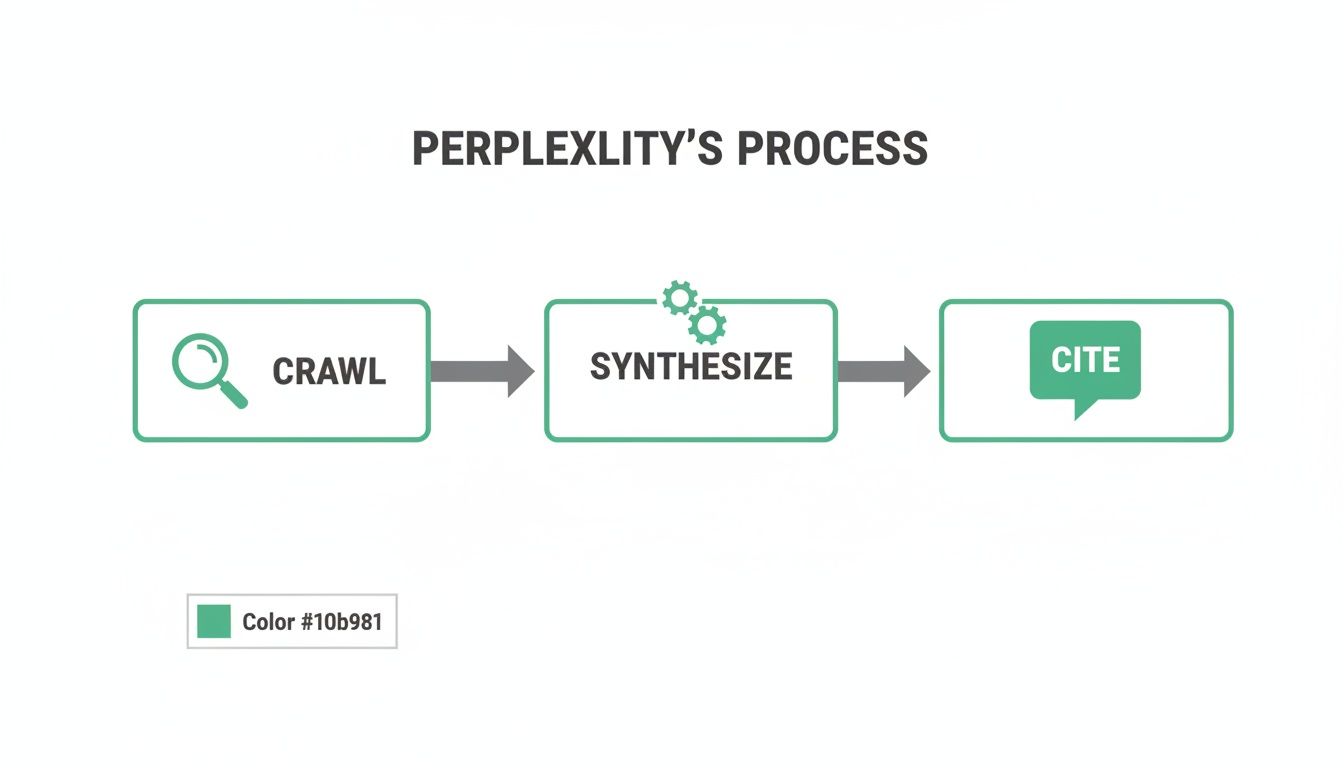
This three step process—crawl the web, synthesize information, and cite sources—is the engine driving this new SEO challenge. To win, your content must be optimized to stand out at every stage.
New Metrics for Optimizing Perplexity AI Visibility
If clicks and traffic are becoming less reliable, what should you measure instead? An effective Perplexity AI SEO strategy tracks a new set of metrics that reflect influence and authority inside the AI ecosystem. These KPIs should be on your new dashboard:
- Citation Frequency: How often is your domain cited as a source in Perplexity answers for your core topics?
- Brand Mentions: Is your brand name, product, or service mentioned directly in the AI's synthesized responses?
- Answer Share: For a given set of queries, what percentage of answers feature your content or brand?
These metrics provide a much clearer picture of your brand's authority in a world where direct answers are the new currency. This new form of LLM tracking is essential for success.
Creating Content That Perplexity AI Cites
Getting your brand featured as a trusted source in an AI generated answer is the new holy grail of SEO. In 2025 and 2026, the goal is to create content that Large Language Models (LLMs) find credible, accurate, and easy to understand. It’s a shift from just chasing keywords to building undeniable authority. Think of it as writing for a brilliant but very literal research assistant. To earn a citation, your content must be structured, factual, and completely unambiguous.
Optimizing Content for Perplexity AI Citations
When you’re optimizing for Perplexity AI SEO, factual accuracy is everything. LLMs are built to synthesize verifiable information, so pages filled with fluff or unsupported claims get tossed aside. Build your articles around hard data, statistics, and solid evidence. Content that uses structured formats like tables and bulleted lists to present data is far more likely to be understood and cited. An AI can easily pull a specific number from a well organized table, making your page a prime candidate for a citation.
Building Factual Authority for Generative SEO
Building strong entity authority is another critical piece of the puzzle. This means consistently producing high quality content on a specific topic until your brand becomes synonymous with that subject. You're building your digital reputation not just for people, but for algorithms. If you want your content to be cited by AI, you need to understand the best ways to get mentioned by AI in its responses. A natural, conversational tone also matters. AI models are trained on human language, so content that reads like a dry textbook is often less effective than clear, direct writing.
According to content strategists, the ideal format for AI consumption is "structured clarity." This means using short paragraphs, descriptive subheadings, and a logical flow to guide the AI through your key points, making your expertise impossible to misinterpret.
Comparing Content Structures for AI Visibility
How you structure your information can directly impact whether an LLM trusts and references your work. This table breaks down the difference between a traditional blog format and one optimized for generative SEO.
| Content Element | Traditional Blog Post Approach | AI Optimized Approach for Perplexity |
|---|---|---|
| Data Presentation | Data is often buried inside long paragraphs. | Data is laid out in clear tables or bullet points. |
| Headings | Creative, catchy headings are common. | Descriptive H2s and H3s act as mini summaries. |
| Language Style | Often uses marketing buzzwords and broad statements. | Uses precise, factual language with clear definitions. |
| Source Citing | Might link out occasionally for credibility. | Includes explicit internal and external source links. |
Adopting this AI first structure is a practical way to optimize both new and existing content. For more strategies, check out our guide on how to increase visibility in ChatGPT searches, since many of these principles apply across different AI platforms.
Technical SEO for AI Engine Discoverability
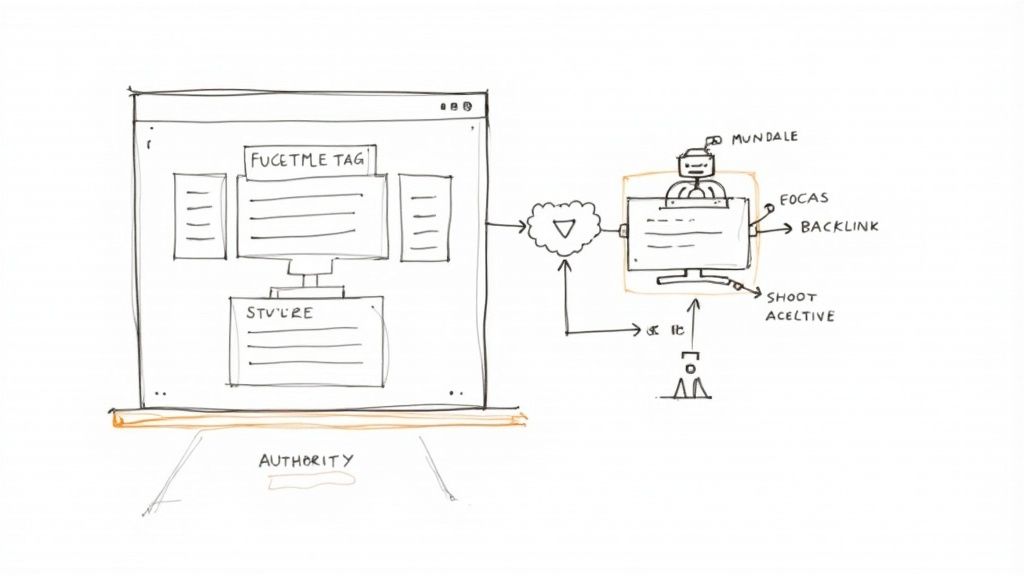
Creating great content is only half the battle. If AI engines like Perplexity cannot find, crawl, and make sense of your pages, all that effort goes to waste. Heading into 2025 and 2026, technical SEO is about giving AI crawlers a crystal clear, machine readable roadmap to your expertise. Foundational signals like site authority, a clean backlink profile, and strong Core Web Vitals are as critical as ever. These elements build the trust an AI engine needs before it considers your website a credible source.
Harnessing Structured Data for Perplexity AI SEO
Structured data, especially Schema markup, is one of the most powerful tools in your Perplexity AI SEO arsenal. It explicitly tells AI crawlers what each piece of information is: a product name, a price, a review, or an author's name. By adding this layer of context, you remove all guesswork for the AI. This makes it incredibly easy for Perplexity to pull accurate facts and figures from your pages, dramatically increasing the odds your data gets used in a generated answer. You are essentially spoon feeding the AI the exact information you want it to see.
The Lasting Role of Website Authority and Backlinks
While Schema clarifies what's on your page, your site’s overall authority sends a broader signal of trust. AI engines, just like Google, rely on signals of credibility. A strong profile of backlinks from other reputable websites in your niche is a massive vote of confidence.
According to a study on LLM behavior, models are often trained to associate high authority domains—those with strong backlink profiles and established expertise—with more reliable information, influencing their source selection process.
This means old school link building and digital PR are still hugely important for generative SEO. The goal isn't just to get links, but to earn high quality links that reinforce your topical expertise.
Adapting Workflows for AI Answer Engine SEO
The rise of AI search means we need to shift our technical priorities. SEO teams now need to fold new tasks into their routines to optimize for machine readability and factual extraction.
| Focus Area | Traditional SEO Tactic | Perplexity AI SEO Tactic |
|---|---|---|
| On Page Optimization | Keyword density and meta tags. | Granular Schema markup for key facts and entities. |
| Site Structure | User friendly navigation and simple URL structures. | Logical content hubs that establish topical authority. |
| Performance | Page load speed (Core Web Vitals). | Core Web Vitals plus efficient crawlability for bots. |
| Link Building | Acquiring a high volume of backlinks. | Earning high quality links from authoritative sources. |
How to Measure Your Perplexity AI SEO Performance
If clicks and keyword rankings are the metrics of the past, what replaces them? As we push deeper into 2025 and 2026, success in AI search demands a new way of thinking. The old dashboards built around website traffic are becoming obsolete. Success with Perplexity AI SEO isn't about driving a high volume of clicks; it’s about demonstrating influence. This means shifting your focus to metrics that prove your brand's authority inside the AI’s generated answers.
Key Metrics for Tracking Perplexity AI Search Visibility
To get a real sense of your performance, your analytics must evolve. These new key performance indicators (KPIs) paint a much clearer picture of your brand's real authority and visibility.
- Citation Frequency: Tracks how many times your domain is referenced as a source in Perplexity answers.
- Brand Mentions: Measures how often your brand name or products are named directly within the body of an AI generated response.
- Answer Share: For a specific group of queries, this calculates the percentage of answers that feature your content or brand. It's your share of the AI's "voice."
The Necessity of LLM Tracking Tools
Trying to track these new metrics manually is impossible. This challenge has sparked the creation of specialized LLM tracking tools built specifically to monitor brand visibility across platforms like Perplexity, Gemini, and ChatGPT. These platforms automate the heavy lifting by querying AI engines at scale and compiling the results into actionable data. For any brand serious about its generative SEO strategy, using a dedicated tool for LLM tracking is non negotiable.
According to industry analysts, "Without dedicated AI visibility tools, brands are essentially flying blind. You cannot optimize for a platform you cannot measure."
Comparing Measurement Workflows in Perplexity SEO
Rethinking your measurement strategy requires a shift in both tools and mindset. The traditional SEO workflow was about tracking your position in a list of links. The new approach is about analyzing your presence inside a synthesized answer.
| Measurement Area | Traditional SEO Workflow | Perplexity AI SEO Workflow |
|---|---|---|
| Primary Goal | Monitor keyword rankings and organic traffic. | Track citation frequency and answer share. |
| Core Toolset | Google Analytics, SEMrush, Ahrefs. | LLM tracking platforms and AI mention monitors. |
| Reporting Focus | Clicks, impressions, and click through rate. | Brand mentions and sentiment analysis. |
| Success Metric | High ranking on a search engine results page. | Becoming a trusted, cited source in AI answers. |
Summary and Final Thoughts on Perplexity AI SEO
Perplexity AI fundamentally alters search by delivering direct, cited answers instead of lists of links. This shift moves the goalposts for SEO from winning clicks to earning citations. Success now hinges on creating factually accurate, well structured, and authoritative content that AI models can trust. This new landscape prioritizes generative SEO and AI search visibility, forcing a strategic rethink of how we create content and measure its impact. Adapting to this change is critical for staying relevant in 2026 and beyond.
Frequently Asked Questions
How does Perplexity AI find its information for answers?
Perplexity uses its own web crawlers paired with large language models (LLMs) to search the web in real time. It identifies relevant, high authority pages, synthesizes the key information from them, and then generates a cohesive answer, always including citations to the original sources it pulled from.
Is keyword research still relevant for a Perplexity AI SEO strategy?
Yes, but its role has evolved. Keyword research still helps you understand user intent and the specific questions people are asking. Instead of just optimizing for keywords, you use them as a guide to create comprehensive content that thoroughly answers those questions with verifiable facts and data.
What is the difference between AI search visibility and regular SEO?
Regular SEO focuses on ranking in a list of links to drive traffic. AI search visibility, on the other hand, measures how often your brand and content are mentioned or cited directly within an AI generated answer, positioning you as an authority rather than just a destination.
What is the single most important factor for getting cited by Perplexity AI?
Factual accuracy is the most critical factor. Perplexity is designed to deliver trustworthy answers, so it prioritizes content with verifiable data, statistics, and clear evidence. Unsupported claims or purely opinion based content will almost always be ignored.
Should my content strategy for Perplexity be different than for Google?
Yes and no. Both platforms reward high quality, authoritative content. The big difference for Perplexity is the need for structure and clarity. You must prioritize structuring your data with elements like tables and lists, writing in clear, unambiguous language, and making sure every claim is backed by solid evidence.