Claude SEO: How to Get Your Brand Cited by AI in 2026
Updated February 4, 2026
Imagine your brand becoming the definitive, trusted expert that an AI assistant like Claude cites to answer a user’s question. That is the entire game of Claude SEO. This emerging discipline isn't about climbing a list of blue links; it's about embedding your content as a citable, authoritative source within the answers generated by Anthropic's Claude. As users increasingly turn to AI for information, this form of "answer share" will define digital visibility in 2025 and 2026.
What is Claude SEO and Why It Matters Now
Claude SEO is the practice of optimizing your website, content, and technical signals to increase the likelihood that Claude will feature and cite your brand as an authoritative source in its generative responses. While traditional SEO focuses on winning keyword rankings on a Search Engine Results Page (SERP), Claude SEO aims to win "answer share" inside AI conversations. This is a crucial pivot for any brand looking to stay relevant.
Your content must do more than match a search query. It must deliver clear, trustworthy, and deep information that an AI can confidently reference. Think of it as a shift from a popularity contest based on backlinks to a true meritocracy based on expertise, clarity, and machine readability.
Understanding Generative SEO for Claude
The rise of Claude SEO is part of a larger movement called Generative Engine Optimization (GEO), or the practice of making your brand visible across all major AI platforms. It operates on a different set of principles than classic SEO.
Focus on Authority: Claude heavily favors content demonstrating deep expertise, verifiable facts, and trustworthy sourcing.
Conversational Context: People ask AI full questions, not just keywords. Your content must address these complex, conversational queries directly.
Structured for Machines: AI models need content that is easy to parse. This means using clear headings, short paragraphs, lists, and structured data like Schema.
Comparing Traditional SEO and Claude SEO Workflows
Optimizing for Claude requires adjusting familiar SEO workflows. The fundamentals remain important, but the focus of your effort and the tools you use are changing rapidly. The table below highlights the key differences between legacy search optimization and this new approach for optimizing for Claude.
| Aspect | Traditional SEO (for Google) | Claude SEO (for Generative AI) |
|---|---|---|
| Primary Goal | Achieve high rankings on SERPs | Become a cited source in AI responses |
| Core Metric | Keyword rankings, organic traffic | Answer share, citation frequency |
| Content Focus | Keyword density, backlinks | Expertise, structured data, clarity |
| Monitoring Tool | SEMrush, Ahrefs | AI visibility platforms like Riff |
Getting ahead of this curve is non negotiable for future growth. You can get a solid grasp of the core principles in our guide on Answer Engine Optimization, which lays the foundation for this shift.
How Claude Selects and Cites Your Content
To have your content featured by Claude, you must understand how it thinks. Unlike classic search engines that weigh backlinks and keyword counts heavily, Claude operates on a core principle called Constitutional AI. This framework acts as a built in quality filter, prioritizing information that is helpful, honest, and harmless. This directly influences which sources it trusts enough to cite in its answers.
This means getting your content selected goes far beyond surface level tweaks. As we head into 2025 and 2026, the strategy shifts from being findable to being verifiably trustworthy. Before Claude considers your content, it asks, "Is this source reliable, expert driven, and factually accurate?"
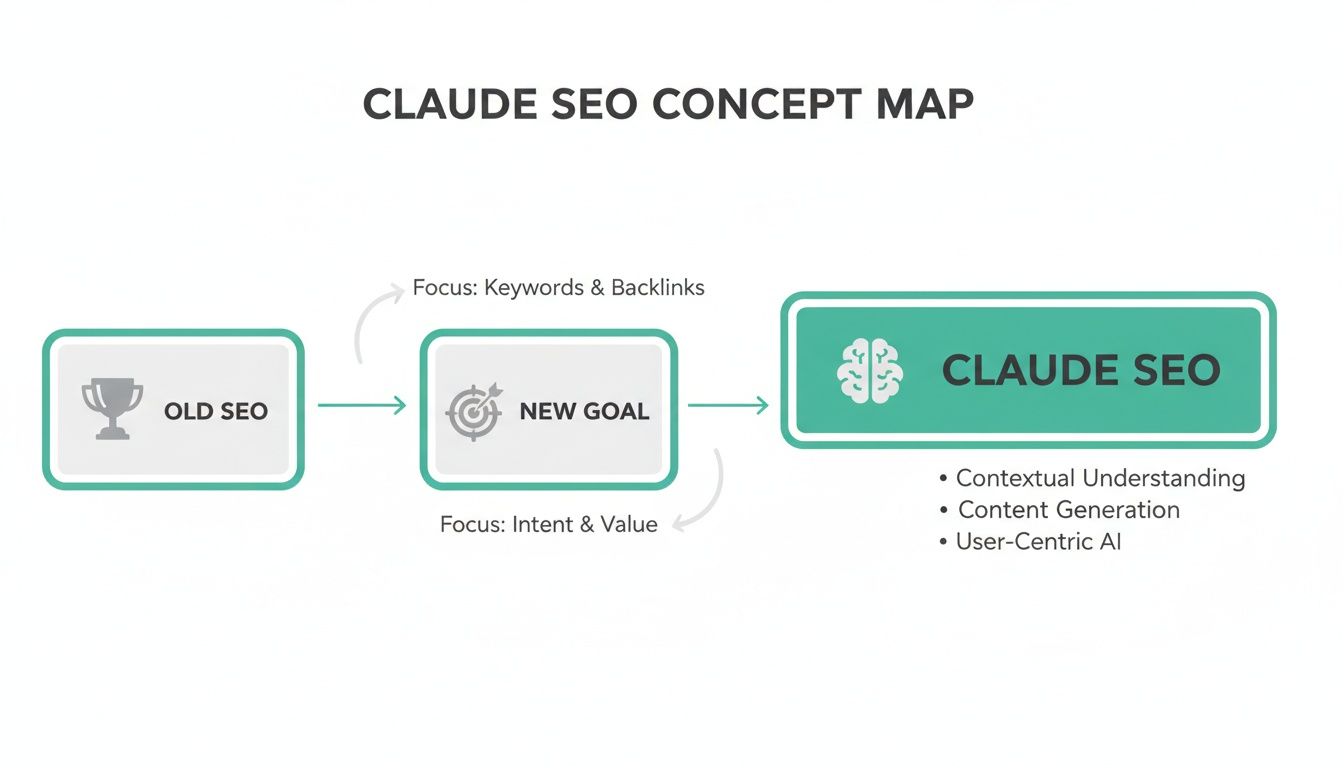
This visual shows the required strategic pivot: stop chasing rankings and start becoming a citable authority. That is the entire goal of generative engine optimization.
Optimizing Your Claude SEO Strategy with Trust Signals
Building trust with an AI involves sending clear signals that your content is high quality. The most important signals align perfectly with Google's E-E-A-T guidelines: Experience, Expertise, Authoritativeness, and Trustworthiness. Claude's algorithms are specifically designed to find and prioritize content that excels in these areas because they are direct proof of reliability.
For instance, a page with original data, expert quotes, and well reasoned arguments will always outperform one that simply rehashes existing information. According to SaaStr, including verifiable statistics and citations can boost a site’s visibility in AI generated answers by over 40%. This proves that factuality is not just a best practice; it is a measurable ranking factor for AI search visibility.
Why Structure and Semantics Matter for LLM Tracking
Beyond authority, Claude gives a significant advantage to content that is logically structured and semantically rich. Your content needs to break down complex topics, connect ideas, and present information in a clear, easy to follow manner for the machine.
This involves using clear headings (H2s, H3s), short paragraphs, and lists to make your content simple for the AI to parse. This structural clarity helps Claude quickly grasp the main points and understand the relationships between different pieces of information. The ultimate goal is to create a definitive, single topic resource that becomes the go to guide, making it an easy choice for a citation.
Practical Content Optimization for Claude SEO
Optimizing your content for Claude is not about gaming an algorithm; it is about making your content the most logical and trustworthy choice for an AI citation. You must shift your mindset from writing for search crawlers to creating content for machine comprehension. As we move into 2025 and 2026, this is the only strategy that will deliver lasting results.
The entire playbook is built on a foundation of structure. Large language models like Claude need content that is easy to parse and digest. Use clear headings, short paragraphs, and plenty of lists to break down complex topics into their core components. This makes your information machine readable.
Developing Content for Your Claude SEO Playbook
A winning approach to Claude SEO content is to build comprehensive, single topic resource pages. Consolidate your expertise into one definitive guide that covers a subject from every angle. This positions your page as the ultimate authority, making it an easy choice for Claude when it needs a reliable source.
Writing in a natural, conversational style is also critical. People ask AI assistants full questions. Your content needs to mirror this conversational flow by directly addressing the nuanced queries of your audience. Understanding how these models work, such as prompting Claude effectively, can provide an edge in structuring content that meets user intent.
The Power of Originality in Generative SEO
In the world of generative SEO, nothing builds authority faster than original data and unique insights. AI models synthesize information from countless sources, so content that offers something genuinely new stands out. Incorporating proprietary research, exclusive expert interviews, or a novel analysis gives Claude a compelling reason to cite you over the competition. This new reality is about merit, not just marketing spend.
For more hands on advice, check out our guide on optimizing content for AI search.
Technical Signals That Boost Claude Visibility
Killer content is only half the battle for Claude SEO. If an AI model cannot efficiently find, crawl, and understand your website, even your best insights will go uncited. This is where technical optimization forms the bedrock of your generative SEO strategy. Looking ahead to 2025 and 2026, a clean, accessible technical setup is non negotiable for earning AI trust.
It starts with the basics that build confidence with any crawler. A logical site architecture, fast page speeds, and a mobile first design are essential. These elements signal that your website is well maintained and user friendly, which are foundational trust indicators for large language models.
Improving Your Technical Claude SEO Foundation
To move beyond the basics, focus on signals that give machines explicit context. The most powerful tool is comprehensive Schema markup. Schema is structured data added to your site’s code that acts like clear labels, telling AI models exactly what your content is about.
For example, you can use it to label an author as a recognized expert, specify that a page is a detailed technical article, or define key entities mentioned in your text. This process removes ambiguity and helps Claude process your information with greater confidence.
Advanced Signals for AI Discoverability
Beyond on page markup, your site’s overall discoverability is a huge factor. Two components are key: clean XML sitemaps and a logical internal linking structure. A well organized XML sitemap is a direct guide for crawlers, ensuring they can find every important page on your site, especially your most valuable content hubs.
Internal links create pathways that show how different concepts on your site connect. By linking from a high level guide to more specific sub topics, you help Claude understand the breadth and depth of your expertise. This interconnected web of knowledge makes your entire domain a more authoritative source.
How to Measure Your Claude SEO Performance
How do you know if your Claude SEO efforts are paying off? For years, we tracked keyword rankings and organic traffic. As we head deeper into 2025 and 2026, those numbers only tell part of the story. Measuring performance in the age of generative AI means looking at a completely different dashboard.
The new goal is to measure your brand’s direct influence inside Claude’s answers. This is a fundamental shift from tracking page positions to tracking answer share and citation frequency. These are the real currencies of generative SEO.
Moving Beyond Traditional SEO Metrics for Claude
To get a handle on your Claude SEO impact, you need a new set of KPIs. Traditional tools were built for a world of blue links, not for monitoring conversational AI. This is where specialized AI visibility platforms become essential.
Here are the metrics that matter now:
Answer Share: Your market share in AI conversations. It’s the percentage of AI generated answers for your topics where your brand is mentioned or cited.
Citation Frequency: A simple count of how many times Claude points to your content as a source.
Contextual Mentions: How your brand is being framed. Are you positioned as a leader, a resource, or just another name?
Citation Gaps: Any topic where competitors are cited but you are not. This is a road map for your next content play.
Using an AI Visibility Platform for Claude SEO Tracking
You cannot find this data in your old SEO tool. Platforms like Riff Analytics are built specifically to monitor these new metrics. They show you exactly when and how Claude is using your brand, turning a vague idea like "AI visibility" into hard data.
For instance, the Riff Analytics dashboard lets you see your citation trends over time and benchmark them directly against competitors.
This competitive analysis shows where rivals are winning the AI narrative and where you can improve. It’s a data first approach that lets you fine tune your content strategy with precision. If you're ready to get started, you might want to learn more about our Claude brand mention tracker.
A New Workflow for Measuring Claude AI Visibility
Folding Claude SEO measurement into your routine is different from rank tracking. You are monitoring topics and brand presence within a living conversation. This table breaks down the shift:
| Step | Traditional SEO Workflow | Modern Claude SEO Workflow |
|---|---|---|
| 1. Setup | Add keywords to a rank tracker. | Define core topics and competitors in an AI visibility tool. |
| 2. Monitor | Check weekly keyword position changes. | Track daily answer share and citation frequency. |
| 3. Analyze | Identify pages with declining rankings. | Analyze citation context and identify competitor citation gaps. |
| 4. Act | Build backlinks or update on page SEO. | Prioritize content updates for pages losing answer share. |
Your Advantage in the AI Search Era
We have covered a lot of ground, and it all boils down to this: Claude SEO is a fundamental piece of your online visibility. From building authoritative content to cleaning up technical signals and measuring what moves the needle, this is the new reality of search.
The brands that get proactive about managing their visibility inside AI conversations are building a massive competitive moat. By putting these strategies into practice and using the right tools, you cement your brand's place as a voice worth citing.
Summary of Claude SEO Success
To recap, getting your Claude search engine optimization right hinges on three core pillars. These actions translate directly into more citations and a bigger share of the answers Claude generates.
Authoritative Content: Create comprehensive, single topic resources backed by original data and expert insights.
Technical Clarity: Use clean site architecture and structured data like Schema to make it easy for machines to understand your content.
Strategic Measurement: Use dedicated AI visibility tools to track your answer share and citation frequency to prove the ROI of your work.
The brands that consistently execute on these three things are the ones who will win. It is that straightforward.
Frequently Asked Questions about Optimizing for Claude
What is the difference between Claude SEO and Google SEO?
Google SEO aims to rank a webpage in a list of results, while Claude SEO aims to become a cited source within an AI's conversational answer. The goal shifts from winning a SERP position to securing "answer share" in a generative response, prioritizing authority and structured data over backlinks.
What type of content is best for a Claude SEO strategy?
Deep, well structured content that serves as the definitive guide on a single topic performs best. This includes in depth articles, original research, and pages that directly answer complex questions. Using clean headings, lists, and factual data helps Claude parse and trust your content, increasing citation chances.
How can I track my brand's visibility in Claude answers?
Traditional SEO tools like SEMrush or Ahrefs cannot track citations inside AI models. To measure your brand's visibility on Claude, you need a specialized AI visibility platform that can monitor how often your content is referenced and show how you compare against competitors.
Is E-E-A-T still important for Claude SEO?
Yes, it is more important than ever. E-E-A-T (Experience, Expertise, Authoritativeness, Trustworthiness) is a core component of Claude SEO. Anthropic's Constitutional AI framework means its models are hardwired to prefer trustworthy, factual sources, making signals of expertise critical for visibility.