Optimizing Your Content for AI Search in 2026: A Practical Guide
Updated December 30, 2025
Optimizing content for AI search means creating factual, clear, and authoritative information that AI engines like ChatGPT, Perplexity, and Google's AI Overviews can easily understand, trust, and cite in their answers. Looking ahead to 2025 and 2026, this is no longer just another SEO tactic. It is the fundamental shift required to ensure your brand remains visible as users increasingly get answers directly from AI instead of clicking through a list of links. The goal is to become the trusted source behind the AI's response.
Understanding the New Search Frontier: Why Optimizing for AI Search is Non-Negotiable
The way people find information online is undergoing its most dramatic evolution in decades. Instead of scanning ten blue links, users now receive direct, synthesized answers from AI. If your content is not the bedrock of those answers, your brand effectively becomes invisible. This is not a distant trend; it is the reality of search in 2025 and will be the standard by 2026. This massive shift demands a new playbook, often called generative SEO or answer engine optimization. It is no longer enough to chase keywords. The new game is about making your content a prime, citable source that AI models trust implicitly.
The Shift in Content Optimization for AI Search Visibility
The core difference between traditional SEO and optimizing for AI search is the endgame. One chases clicks, the other earns citations. A click requires someone to leave the search results and visit your site. A citation, however, places your brand and information directly into the AI's response, establishing you as the authority without the user ever needing to leave the search interface. Recent data highlights the urgency of this shift. According to growth of AI powered search on Statista, the use of AI for online search is projected to grow significantly, fundamentally changing user behavior. By mid 2025, some informational queries already saw AI adoption rates hit 47%.
Why Adapting Your Content for AI Engines is a Business Imperative
Ignoring this evolution is a significant business risk. As more users turn to AI for answers, websites that have not adapted will see their organic traffic and brand awareness decline. The content that wins in this new environment will be meticulously structured, factually dense, and undeniably authoritative. The focus moves from keyword optimization and backlinks to factual accuracy, clarity, and structured data. Learning to optimize your content for AI search is about future proofing your marketing, ensuring your brand remains a relevant and trusted voice.
How AI Answer Engines Find and Use Your Content for Search
To master this new landscape, you must think differently. AI answer engines are less like a library index and more like a research assistant. They do not just find your page; they read it, break it down, and synthesize the best parts with information from other sources to create a single, direct answer. By 2026, success will not be about ranking number one. It will be about being chosen as a citable source for the AI's answer. This process relies on contextual relevance, entity recognition, and structured data. An AI model is not just looking for keywords; it is dissecting your content into logical pieces and running a credibility check on each one.
Signaling Authority to Improve AI Search Sourcing
If you want your content to be used, you must make it obvious that you are an authority. This is where E-E-A-T (Experience, Expertise, Authoritativeness, Trustworthiness) becomes critical. AI models are trained to prioritize content that is verifiable, accurate, and written by a credible source. They look for signals like detailed author bios, links to professional profiles, and citations from other reputable sites. For instance, advanced strategies like training ChatGPT on custom data show how AI can be guided toward trusted information.
According to digital strategy trainer Clark Boyd, "Schema markup is structured data code that helps search engines and AI understand what your content means, not just what it says."
Using schema markup for articles, authors, and organizations is like putting clear labels on your information that a machine can instantly read and trust. It removes ambiguity and boosts the AI's confidence in your facts.
The Difference in Optimizing for Crawling vs. AI Ingestion
It is crucial to understand that a traditional Googlebot and a new AI ingestion model have different jobs. One is built to discover and rank pages for a results list, while the other is built to extract facts for a synthesized answer. This distinction creates a new optimization challenge. While Google still dominates with a significant portion of the search engine market share at infront.com, a new channel has opened. AI native tools are fielding millions of queries daily, requiring a strategy focused on creating citable, authoritative content for this growing audience.
A Practical Framework for AI Search Visibility
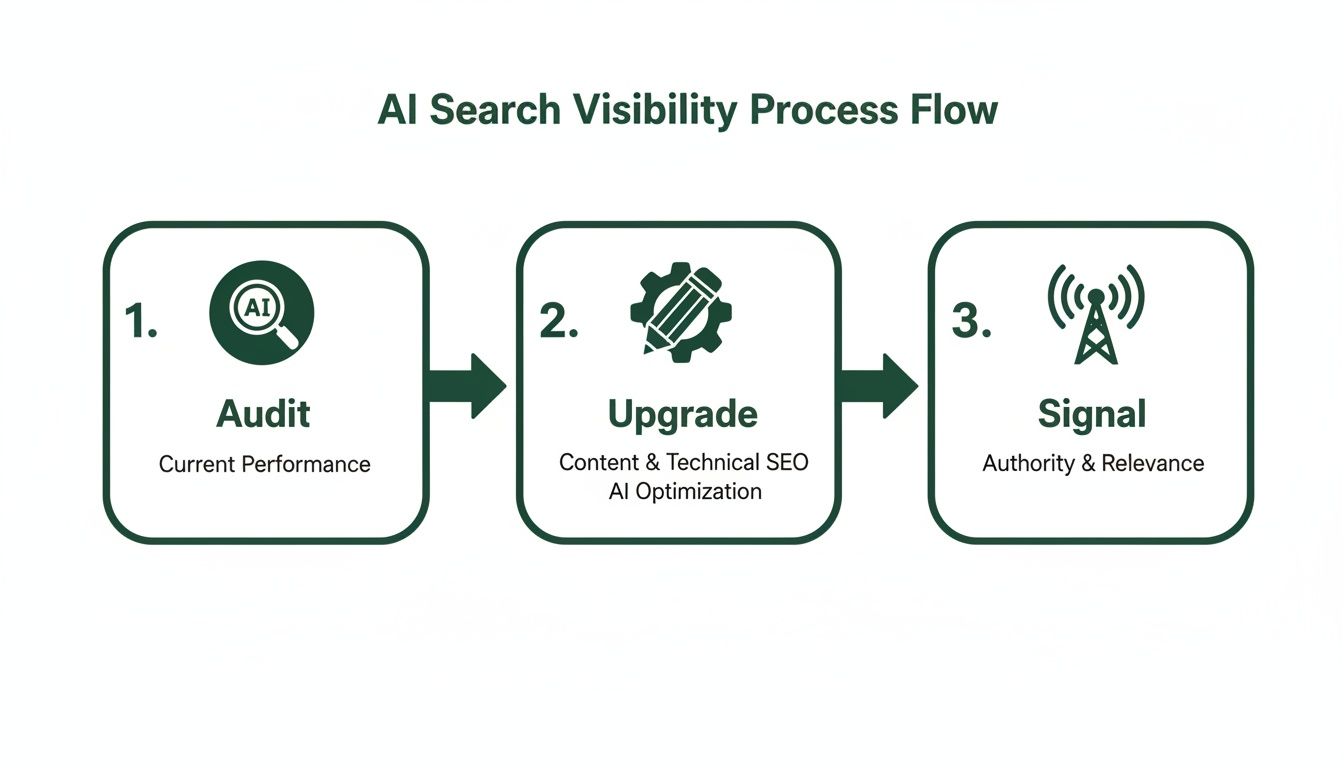
Getting your content featured in AI answers requires a practical system to audit, upgrade, and signal your content's authority to AI models. The goal is to transform your existing articles into assets that an AI engine can parse, trust, and confidently cite. Remember, AI models are data processors scanning for clean, credible signals. This framework is about building those signals and turning your content into a preferred source for AI generated answers.
A System for Optimizing Content for AI Search
First, shift your mindset from writing articles to engineering information. Every element on the page, from the H1 tag to the last sentence, needs a clear purpose. For larger sites, applying this at scale is the real challenge. Exploring programmatic AI SEO strategies for scaling landing pages can be a game changer. For most teams, the best place to start is with an audit of top performing informational posts. These are your prime candidates for an AI optimization retrofit because they have already proven their relevance. Once you have your list, apply a structured upgrade process focused on clarity, scannability, and factual accuracy.
Building Trust Through Effective Citation Signaling for AI
A huge part of this framework is citation signaling. It is the art of making your sources and credentials so obvious that you build digital trust with both users and machines. AI models are trained to reward content that backs up its claims. You can actively signal your trustworthiness by including expert quotes, linking to primary sources like academic papers or government data, and clearly stating author credentials with links to professional profiles. This whole process is about removing any doubt and making your content a low risk, high reward choice for an AI.
Comparing Traditional vs. AI Search Optimization Workflows
Changing your content is only half the battle; you also need to adapt your internal processes. The focus is shifting from acquiring links to building verifiable, machine readable authority. The table below breaks down how the focus needs to shift.
| Workflow Stage | Traditional SEO Focus | AI Search Optimization Focus |
|---|---|---|
| Content Planning | Keyword research and search volume analysis. | Answering user intent comprehensively with topic clusters. |
| Content Creation | Writing long form content to cover keywords. | Structuring content with concise, fact first statements. |
| Authority Building | Acquiring backlinks from high domain authority sites. | Signaling E-E-A-T with expert quotes and source links. |
| Technical SEO | Page speed, mobile friendliness, and crawlability. | Implementing detailed Schema.org markup and structured data. |
| Measurement | Tracking keyword rankings and organic traffic. | Monitoring citation frequency and "answer share" with LLM tracking. |
As you can see, the priorities are fundamentally different. While the basics of SEO still matter, the new emphasis is on creating content that is explicitly trustworthy and easy for a machine to digest.
Structuring Content to Win in Generative AI Search
To get noticed in this new era, your content has to be prompt friendly. This means structuring your articles to be the most logical, authoritative, and easily digestible sources for generative AI. As we look toward 2025 and 2026, content designed to directly answer conversational questions will own AI search. It is not about writing a good article anymore. It is about engineering a piece of content that a large language model (LLM) can parse, trust, and cite with confidence. The core principle is simple: make your content scannable and fact based. This is precisely why platforms like Wikipedia are cited so often by AI.
How to Optimize Content Structure for AI Engines
Optimizing your content structure is about making your information modular and easy for a machine to extract. Start with your headings. An H2 or H3 needs to be a direct statement or question that the following paragraphs answer, like "How to Troubleshoot Common Installation Errors." Next, pack your content with data rich elements that are easy to parse, such as bulleted lists for processes, comparison tables for complex data, and concise summaries at the beginning of your article.
According to a 2025 study by the Digital Marketing Institute, content that is well structured with clear headings, lists, and schema is 40% more likely to be cited by AI.
Creating Prompt Friendly Content to Improve AI Search Sourcing
One of the most powerful tactics for AI search optimization is adding a dedicated FAQ section. This format naturally mirrors the conversational style of user prompts and provides direct, concise answers that AI models love to reference. Every question in your FAQ should target a specific long tail query. Pairing your FAQ page with FAQPage schema markup is critical. This structured data explicitly tells AI systems, "Hey, this is a question, and this is its answer," leaving zero room for interpretation. A deep dive into how to rank in AI Overviews reveals more actionable insights on structuring your content for maximum impact.
Measuring Your Success in AI Search
If you do not measure something, you cannot improve it. The classic SEO metrics we have relied on for years, like keyword rankings and organic traffic, only paint half the picture in 2025 and beyond. The most critical new metric is answer share. This tells you how often your brand appears as a cited source in AI responses for your key topics. It is not about ranking number one; it is about being the answer. Answer share directly connects your content work to real influence in this new landscape.
Monitoring Your Generative SEO Performance
To see what is happening, you need tools built for this new world. Platforms like Riff Analytics are designed specifically to track your visibility inside Large Language Models (LLMs). They let you monitor every citation and mention across ChatGPT, Perplexity, and Google's AI Overviews. You might find your blog post ranks well in a classic Google search, but a competitor is getting all the AI citations for that same topic. That is a citation gap, and spotting it is your first step toward retaking control of the narrative.
Using Data to Improve Your AI Search Visibility
A winning AI optimization strategy is a continuous loop: optimize your content, monitor how it performs in AI engines, and then iterate based on what the data shows you. This turns guesswork into a repeatable, data backed process.
According to Nicai de Guzman of the Digital Marketing Institute, "Marketers must also track AI related metrics, which reflect how often and how prominently their content appears in AI results and answers."
This expert take reinforces why a dedicated measurement strategy is no longer optional. The workflow should be: optimize, monitor with a tool like Riff Analytics to track citations, analyze your answer share against competitors, and iterate based on what you have learned. By making this data driven loop part of your regular process, you can systematically improve your visibility. For a deeper dive, check out our guide on the keyword rankings and visibility report.
Summary and Next Steps for AI Search Optimization
Winning in AI search requires a methodical, hands on approach. It is a constant commitment to creating high quality, citable content built on clarity, authority, and solid structure. This is the core of generative SEO. The game is no longer just about ranking; it is about becoming the definitive source an AI quotes in its answer.
Start by auditing your most critical informational pages to get a baseline. This initial audit becomes your roadmap, showing you exactly where the structural and authority gaps are. From there, it is a simple, repeatable process: systematically upgrade your content, monitor performance with LLM tracking, and make adjustments based on the data. The work to improve your AI search visibility starts today, turning the assets you already have into powerful tools for this new era of search.
Frequently Asked Questions
How do I start optimizing my content for AI search?
Begin with an audit of your top 5 to 10 informational blog posts that already receive organic traffic. Focus on improving their structure with clear H2s and H3s, adding a concise summary, and ensuring every factual claim is backed by a verifiable source link. This is the fastest way to see initial results.
What is "semantic richness" and why does it matter for AI search?
Semantic richness means including related concepts, entities, and synonyms (like "AI search visibility," "generative SEO," or "LLM tracking") in your content. This helps AI models understand the full context of your topic, demonstrating your deep expertise and increasing the likelihood that your content will be used for a wider range of related queries.
How do I track if my AI search optimization efforts are working?
Traditional tools like Google Analytics cannot track AI citations. You need specialized platforms designed for LLM tracking, such as Riff Analytics, to measure your "answer share." This metric shows how often your brand is cited in AI responses, providing a clear KPI for your efforts.
Is structured data like Schema.org markup essential for AI search?
Yes, it is absolutely critical. Structured data acts as a clear set of labels for machines, giving AI models machine readable context about your content. It clarifies what is a fact, who the author is, and what the organization is, which significantly boosts an AI's confidence in your information and makes it easier to cite.