best ai visibility analytics for search optimization
Updated February 6, 2026
AI visibility is no longer a side experiment for SEO teams. Google’s AI Overviews can suppress, reshape, or redirect clicks, while tools like ChatGPT, Perplexity, Gemini, and Claude increasingly influence discovery before a user ever reaches a classic results page. The measurement gap is real: McKinsey reports that only 16% of brands systematically track AI search performance, and even strong brands can lag traditional SEO performance by 20% to 50% in generative search visibility, according to its AI search analysis. That is why this category has expanded so quickly.
This guide evaluates the best AI visibility analytics for search optimization using buyer-focused criteria instead of vendor positioning alone. I looked for tools that can answer practical questions: Which engines are covered, can you see the sources behind AI answers, how far back does historical data go, how strong is competitor benchmarking, and can a non-enterprise team actually use the product without a heavy implementation. To understand how AI impacts sector specific search optimization, explore the nuances of how to achieve SEO visibility for attorneys in an AI world.
How I Picked These AI Visibility Analytics Tools
I used a simple filter: a tool had to help a real search team make a decision, not just generate a screenshot. For inclusion, I reviewed product documentation, public feature pages, release notes where available, and live examples of AI tracking workflows. Where a trial, demo environment, or public walkthrough existed, I used that to verify whether the product showed actual citations, historical captures, or competitor comparisons instead of vague “visibility scores.” I also checked whether the tool tracked live AI surfaces directly, relied on Google SERP features only, or mixed both approaches.
The evaluation criteria were the same across the list:
- Engine coverage: Google AI Overviews only, or broader coverage across ChatGPT, Perplexity, Gemini, Claude, and related engines.
- Citation and source visibility: Whether the platform shows the pages or domains being cited, not just your brand mention count.
- Historical data: Whether you can audit past AI answers or archived SERPs to diagnose gains and losses.
- Competitor analysis: Whether you can benchmark rival brands, cited domains, and answer-share patterns.
- Workflow fit: Whether the product works for enterprise analytics teams, agencies, or lean in-house marketers.
- Pricing transparency: Whether buyers can estimate cost before booking a demo.
I excluded tools that were mostly prompt-testing utilities, generic web analytics products, or rank trackers that mention AI in marketing copy but do not show meaningful answer, citation, or AI Overview data. I also discounted products that looked promising but lacked enough evidence to judge reporting depth.
1. Riff Analytics
Riff Analytics ranks highly because it covers the decision criteria that matter most for modern AI visibility work: broad engine coverage, source-level insight, competitor benchmarking, fast setup, and usability for teams that are not operating at enterprise SEO-suite scale. According to the Riff Analytics website, the platform tracks visibility across ChatGPT, Perplexity, Claude, Gemini, Grok, and Google AI Overviews, and it emphasizes source analysis rather than simple mention counting. That makes it a strong fit for teams that need one view across both Google-centric and chatbot-driven discovery without stitching together several point tools.

The platform’s core strength is that it is built around actionability rather than raw monitoring. Riff surfaces where your brand appears, which pages are being cited, and where competitors are winning references you are missing. In practice, that matters more than a vanity visibility score. If an AI answer cites three competitor pages and none of yours, the useful next step is not “watch the trend line,” but identifying which source patterns are being rewarded and what content gap caused the loss. That source-first model is why Riff feels more useful than lighter mention trackers for search optimization work.
Unlocking Actionable Generative SEO Insights
What sets Riff Analytics apart is its focus on actionable intelligence. The platform’s citation gap analysis is particularly powerful. It not only shows you where your brand is mentioned but also reveals the exact sources AI models are citing. It then highlights opportunities by showing which sources competitors are leveraging to get cited instead.
This empowers teams to:
- Prioritize Content: Identify the specific pages and topics that have the highest potential to influence AI responses.
- Benchmark Performance: Use built in dashboards to track mention trends and measure visibility against key competitors over time.
- Audit AI Readiness: Analyze existing content to understand its likelihood of being used as a source by large language models.
A second reason Riff stands out is accessibility. Many products in this market are built like enterprise search intelligence systems first and buyer-friendly software second. Riff appears to aim lower on implementation friction, which is valuable for smaller in-house teams and agencies that need usable reporting quickly. That aligns with the broader market direction: AI visibility is becoming measurable at a much deeper level, and buyers increasingly expect benchmarking, context, and operational insight rather than a binary “you appeared / you did not appear.” Adobe Brand Visibility, for example, says it tracks performance across 10 LLM families, more than 25 languages, and up to five direct competitors in its AI visibility overview, showing how fast buyer expectations have matured.
Implementation and Access
Riff is engineered for accessibility, promising initial results within minutes without requiring technical expertise or engineering resources. This makes it an ideal choice for agile marketing, brand, and content teams that need to demonstrate value quickly.
While specific pricing details are not listed publicly and require contacting sales, the platform offers a 7 day free trial and a complimentary AI visibility report. This allows prospective users to validate its utility before making a commitment. For teams seeking a deeper understanding of how different tools stack up, Riff also provides a helpful AI SEO tools comparison on their blog.
Before buying, verify four things. First, whether the reporting depth matches your need for exports, scheduled reports, and stakeholder dashboards. Second, whether the pricing model stays practical once you add multiple brands, competitors, or prompt sets. Third, whether your workflow depends on historical SERP-style archives, because some Google-focused tools still go deeper there. Fourth, whether your use case is primarily Google AI Overviews or cross-engine monitoring. If you need broad coverage across assistants plus source visibility without enterprise overhead, Riff is one of the strongest options in this list. If your team needs massive keyword-level Google archives and API-heavy warehousing, a product like STAT may be a better fit.
Website: https://riffanalytics.ai
2. seoClarity
seoClarity positions itself as an enterprise grade solution specifically engineered for tracking visibility within Google’s AI Overviews (AIO). For large organizations managing tens of thousands of keywords, this platform provides the scale needed to understand the true impact of generative AI on search traffic. It moves beyond simple rank tracking to reveal which specific keywords trigger AIOs and where your brand is being cited or merely mentioned within those generated responses.

This tool excels at providing the kind of deep, competitive AI visibility analytics that large scale search optimization campaigns require. It directly connects AIO performance to traffic and click through rate changes at both the keyword and URL level, closing the loop for ROI analysis.
Core Features for Enterprise AIO Tracking
- AIO Identification: Daily scans identify which of your target keywords are currently displaying an AI Overview.
- Citation vs. Mention Tracking: The platform distinguishes between a linked citation and a simple brand mention, offering granular insight into your brand’s authority within AIOs.
- Competitive Benchmarking: You can systematically track how often competitors appear in AIOs for your core keyword set, identifying content gaps and opportunities.
- Historical Analysis: seoClarity allows you to track changes in AIO content over time, helping you understand the volatility and evolution of AI generated answers.
Platform Evaluation
Leverage the historical AIO comparison feature before and after a major content update. This helps you correlate your content optimization efforts directly with improved visibility or citation frequency in Google’s AI generated results.
Website: https://www.seoclarity.net/ai-overviews-tracking
3. Semrush
Semrush bridges the gap between traditional SEO and generative AI by integrating AI Overview analytics directly into its widely used tool suite. For teams already leveraging Semrush for keyword research and rank tracking, this provides a familiar environment to begin monitoring AI driven search visibility. The platform allows users to filter SERP features to isolate keywords that trigger AIOs, track their presence over time, and analyze competitor citations within these generated answers. This integration makes it a practical choice for marketers looking to extend their existing SEO workflows into the AI era without adopting an entirely new system.
This tool is powerful for teams that need to incorporate AI analytics into a broader digital marketing strategy. By connecting AIO performance to existing rank tracking and competitive intelligence data, Semrush provides a comprehensive picture of how generative AI is impacting a brand's overall search footprint.
Features for Integrated AI Search Visibility Analytics
- AIO SERP Feature Filter: Easily identify keywords in your tracked projects or within the research database that currently generate an AI Overview.
- Competitor Citation Analysis: Benchmark your brand’s mentions and linked citations against competitors within AIOs for your target keyword set.
- Ongoing Position Tracking: Monitor your domain's visibility in AIOs over time, treating it as a key SERP feature alongside traditional organic rankings.
- Semrush Sensor for AIO Volatility: Use the Sensor tool to track the prevalence and changes in AI Overviews across different industries and niches.
Platform Evaluation
Use the Position Tracking tool to create a custom tag for all keywords that trigger an AI Overview. This allows you to build a dedicated dashboard to monitor your performance specifically for this high impact SERP feature and report on it separately.
Website: https://www.semrush.com
4. BrightEdge
BrightEdge approaches AI driven search from a strategic, enterprise perspective, leveraging its proprietary BrightEdge Generative Parser to analyze and report on AI Overviews (AIO) visibility. The platform is designed for large organizations that need to understand not just AIO presence, but also the content strategies required to earn citations. It excels at providing industry level coverage statistics and actionable guidance for content creation, connecting AI visibility directly to content planning workflows.
This tool stands out by integrating AIO tracking with its broader content optimization suite, including BrightEdge Copilot. This integration helps teams move from data analysis to content execution, offering recommendations on how to structure content to improve the likelihood of being cited in AI generated responses.
A Strategic Approach to LLM Tracking
- AIO Presence Tracking: Continuously monitors your keyword sets to detect the presence and frequency of AI Overviews.
- Industry Benchmarking: Provides data on AIO coverage across different industries, helping you gauge the impact on your specific market.
- SERP Real Estate Analysis: Educates users on how AIO and traditional SERP features like snippets interact, allowing for more informed strategy.
- Content Recommendations: BrightEdge Copilot offers guidance on content structure and topics to improve your chances of earning AIO citations.
Teams that need to connect AI-search monitoring with engineering or observability workflows may also want a technical companion resource beyond SEO software. See more from Applied if your organization is trying to monitor both search-facing AI outputs and internal LLM systems.
Platform Evaluation
Use the platform’s filters to identify keywords that currently generate featured snippets but do not yet trigger an AIO. Prioritize optimizing these pages with structured data and clear, authoritative answers, as they are strong candidates for future AI Overview citations.
Website: https://www.brightedge.com/ai-overviews
5. SISTRIX
SISTRIX provides a direct and accessible workflow for analyzing visibility within Google's AI Overviews. The platform is designed for SEO professionals who need to quickly identify which keywords trigger AIOs and which specific domains are being cited as sources. Its strength is an efficient process that lets users move from high level trend analysis to granular SERP inspection without a steep learning curve, making it a powerful tool for tactical AI search optimization.
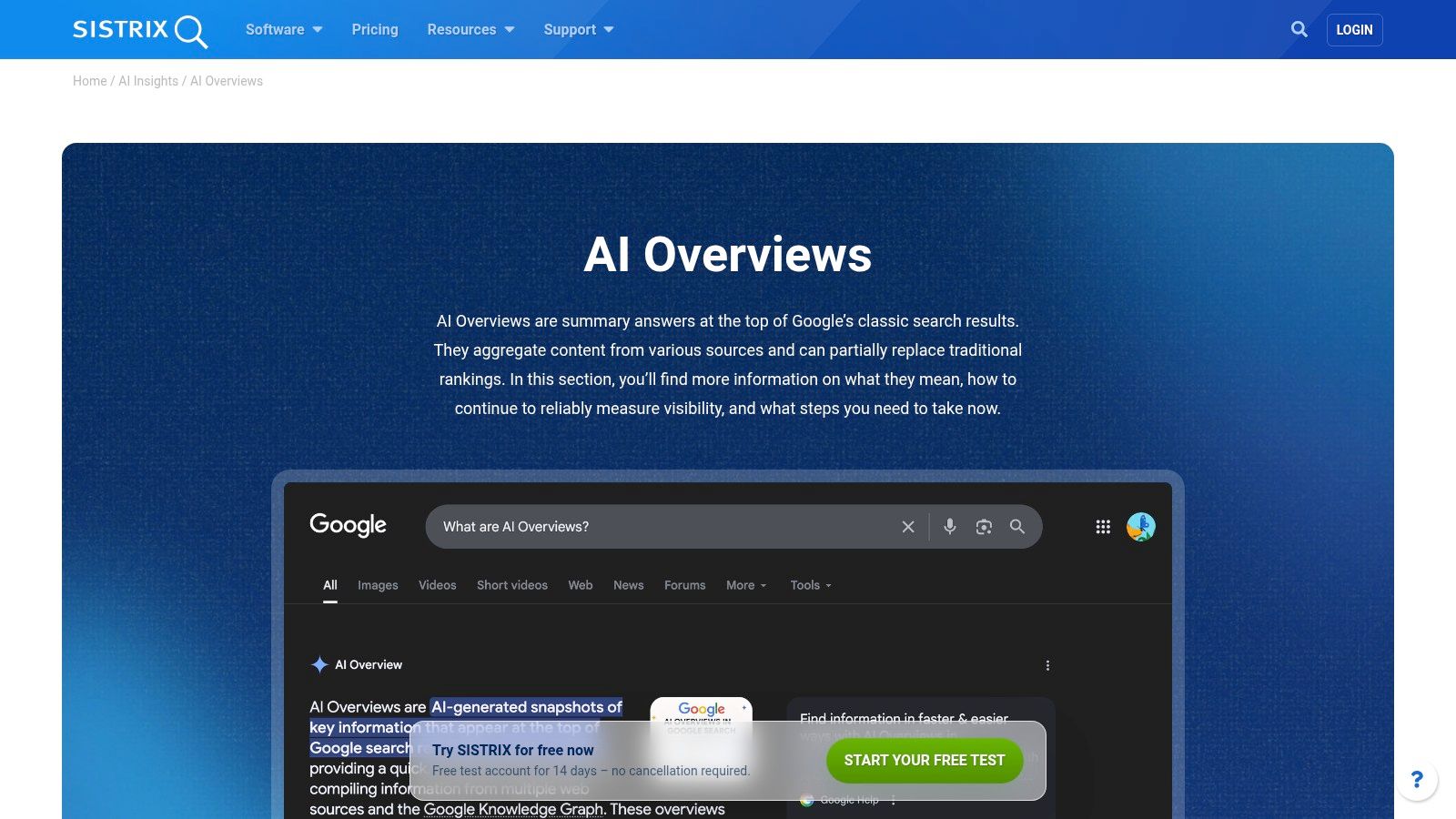
This tool excels at bridging the gap between keyword research and practical AIO analysis. By providing a filterable database and a historical SERP archive, SISTRIX empowers marketers to not only see their current AIO presence but also to understand how that visibility has evolved, connecting content changes to performance shifts within generative results.
Core Features for Practical AIO Analysis
- AIO Citation Analysis: Pinpoint exactly where your domain is cited within an AI Overview and its position in the AIO box.
- Keyword Filtering: Easily filter entire keyword lists to show only those that currently generate an AI Overview, focusing your optimization efforts.
- Historical SERP Archive: Review the full content of past AIOs, including all linked sources, to audit changes and understand the dynamics of AI generated content.
- Visibility Measurement Guidance: The platform offers metrics and insights for measuring performance beyond classic organic rankings, adapting to the new SERP environment.
Platform Evaluation
Use the AIO keyword filter to identify a core set of high value keywords that trigger generative results. Then, use the SERP archive to track how the cited sources for these keywords change on a weekly basis, helping you spot emerging content competitors.
Website: https://www.sistrix.com/ai-insights/ai-overviews/
6. Similarweb
Similarweb offers a powerful, market level perspective on AI's impact, extending far beyond Google's ecosystem. It’s designed for strategists who need to connect brand visibility across multiple generative AI platforms like ChatGPT, Gemini, and Perplexity with tangible traffic estimates and competitive benchmarks. Instead of focusing solely on rank, Similarweb provides intelligence on which brands and topics are associated with your keywords in AI answers, offering a fuller view of your brand’s authority in the generative space.
The platform excels at bridging the gap between visibility and performance by estimating traffic driven from AI citations. This makes it an invaluable tool for competitive intelligence, allowing teams to see not just where they appear, but how they stack up against the competition across the broader AI ecosystem.
Market Level AI Visibility Analytics for SEO
- GenAI Intelligence: Tracks brand appearances, citations, and mentions across multiple AI chatbots and connects them with traffic insights.
- AI Brand Visibility: Identifies topics and brands associated with your keywords in AI responses, revealing your perceived authority.
- AIO Keyword Identification: The integrated Rank Tracker flags which of your tracked keywords trigger an AI Overview in Google search results.
- Competitive & Market Insights: Provides industry level data to benchmark your AI visibility against key competitors and the market as a whole.
Platform Evaluation
Use Similarweb's GenAI Intelligence to identify non traditional competitors who are frequently cited for your core topics in ChatGPT or Gemini. This can uncover new content partnership opportunities or highlight emerging threats you might miss by only tracking search engine rankings.
Website: https://www.similarweb.com
7. STAT Search Analytics (Moz)
STAT Search Analytics, part of the Moz ecosystem, is one of the strongest options for teams that need enterprise-grade Google AI Overviews analysis rather than lightweight cross-engine monitoring. Its defining advantage is large-scale daily SERP capture. Moz positions STAT as a platform built for highly granular keyword tracking, local and device segmentation, and deep SERP feature analysis in its STAT product documentation. That architecture matters because AI Overview analysis gets much more useful when you can inspect the full page context around the answer, not just a yes-or-no flag that an overview existed.
For very large keyword sets, STAT is often stronger than lighter AIO trackers because it is designed around operational scale. If you manage national and local keyword portfolios, multiple device profiles, or category-level reporting across thousands of terms, the platform’s daily HTML SERP archiving becomes a durable source of record. You can segment by geography, device, keyword group, and feature presence, then export or pipe the data into internal BI workflows through APIs and bulk exports. That makes STAT especially effective for enterprise SEO, publishing, ecommerce, and franchise organizations where AI visibility needs to be audited at scale rather than checked ad hoc.
Granular SERP Data for AI Optimization
- Daily SERP Capture: Provides full HTML captures of search results pages, offering a complete historical record for forensic analysis of AIO behavior.
- AIO Trend Analysis: Tracks the appearance and frequency of AI Overviews by keyword segment, topic, location, and device, revealing market wide patterns.
- Citation Source Analysis: Identifies the sources and formats of citations within AIOs, helping to measure brand ownership and content authority.
- API and Data Export: Offers extensive APIs and export options, enabling integration with business intelligence tools and custom dashboards for deeper analysis.
Historical capture is where STAT becomes especially valuable. When Google changes AI Overview formatting, source display, or trigger patterns, many teams see visibility losses and cannot tell whether the drop came from weaker content, different cited sources, a location-specific rollout, or a layout change that altered how answers were assembled. With archived HTML SERPs, you can compare the before-and-after page state directly: Did the AIO disappear? Did it still appear but cite different domains? Did mobile lose visibility while desktop held? Did a competitor gain citations after Google changed the source cards? That kind of forensics is difficult with simpler trackers that only report current-state visibility.
In buyer terms, STAT is a better choice when your AI Overviews work is inseparable from serious SERP research. It is well suited for teams that need historical evidence, regional segmentation, and reliable exports for downstream analysis. Independent reviews of enterprise rank trackers routinely point to STAT’s strength in large-scale SERP monitoring and data depth, including G2’s STAT reviews, which align with Moz’s positioning around scale and customization.
The limitation is scope. STAT is strongest for Google-centric AI Overview analysis, not for broad chatbot visibility across ChatGPT, Perplexity, Claude, and Gemini. If your main question is “How often do we appear across multiple AI engines, and which sources are driving those answers?” a multi-engine platform will usually get you to insight faster. If your question is “What exactly changed in Google’s AI SERP behavior across 50,000 keywords by market, device, and competitor set?” STAT is one of the best tools available.
Platform Evaluation
Use the location based AIO tracking to understand how generative results differ in key markets. This can uncover regional content opportunities and inform your international or local SEO strategies for AI search.
Website: https://getstat.com
8. Nozzle
Nozzle is a powerful rank tracking platform that has pivoted effectively to offer detailed monitoring of Google's AI Overviews. It's designed for SEO professionals who need granular, keyword level data on AIO presence and competitive share of voice. The platform’s strength lies in its flexible dashboards and reporting capabilities, allowing users to segment and analyze AIO visibility from multiple angles, from high level domain rollups down to the specific content extracted for a single keyword query.
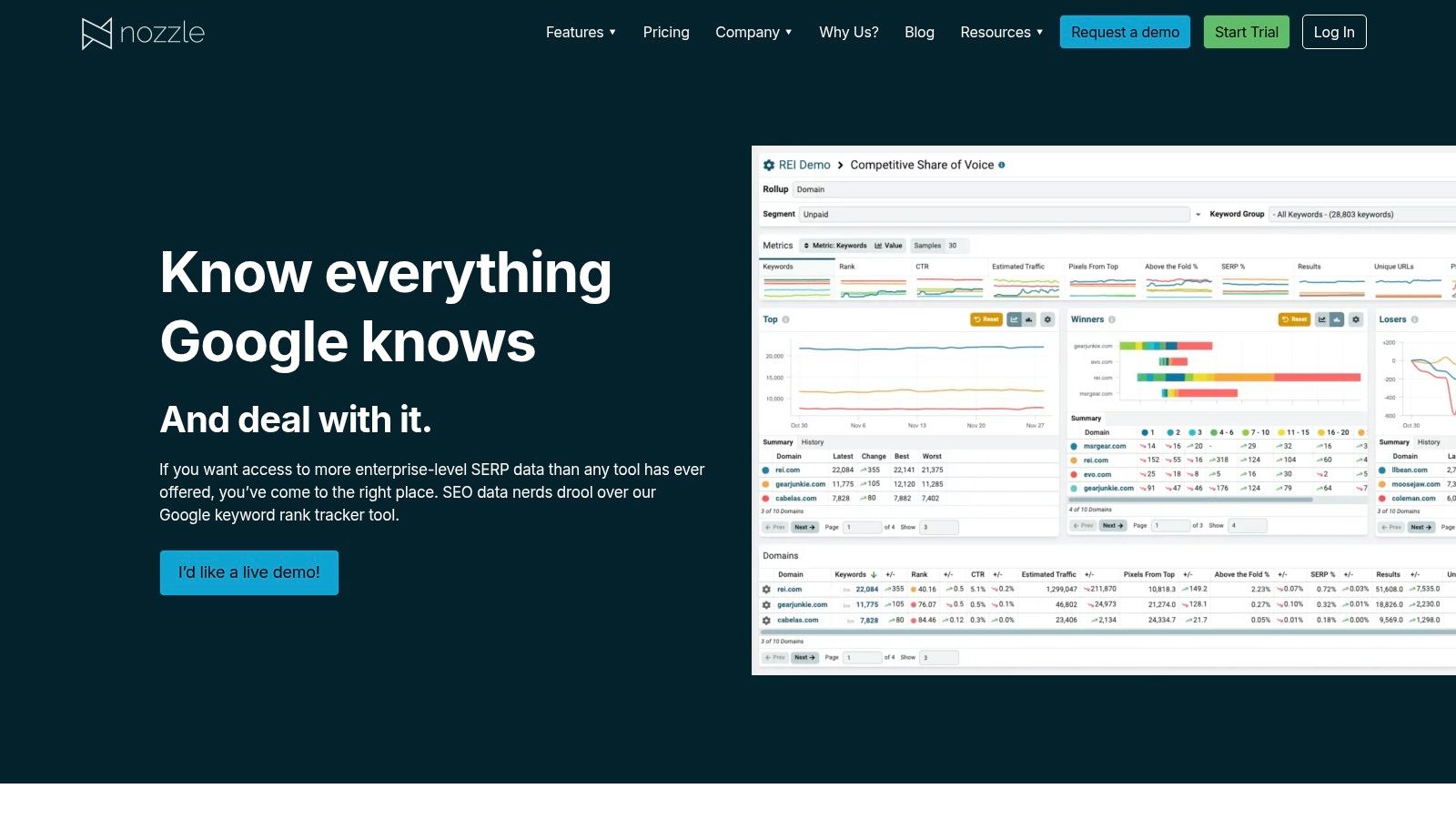
This tool moves beyond simple presence tracking by providing a transparent view of competitor performance within AI Overviews. Nozzle's share of voice metrics are particularly useful, helping teams understand not just if they appear in an AIO, but how their visibility compares to rivals vying for the same generative real estate. This makes it a valuable asset for competitive intelligence.
Competitive AI Search Visibility Reporting
- AIO Specific Dashboards: Dedicated views and widgets that count AIO triggering keywords and track your domain's overall presence in generated results.
- Competitive Share of Voice: Analyze AIO visibility at the domain or URL level to benchmark your performance directly against key competitors.
- Single Keyword AIO Inspector: A SERP visualizer that extracts and displays the exact AIO content, including sources, for any tracked keyword.
- Group Level Reporting: Aggregate AIO data across keyword groups to analyze the performance of specific product categories, topics, or content clusters.
Platform Evaluation
Use the single keyword AIO inspector to analyze the sources and structure of competitor won AI Overviews. This reveals the specific content formats and data points that Google’s AI is prioritizing, offering a direct roadmap for your own content optimization efforts.
Website: https://nozzle.io
9. SE Ranking
SE Ranking integrates AI visibility tracking directly into its all in one SEO platform, offering a practical solution for marketers who need to monitor AI driven search without adopting a standalone tool. Its AI Results Tracker and AI Search Add on are designed to track citations and mentions across a wide range of engines, including Google AIO, ChatGPT, Perplexity, and Gemini. This multi platform approach is important for businesses aiming to understand their brand's footprint across the entire generative AI ecosystem.
The platform's standout feature is its "Sources" view, which reveals the specific domains and pages that AI models cite when generating answers. This provides actionable intelligence, helping teams identify high authority sources for outreach or pinpoint content formats that generative engines prefer. This makes it one of the best AI visibility analytics for search optimization for teams focused on building topical authority.
Multi Engine LLM Tracking Features
- Multi Engine Tracking: Monitors your visibility and citations across Google AIO, Gemini, Perplexity, and ChatGPT from a single interface.
- Competitive AI Research: Allows you to analyze competitor performance on each AI platform, identifying where they are cited and for which topics.
- Source Analysis: The "Sources" tab provides context on cited domains, including their authority, traffic, and backlink profile, guiding content and link building strategy.
- Integrated Reporting: As part of a full SEO suite, AI visibility data can be exported and combined with traditional rank tracking and analytics reports.
Platform Evaluation
Use the "Sources" tab to identify unlinked brand mentions within AI answers. This creates a targeted list of high authority domains for digital PR and outreach campaigns, asking them to link back to your content. A solid AI search visibility tool should facilitate such actionable insights.
Website: https://seranking.com
10. SEOmonitor
SEOmonitor integrates AI Overviews tracking directly into its established rank tracking and forecasting suite, making it a natural fit for agencies and in house teams already using the platform. It focuses on providing daily, actionable data by capturing the full content of AI Overviews for existing keyword sets on both desktop and mobile. The platform’s key strength lies in its ability to contextualize AI visibility within your broader SEO strategy, showing how AIO appearances affect traditional rankings and organic traffic forecasts.
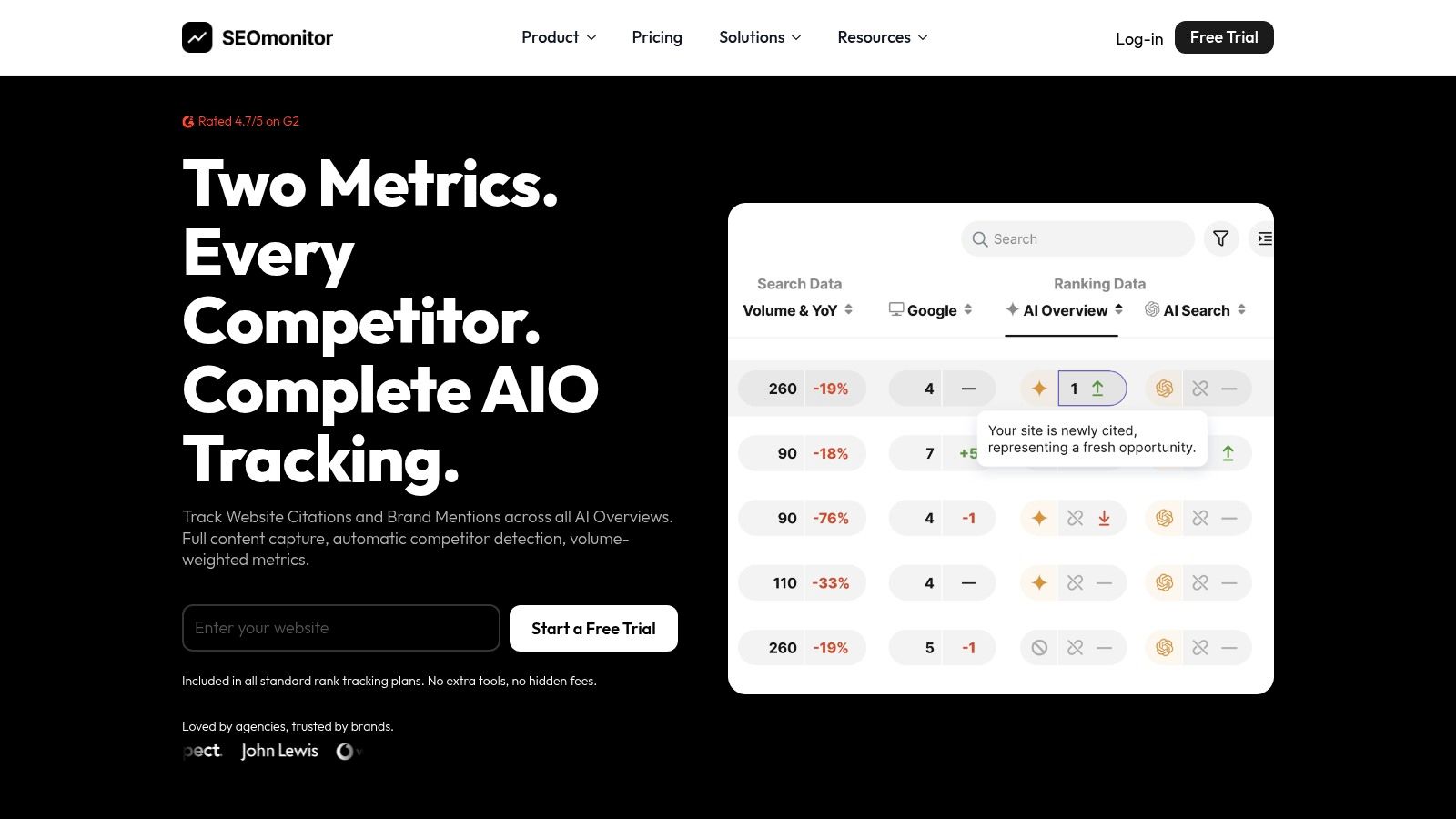
This integration helps teams model the potential impact of AIOs without needing a separate, standalone tool. By distinguishing between brand mentions and direct citations, SEOmonitor provides the clarity needed to understand not just if you are visible, but the quality of that visibility. This makes it one of the best AI visibility analytics for search optimization workflows that prioritize efficiency and integrated data.
Integrated AI Visibility and Forecasting
- Daily AIO Capture: Tracks the presence and full content of AI Overviews daily across both desktop and mobile SERPs for your monitored keywords.
- Mentions vs. Citations: Clearly separates passive brand mentions from valuable, linked citations, allowing for a more accurate assessment of brand authority in AI answers.
- Competitor AIO Tracking: Monitors competitor presence within AIOs for your target keywords, revealing who is dominating the AI generated space.
- Integrated Impact Modeling: Combines AIO data with standard ranking and traffic data, helping you forecast the business impact of gaining or losing AI visibility.
Platform Evaluation
Use the integrated view to create a custom dashboard that shows the correlation between a drop in traditional organic clicks and an increase in competitor citations within AI Overviews for the same keyword group. This provides a clear narrative for why traffic may be shifting.
Website: https://www.seomonitor.com/sge-tracking/
11. Morningscore
Morningscore provides a lightweight and accessible solution for tracking Google AI Overviews, specifically targeting small to medium sized enterprises and marketing agencies. Its strength lies in its simplicity, offering daily checks to see which keywords trigger an AIO and providing clear snapshots as proof of your brand's citation or mention. This straightforward approach allows less technical teams to quickly grasp their visibility within AI generated search results without the complexity of enterprise level software.
The platform focuses on delivering actionable insights through domain level visibility metrics and simplified workflows. This design helps users prioritize which content pieces need optimization to gain or improve their standing in AIOs. By stripping away complex features, it presents a clear path from data to action for teams needing to prove ROI on a smaller scale.
Accessible Analytics for AI Search Optimization
- Daily AIO Detection: Automatically scans your keyword list each day to identify the presence of an AI Overview.
- Domain Citation Monitoring: Tracks when your domain or a competitor's domain is cited or mentioned within an AIO, complete with snapshots for verification.
- Simplified Opportunity Workflow: The interface is designed to help users easily identify and prioritize keywords where AIO visibility is a viable opportunity.
- Quick Value Validation: A free trial allows teams to test the functionality and see tangible results before committing to a subscription.
Platform Evaluation
Use the free trial to monitor your top 10 to 20 commercial intent keywords. Analyze the provided AIO snapshots to understand the structure and sources Google prefers for those queries, giving you a clear template for your own content updates.
Website: https://morningscore.io/ai-overviews-tracker/
12. Surfer (AI Tracker)
Surfer’s AI Tracker is a specialized add on designed to bridge the gap between content creation and AI visibility analysis. Rather than operating as a standalone rank tracker, it integrates directly into the Surfer ecosystem, allowing content teams to immediately gauge their performance across multiple generative AI models. It moves beyond just Google's AI Overviews to provide insights from Perplexity, ChatGPT, and Google's AI Mode, offering a more comprehensive view of a brand’s presence in the emerging AI search field.
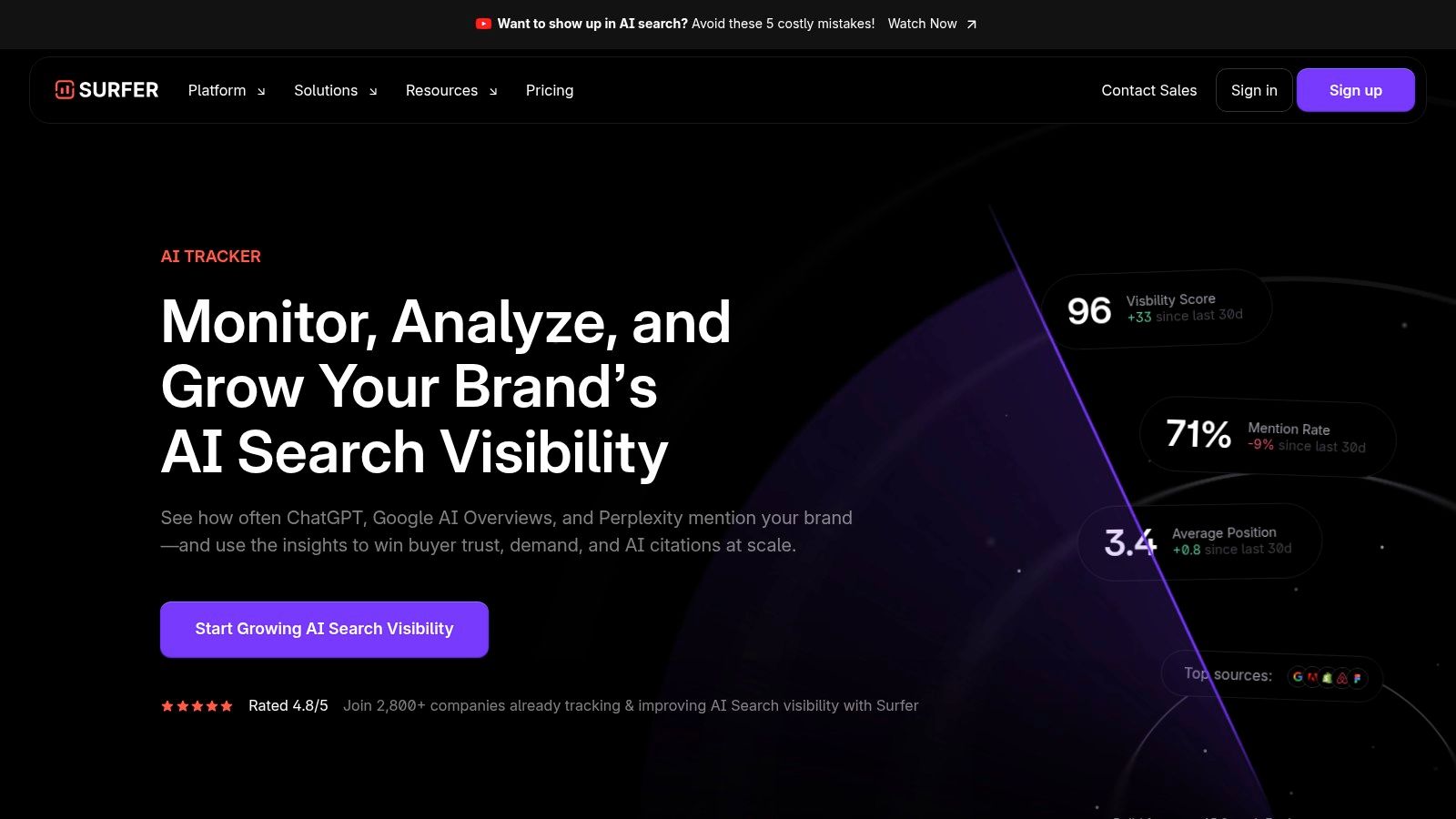
This tool is uniquely positioned for content focused SEOs who are already using Surfer to optimize articles. By scraping real, live answers instead of relying on limited APIs, it provides an accurate snapshot of how your brand is being mentioned or cited, connecting content optimization efforts directly to their impact on AI generated responses. This makes it one of the best AI visibility analytics for search optimization for teams focused on the content creation lifecycle.
Features for Content Focused Generative SEO
- Cross Model Visibility Tracking: Monitors your brand’s presence across Google AIO, AI Mode, ChatGPT, and Perplexity from a single dashboard.
- Citation Source Extraction: Identifies the exact URLs being cited in AI answers, helping you understand which content pieces are driving your visibility.
- Response Framing and Context: Analyzes how your brand or content is framed within the AI generated text, giving context to simple mentions.
- Integrated Workflow: As an add on, it connects AI visibility data directly with Surfer’s content optimization and auditing tools.
Platform Evaluation
Use the AI Tracker to monitor a newly published or optimized article. Track its citation frequency across different AI models over the first 30 days to measure the direct impact of your content efforts on your generative SEO visibility.
Website: https://surferseo.com/ai-tracker/
Agent Analytics and Other AI Visibility Startups to Watch
The AI visibility market is still early enough that new categories are forming in public. One of the most interesting is agent analytics: products focused not only on where brands appear in AI answers, but on whether AI systems themselves are reaching, citing, or transacting with websites. That category is gaining urgency because AI systems now generate their own traffic patterns. HUMAN Security reported that AI agent traffic grew 7,851% in late 2025, and argued that companies need “agentic visibility” to distinguish AI agent traffic from humans and conventional bots in its agentic visibility report. That creates room for startups that sit between SEO monitoring, analytics, and AI observability.
Agent Analytics is part of that emerging group of AI visibility products to watch. Based on the limited public evidence available, it appears aligned with the idea that brands need clearer measurement around AI-driven discovery, AI-originated interactions, and competitive presence in generative environments. What I would want to verify before treating it as a primary platform is reporting depth: Does it expose source-level citations, support historical comparisons, and benchmark competitors in a way an SEO or growth team can operationalize? If the answer is yes, it becomes much more than a novelty category label. If not, it may remain a useful directional dashboard rather than a system of record. That is the core question for any agent analytics ai visibility products company trying to move from emerging category awareness into practical adoption.
Compared with more established platforms, startups in this segment usually win on speed, focus, and category-native thinking. They can be better at surfacing newer visibility metrics or AI interaction signals that older SEO suites were not designed around. They are usually weaker on proven exports, API maturity, pricing predictability, and long historical datasets. For buyers, that means these tools are worth monitoring closely, especially if your company cares about AI referral traffic and chatbot discovery, but you should validate the fundamentals before replacing a mature SEO reporting stack. If you are comparing ai search optimization startups with top visibility metrics, the most useful tests are still straightforward: citation evidence, historical retention, competitor depth, and whether the outputs can support real reporting.
Other vendors are pushing the market forward too. The category now includes platforms and modules from larger analytics and SEO companies as well as startups, which is a sign that AI visibility has moved beyond experimentation and into budgeted measurement. The best emerging products are not just counting mentions; they are trying to connect visibility, citations, competitors, and resulting traffic in one workflow.
A Comparison of the Top AI Visibility Analytics Platforms
The strongest choice depends on whether you need cross-engine monitoring, enterprise Google AIO forensics, or deep competitor benchmarking. This comparison is built to help with that decision rather than just list features.
| Tool | Best for | AI engines covered beyond Google | Historical data retention | Competitor benchmarking depth | Citation/source visibility | Best-fit team size | Notes |
|---|---|---|---|---|---|---|---|
| Riff Analytics | Cross-engine AI visibility for search teams | Yes — ChatGPT, Perplexity, Claude, Gemini, Grok, Google AIO | Useful trend and source comparison, but verify archive depth for your use case | Strong practical benchmarking around mentions, citations, and gaps | Yes, source-oriented workflows are a core strength | SMB to mid-market, agencies, lean in-house teams | Best balance of breadth and usability if you need more than Google-only tracking |
| seoClarity | Enterprise Google AI Overviews operations | Limited; primarily Google AIO | Strong historical AIO comparison inside enterprise SEO workflows | Strong at scale for large tracked keyword sets | Yes | Enterprise | Ideal if you already manage large SEO programs in one platform |
| Semrush | Teams already using an all-in-one SEO suite | Minimal beyond Google in this context | Moderate inside broader rank tracking workflows | Good, especially for existing Semrush users | Some source and competitor context in AIO workflows | SMB to enterprise | Best when adoption speed matters more than specialized depth |
| BrightEdge | Enterprise content and AI Overview strategy | Primarily Google-focused in this use case | Good trend visibility; stronger in strategic workflow integration than raw archives | Strong enterprise benchmarking | Good, with content strategy tie-ins | Enterprise | Best for organizations pairing AI monitoring with content operations |
| SISTRIX | Tactical AIO analysis with historical SERP review | Primarily Google | Strong SERP archive value | Good for practical competitor review | Yes | Mid-market to enterprise | Very good for inspecting how cited sources changed over time |
| Similarweb | Multi-engine brand monitoring and market intelligence | Yes — strong multi-engine orientation | Moderate; stronger on market trends than HTML-style SERP archiving | Strong market and brand-level benchmarking | Good, depending on product module | Mid-market to enterprise | Best for competitive intelligence across the wider AI ecosystem |
| STAT (Moz) | Enterprise AIO forensics and historical SERP research | No meaningful broad chatbot focus; strongest on Google | Excellent daily HTML SERP archiving | Strong for segmented enterprise analysis | Yes | Enterprise data teams | Best for diagnosing visibility losses after Google SERP changes |
| Nozzle | Competitive Google AIO reporting | Mostly Google | Good keyword-level tracking history | Strong share-of-voice style analysis | Good at keyword-level inspection | Agencies, advanced in-house teams | Useful when competitive reporting is the main job |
| SE Ranking | Affordable multi-engine coverage inside an SEO suite | Yes — ChatGPT, Perplexity, Gemini, Google AIO | Moderate | Good | Strong “Sources” workflow | SMB to mid-market | Good fit for teams wanting cross-engine data without enterprise complexity |
| SEOmonitor | Agency reporting and forecasting with AIO context | Mostly Google | Good in ongoing project tracking | Good | Yes | Agencies, in-house teams | Best if you want AIO data embedded in forecasting and client reporting |
| Morningscore | Lightweight AIO monitoring | Mostly Google | Light to moderate | Basic to moderate | Snapshot-style evidence | SMBs, small agencies | Good entry point, not a deep intelligence platform |
| Surfer (AI Tracker) | Content teams linking optimization to AI visibility | Yes, focused on a subset of live engines | Moderate | Moderate | Yes | Content teams, SMB to mid-market | Best for teams already operating inside Surfer |
A few patterns stand out. For multi-engine brand monitoring, Riff Analytics, Similarweb, SE Ranking, and Surfer are the most natural starting points because they extend beyond Google. For enterprise AIO forensics, STAT is the standout due to daily HTML SERP archiving and segmentation depth, while seoClarity and BrightEdge are strong if you want AIO tracking inside a broader enterprise SEO stack. For competitor analysis, Similarweb is strongest at market-level AI visibility, while Nozzle and Riff are especially useful when you want practical competitive reporting tied to search execution. For teams already committed to an all-in-one SEO suite, Semrush, seoClarity, BrightEdge, and SE Ranking usually deliver the smoothest operational fit.
If your buying question is which platform excels in ai visibility metrics, the answer depends on the metric class you care about. Riff is strongest when you want cross-engine visibility plus source-level insight. STAT Search Analytics is strongest when ai overview tracking and historical Google SERP evidence are the deciding factors. For buyers specifically evaluating the best companies for competitor analysis in ai visibility, Similarweb, Riff, Nozzle, and STAT are the clearest shortlist because they emphasize either market benchmarks, citation gaps, or historical comparative evidence.
| Tool | Primary Focus | Key Metrics | AI Engines Covered | Ideal User |
|---|---|---|---|---|
| Riff Analytics | Multi engine AI visibility | Citation Sources, AI Readiness Score | ChatGPT, Perplexity, Gemini, AIO, etc. | SEO Managers, Content Teams |
| seoClarity | Enterprise Google AIO tracking | Mentions vs. Citations, AIO Frequency | Google AIO | Large Enterprises |
| Semrush | Integrated SEO suite | AIO SERP Feature Presence | Google AIO | All in one SEO Teams |
| STAT (Moz) | Large scale SERP capture | Full HTML SERP data, AIO Trends | Google AIO | Enterprise Data Teams |
| Similarweb | Market intelligence | AI Brand Visibility, Traffic Estimates | ChatGPT, Perplexity, Gemini | Competitive Intel Teams |
| Nozzle | Competitive AIO analysis | AIO Share of Voice | Google AIO | SEO Agencies, In house Experts |
Summary: Choosing Your Platform for the Future of Search
If your priority is multi-engine AI visibility, start with Riff Analytics, Similarweb, or SE Ranking. Riff is the most balanced choice for teams that want broad engine coverage plus source and competitor insight without requiring an enterprise implementation. Similarweb is stronger when market intelligence and brand benchmarking matter as much as direct optimization. SE Ranking is a good value play for teams that want multi-engine data inside a broader SEO suite.
If your priority is Google AI Overviews tracking at enterprise scale, shortlist STAT, seoClarity, and BrightEdge. STAT is the best fit when historical SERP capture, exports, and forensic analysis are essential. seoClarity is strong for large organizations already managing enterprise SEO workflows and needing AIO reporting at scale. BrightEdge works well when content operations and AI visibility strategy need to stay tightly connected.
If your priority is competitor analysis and historical SERP research, look closely at Similarweb, STAT, Nozzle, and SISTRIX. Similarweb is strongest for broader AI-market intelligence; STAT and SISTRIX are stronger when you need to inspect how Google’s cited sources changed over time; Nozzle is especially useful for competitive share-of-voice analysis inside Google’s AI results.
If you need an ai serp visibility tracker for a lean team, Riff, SE Ranking, and Morningscore are usually the easiest starting points because they keep reporting more accessible than enterprise-heavy platforms. If your main requirement is the best ai search optimization historical data software, STAT and SISTRIX are the stronger fits because historical SERP evidence is central to their value.
If you only shortlist three tools, make it Riff Analytics for cross-engine visibility, STAT Search Analytics for enterprise Google AIO forensics, and Similarweb for competitive AI market intelligence. Those three cover the clearest buying paths in this category and provide a practical starting point grounded in the evaluation criteria applied.
Frequently Asked Questions (FAQ)
What is the best way to track my brand’s visibility in ChatGPT?
To track brand visibility in ChatGPT, you need a specialized AI analytics tool like Riff Analytics, SE Ranking, or Surfer AI Tracker. These platforms monitor how often your brand or content is mentioned and cited in AI responses across various models, including ChatGPT. They move beyond Google centric metrics to give you a broader view of your generative SEO performance.
How can I improve my content for AI search optimization in 2026?
To improve your content for AI search, focus on creating clear, factual, and well structured information that directly answers user questions. Use schema markup to provide context for search engines and LLMs. Prioritize building topical authority with content clusters and ensure your information is supported by expert sources, as these are key signals AI models use to determine trustworthy answers.
Which AI analytics tools can measure visibility in Google AI Overviews?
Most major SEO platforms now offer features to measure visibility in Google AI Overviews. Tools like seoClarity, Semrush, BrightEdge, and STAT are excellent for enterprise level AIO tracking. For more specialized or accessible options, consider Nozzle, Morningscore, or SEOmonitor, which provide detailed data on citations, mentions, and competitor performance within Google's AI generated results.