Your Guide to the Modern AI Search Visibility Tool
Updated February 1, 2026

In 2025, the old rules of search no longer apply. An AI search visibility tool is your new command center for a world where customers get answers directly from AI like ChatGPT and Google's AI Overviews, not from a list of blue links. In simple terms, this tool shows you how often your brand is cited as a trusted source inside these AI generated answers, a critical metric for a future where being in the answer is more valuable than ranking #1.
What Is an AI Search Visibility Tool and Why It Matters Now
Navigating today's search landscape with old SEO tactics is like using a paper map in a city that rebuilds itself daily. The way people find information has fundamentally changed. Users are shifting from scanning ranked lists to receiving direct, conversational answers from an AI.
An AI search visibility tool is built for this new reality. Its core function is to monitor your brand’s presence inside these AI generated responses, a metric often called "share of answer." This is a massive departure from tracking simple keyword positions. As the search landscape evolves towards 2026, understanding your visibility within large language models (LLMs) is no longer optional; it's essential for survival.
According to Microsoft, visibility in AI search is no longer about just being found in a ranked list; it’s about being selected as a trusted piece of content for the final AI generated answer.
Being cited as a source in an AI conversation is quickly becoming more valuable than a top ranking. Why? Because users get their answers without ever needing to click through to a website, making your brand's mention within the answer itself the new finish line.
Why Generative SEO Tools Are Essential for Your Strategy
If you're still relying only on old school SEO metrics, you're flying blind. An AI search visibility tool provides the intelligence needed to adapt and win in this new environment by tracking your AI footprint across various LLMs.
To make this shift, you must understand how to make your website AI-friendly so your brand still shows up when the ten blue links disappear. A dedicated tool makes this process manageable and, most importantly, data driven. You can dive deeper into this strategy in our guide on Answer Engine Optimization. These tools offer a clear path forward, showing you which content resonates with AI models and where competitors are winning the conversation.
The New Search Landscape and AI Search Visibility
The ground is shifting beneath our feet. For two decades, we played the game of links and rankings. Now, that entire model is being replaced by a new ecosystem of AI driven discovery, where direct answers are the new currency. This isn’t a far off prediction; it's actively reshaping user behavior and website traffic right now.
Imagine a world where Google's total dominance isn't a given. That world is here. Recent search market share statistics show a landscape in flux, driven by AI interfaces like ChatGPT, which commands a significant portion of the AI chatbot market. With billions of monthly visits, ChatGPT has become a primary destination for information, fundamentally changing how brands need to appear online.
Tracking AI Mentions in a Zero Click World
This new environment is creating a "zero click" reality. AI Overviews and chatbot responses often satisfy a user's question right inside the AI's interface, making a click through to a website unnecessary. We’re no longer just competing for clicks; we're now competing for citations within those answers. This marks the emergence of a new north star metric for generative SEO: answer share.
An AI search visibility tool is purpose built to track this critical new KPI. Without it, you are essentially invisible to a huge segment of your audience who now turns to AI for answers first. By monitoring your answer share, you can adapt your content strategy, see how you stack up against competitors, and ensure your brand's voice is heard in the new conversations that are driving decisions.
Core Features of a Powerful AI Visibility Platform
Not all platforms are created equal. An effective AI search visibility tool has to go way beyond surface level data to give you intelligence you can act on. The best ones are built to deliver comprehensive tracking, deep analysis, and crystal clear competitive insights. These are the features that form the backbone of a system truly built for this new era of generative SEO. They give you the visibility you need into how AI models actually perceive and use your content. Without them, you’re basically just guessing.
Multi Engine LLM Tracking Capabilities
First things first: any top tier tool has to track your brand across multiple large language models (LLMs). The AI search world is fragmented. Your customers are turning to different engines like ChatGPT, Perplexity, and Gemini for answers, and if you only monitor one, you're leaving massive blind spots. Effective LLM tracking means seeing where you’re cited, how you’re cited, and which specific pieces of content are getting referenced across the entire ecosystem. This multi engine view is absolutely critical for building a resilient content strategy that works no matter which AI a user prefers.
Citation Source Analysis for AI Visibility
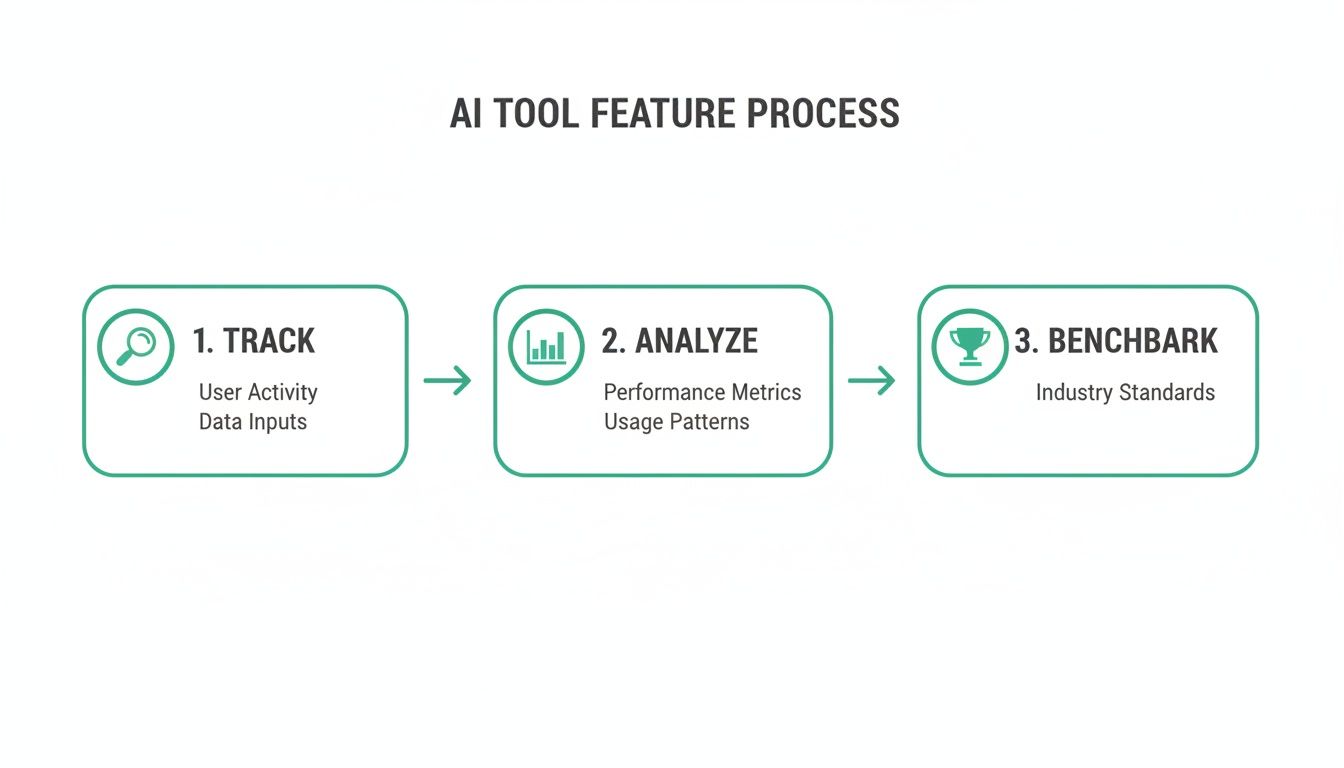
Just knowing you were mentioned isn't enough. A powerful platform needs to offer deep citation source analysis, pinpointing the exact URLs and content pieces that AI models are referencing. This feature turns raw data into a strategic roadmap, showing you precisely which assets are your heavy hitters for AI visibility.
A great tool also lets you benchmark against competitors, showing you where they’re earning citations that you aren't. This instantly reveals content gaps you can target to reclaim your share of the conversation. To properly evaluate any AI search visibility tool, you need a checklist that ensures it provides the strategic depth required to actually win.
| Feature | What It Does | Why It's Critical for Your Team |
|---|---|---|
| Multi Engine Tracking | Monitors brand mentions and citations across major AI engines like ChatGPT, Perplexity, and Gemini. | Provides a complete picture of your AI footprint, preventing blind spots from focusing on a single platform. |
| Citation Source Analysis | Pinpoints the exact URLs and content pieces that LLMs are citing in their responses. | Identifies your most valuable content for AI, allowing you to double down on what works and optimize underperforming assets. |
| Competitor Benchmarking | Tracks the citation frequency and sources of your key competitors within the same AI engines. | Uncovers strategic content gaps and opportunities where competitors are winning the conversation, guiding your content strategy. |
| Answer Share Metrics | Quantifies your visibility as a percentage of total citations for a given set of topics or keywords. | Delivers a clear, measurable KPI to track progress and demonstrate the ROI of your generative SEO efforts. |
A platform armed with these features doesn't just show you data. It gives you a clear path forward, helping you move from reactive monitoring to proactive strategy in the age of AI search.
How to Use an AI Visibility Tool for a Competitive Edge
Let's move from theory to action. This is where you get a real advantage. An AI search visibility tool isn’t just about collecting data; it’s about turning that data into a strategic weapon. It gives you a clear, repeatable workflow to systematically outmaneuver your rivals in the AI powered conversations that your customers are having right now.
Your first move is to run a baseline visibility audit. This audit establishes your current "answer share" across key AI engines like ChatGPT and Perplexity. For example, a B2B SaaS company would want to track how often its brand gets cited for queries like “best project management software for remote teams” compared to its top three competitors. This gives you a clear, honest starting point.
Find Where Competitors Are Getting AI Citations
Once you have that baseline, the real work begins. An AI visibility platform is brilliant at pinpointing competitor citation gaps. It shows you exactly where rivals are being mentioned as sources and you’re invisible. This is a goldmine of opportunity.
Imagine our B2B SaaS company discovers a competitor is constantly cited for “how to improve team collaboration.” The tool would highlight the specific blog post that AI engines keep referencing. That single insight lets the company create a more thorough, data rich resource on the same topic, one that’s built from the ground up to be a better source for AI. This isn't about guesswork. It’s a data driven approach to content strategy that focuses your effort on topics with the highest chance of making an impact. You can dig deeper into this process in our guide on how to do competitor analysis in SEO.
Prioritizing Content With an AI Search Monitoring Tool
With the gaps clearly identified, the final step is to prioritize. A good AI search monitoring tool provides the context you need to make smart calls. Instead of randomly optimizing pages, you can zero in on high value topics where competitors are currently winning the conversation. This ensures your resources are spent where they'll have the biggest impact on your answer share. This strategic focus is critical. By turning raw data into a clear strategy, your team can secure its place in the conversations driving your industry forward.
Measuring Success with Your AI SEO Efforts
In the new world of generative search, the old rules don't quite apply. For years, we obsessed over keyword rankings and organic traffic, but those metrics only tell half the story now. To really understand what's working, you have to shift your focus from website visits to brand influence inside the AI's answer.
This means we need a new scorecard. Instead of asking, "How high do we rank?" the most important question has become, "How often are we the source?" This isn't a small shift; it's a fundamental change. By 2026, many experts predict that a majority of search journeys will end without a click to an external site. You can dig into these AI search statistics to see just how much the ground is moving beneath our feet.
Key Metrics to Track with Your AI Visibility Tool
Tracking the right data is everything. A dedicated AI search visibility tool is built to monitor the KPIs that traditional platforms completely miss, giving you a clear picture of how you're actually performing in this new landscape. These are the numbers that tell a compelling ROI story to your stakeholders.
The most important KPIs to watch are:
Answer Share: This is your north star metric. It measures the percentage of AI generated answers for your target topics where your brand is cited as a source.
Citation Frequency: This tracks the total number of times your content is referenced across different AI engines over a set period.
Competitor Visibility Gap: The tool flags topics where your rivals are consistently named, but you're nowhere to be found, pointing you directly to your next content play.
If you want to go deeper on this, check out our guide on how to calculate your share of voice for a more complete view of your brand's presence.
Translating AI Search Visibility into Business ROI
At first glance, the referral traffic from AI answers might seem small. Do not be fooled. That traffic is hyper qualified. A user who clicks a citation link has already seen the AI validate your brand as an authority on the topic. They are not just browsing; they are coming to you with high intent, making them far more likely to convert. This requires a new way of thinking about ROI, one that prioritizes influence and authority over raw volume. By tracking these new metrics with a dedicated tool, you can finally prove how your work is building real brand authority and making a direct impact on the bottom line.
Getting Started with an AI Search Visibility Tool
Jumping into the new world of AI driven search does not have to be a massive, complicated project. Adopting an AI search visibility tool is about securing your brand's future relevance, and the best way to start is with a simple test that shows you exactly what's at stake.
By 2026, the brands that figure out how to show up in AI answers will be the ones that own the conversation. The goal right now is simple: get in early and build a competitive advantage before everyone else catches up. A quick proof of concept or a free trial is all you need to get a clear picture of where you stand today.
Your Quick Start Plan with a Generative SEO Tool
Getting started should be about demonstrating value from day one. Forget about a huge overhaul. Think of this as a small, strategic test to find your biggest opportunities.
Here’s a simple plan you can follow:
Start a Trial: Sign up for a free trial with a platform like Riff Analytics to get an instant baseline of your current answer share.
Run a Competitor Audit: Track a few of your most important topics and see how your visibility stacks up against your top three competitors.
Find One High Value Gap: Pinpoint a single, crucial query where a competitor is consistently cited, but you’re nowhere to be found.
Optimize and Measure: Tweak one of your existing articles to better answer that specific query. Then, watch how your answer share improves over the next few weeks.
This focused approach gives you clean, actionable data that proves the value of a dedicated generative SEO tool. The search game has fundamentally changed, and having the right tool is no longer optional.
Summary
The search world we knew is gone. AI engines are the new gatekeepers of information, and "answer share" is the new benchmark for success. Ignoring this shift means risking your relevance. A specialized AI search visibility tool gives you the data you need to navigate this new terrain, turning what looks like a threat into a strategic opportunity for growth. It is no longer just about ranking; it is about becoming the source of truth for the AI models that now guide your customers.
Frequently Asked Questions
What is the difference between AI search visibility and traditional SEO?
Traditional SEO focuses on ranking web pages in a list of links. AI search visibility measures how often your brand or content is cited as a source inside direct answers generated by AI engines like ChatGPT or Perplexity. It's about being in the answer, not just near it.
How does LLM tracking help my marketing strategy?
LLM tracking gives you a direct look into which pieces of your content language models see as authoritative. This lets you pinpoint your most valuable content assets, understand why they work, and create more of what’s earning you citations and increasing your answer share.
Can I measure the ROI of improving my AI search mentions?
Absolutely. While raw clicks from search results might decrease, the quality of traffic from an AI citation is often much higher. A user arriving from an AI generated answer already sees you as a trusted source, leading to higher intent, better engagement, and stronger conversion rates.
How is an AI search visibility tool different from Semrush or Ahrefs?
A traditional SEO platform like Semrush or Ahrefs tells you how you rank on a results page. An AI search visibility tool shows you if you’re actually cited in the AI generated answer itself. One measures your position on a list; the other measures your share of the narrative.
What kind of content gets cited most often by AI?
AI models prioritize clarity, facts, and structure from trusted sources. Content that performs well includes in depth guides, original research, well organized FAQs, and articles backed by hard data. Simple tables and structured data also perform incredibly well because they are easy for models to parse and understand.