AI Search Optimization: A Guide to Getting Cited in 2025
Updated December 11, 2025
For years, the SEO playbook was simple: climb to the top of Google's blue links. That game is over. In 2025 and 2026, success in search isn't about ranking first; it's about becoming the answer. Users are no longer sifting through pages of results. They are getting direct, conversational answers from AI, and your new job is to ensure your content is the trusted source fueling those responses.
AI Search Optimization is the practice of structuring your content and brand signals so that AI engines like Google's AI Overviews, Perplexity, and ChatGPT choose your information to cite in their generated answers. This isn't a future trend; it's the new reality. An analysis of over 41 million AI search results by authoritive sources revealed that while Google's market share dipped for the first time in a decade, ChatGPT's usage exploded by over 400%, reshaping how information is discovered.
What is the Goal of AI Search Optimization?
While traditional SEO and AI optimization share foundational elements, their end goals are worlds apart. Old school SEO was a race for the top spot on a list. The new goal of AI search optimization is to become the primary, citable source for AI engines. It’s about being the definitive expert that the AI quotes with confidence. For a closer look, check out our guide on AI SEO vs. traditional SEO.
This new reality demands a new mindset. Your content must be ruthlessly clear, factually airtight, and structured for a machine to read and trust it. Success now hinges on one simple question: how easily can an AI understand, verify, and repurpose your information? The brands that master this will become the undeniable authorities that AI systems turn to first, cementing their place in the search landscape of tomorrow.

Auditing Your Readiness for Generative AI Search
Before diving into a new strategy, you need an honest look at where you stand. An audit for generative SEO is not about checking keyword rankings; it's about evaluating your entire digital footprint through the logical lens of a machine. By 2026, the brands that win will be the ones that systematically prepared their content and technical foundation to be trusted and cited by AI. This process means assessing your current assets for the signals that Large Language Models (LLMs) crave: clarity, factual accuracy, and how easily your content can be pulled into a citation.
Assessing Your Content Strategy for AI Search
First, you must analyze your content's machine readability. AI engines do not read like humans; they parse information into structured, bite sized pieces. Content that is easy for them to break down into definitive, self contained facts is far more likely to get used in a generated answer. Start by looking at your key pages. Do they use direct, declarative sentences? Is data laid out in digestible formats like lists and tables? A huge wall of dense text is a major red flag for an AI parser.
Next, audit your entity presence. An entity is a well defined concept like your company, your product, or your CEO. AI relies on knowledge graphs like Wikidata and Google's own to verify facts. If your brand is not clearly defined as an entity with consistent information, LLMs will hesitate to trust you as an authority.
Evaluating Technical Signals for AI Search Visibility
Your site's technical health is the bedrock of trust for AI engines. A solid technical audit for AI search goes way beyond checking page speed. You need to get granular with your structured data implementation. Proper use of Schema.org markup is non negotiable. It translates your content into a language that machines understand without ambiguity, clearly defining your products, articles, organization, and FAQs.
This is where a detailed checklist becomes your best friend. To get a feel for how to build a rock solid audit process, check out this comprehensive site audit checklist. It gives you a structured way to make sure you hit every critical technical and content element. If you need expert guidance, it can be worth talking to specialists, like those featured in this roundup of top SEO Consultants for AI Search Results.
Creating Citation-Worthy Content for AI Engines
In the new era of generative SEO, great content is content that gets cited. As we push deeper into 2025 and 2026, the game is no longer just about attracting human readers. It's about creating information that AI assistants can easily parse, trust, and reference in their generated answers. This means you have to structure your content not just for readability, but for machine digestibility. Citation worthy content is clear, factual, and laid out so an LLM can lift a specific piece of information and confidently attribute it to you.

Optimizing Content Structure for AI Search
To get your AI search optimization right, you have to rethink how you present information. LLMs do not read a page top to bottom like a person. They break it down into modular chunks of information. If your content is just a dense wall of text, you are making the AI’s job harder and dramatically lowering your chances of being cited. Instead, your priority should be formats that create clean, reusable segments of information like direct question and answer blocks, bulleted and numbered lists, and comparison tables.
Enhancing AI Search Visibility with Semantic Richness
Semantic richness is a technical way of saying you need to build deep topical authority. It's about weaving related concepts, entities, and synonyms into your content to create a web of interconnected meaning that an AI can easily understand. This is how you establish your content as a comprehensive resource. For example, a page about "quiet dishwashers" should also include related terms like "decibel ratings," "sound insulation," "open concept kitchens," and "noise levels." This reinforces the core topic and signals to an AI that your content is truly authoritative. According to Microsoft, "clear alignment between your page title, H1, and description improves both discoverability and confidence signals for AI systems."
A core part of modern AI search optimization is learning how to convert AI text to human text that ranks, ensuring your content is both machine readable and genuinely useful for people.
Building Brand Authority for Generative SEO
A powerful and often overlooked part of generative SEO is brand authority. Industry analysis consistently shows that well established, trusted domains are far more likely to be sourced in AI answers. This makes a strong digital PR and citation building strategy more important than ever. Securing mentions and links from authoritative publications, industry reports, and academic journals acts as a powerful vote of confidence. Each high quality citation reinforces your brand's credibility, making you a safer and more appealing choice for an AI engine to reference. This is a core pillar of a successful approach to Answer Engine Optimization.
Technical Signals That Build Trust with LLMs
Winning in AI search optimization is not just about what you write; it's about what happens behind the scenes. While citation worthy content is the star, it's the technical and off page signals that give AI models the confidence to feature it. By 2026, the brands dominating AI answers will be the ones who mastered these trust signals long ago. This comes down to two critical areas: implementing robust, machine readable structured data and building a powerful network of external citations. Think of these as endorsements that tell Large Language Models your information is not just accurate, but genuinely authoritative.
Improving AI Search Optimization with Structured Data
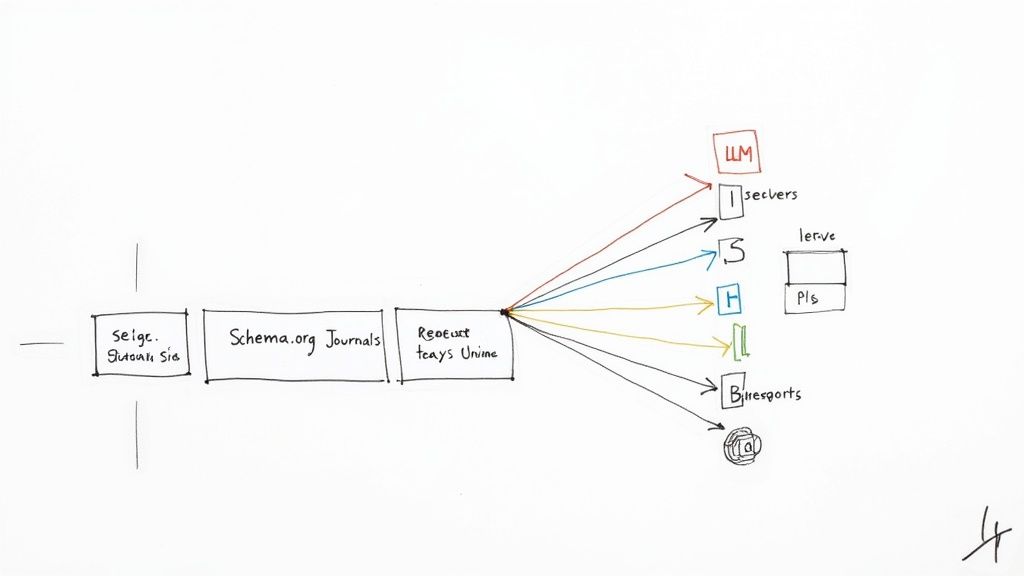
Structured data, especially Schema.org markup, is the native language of AI. It lets you explicitly define your content and entities for machines, completely removing the guesswork. While we've used schema for years in traditional SEO to get rich snippets, its role in AI search optimization is far more fundamental. It helps an LLM understand not just what your page is about, but how all the different pieces of information relate to each other. This direct communication turns your webpage from a simple document into a structured database that an AI can query with absolute confidence.
The Role of Schema in an Effective AI Search Optimization Strategy
Implementing the right schema types is what builds deep, technical trust. Go beyond the basics like Organization and Article schema. Think about what information would make your brand an undeniable authority. For instance, FAQPage schema is a goldmine because it directly answers common questions in a format that AI assistants can easily lift. Person schema establishes the expertise and credentials of your authors, adding another layer of authority. When you map out your key entities with precise schema, you hand the LLM a clear, unambiguous roadmap to your expertise.
Building a Citation Network for Generative SEO
While your on page signals are vital, generative SEO also leans heavily on off page validation. One of the strongest trust signals you can send is a powerful citation network built from authoritative sources. Every mention or link from a respected publication, academic journal, or industry report acts as a powerful external endorsement. LLMs are designed to synthesize information from multiple credible sources. When they repeatedly see your brand cited in trusted contexts, it reinforces your authority. This is different from traditional link building; for AI, the context and credibility of the source matter far more than raw link equity. This is where a tool like Riff Analytics becomes invaluable, helping you monitor your citations and those of competitors.
Measuring Your AI Search Optimization Success
How do you know if your AI search optimization efforts are paying off? Forget traditional metrics. Keyword rankings and organic traffic reports do not cut it anymore. As we push deeper into 2025 and 2026, success is not about climbing a list of blue links, it's about being cited directly in the AI generated answers people trust.
To measure this new reality, you need a different framework. This means shifting away from simple rank tracking and embracing metrics that truly reflect your visibility inside AI models. The name of the game is answer share: how often and how prominently your brand gets cited across key AI platforms like Google’s AI Overviews, Perplexity, and ChatGPT.
Key Metrics for LLM Tracking and AI Search Visibility
Monitoring your AI search visibility requires a mental shift from watching your domain on a SERP to tracking how often your content is used as a legitimate source. This new discipline, often called LLM tracking, boils down to a few core metrics:
- Citation Frequency: How many times is your brand or a specific URL cited as a source in an AI answer for your core topics?
- Contextual Relevance: How are you being cited? Is the context positive and accurate?
- Competitor Answer Share: Who else is being cited for your topics? Spotting where competitors show up is the fastest way to find content and PR gaps.
- Source URL Penetration: Which specific pages on your site are the AI's favorites?
This is not a theoretical shift. Roughly 86% of SEO professionals have already woven AI into their workflows. You can find more on these AI SEO statistics here.
A Practical Workflow for Generative SEO Measurement
You cannot track these new metrics with old tools. Modern platforms like Riff Analytics were built for this purpose. They let you monitor citations, dissect competitor performance, and understand the narrative forming around your brand inside AI responses. A solid workflow starts with setting up tracking for your core topics and key competitor domains. From there, you can check in on your dashboards to see how your citation frequency is trending. The real gold is when you spot a competitor getting cited by a source you have not even thought of. That is an instant, actionable opportunity for a digital PR pitch or a new content partnership.
Comparing Traditional and AI Search Measurement Tools
The difference between old and new measurement is stark. It is not just a feature update; it is a fundamental change in what success looks like.
| Metric Category | Traditional SEO Tools (e.g., SEMrush) | AI Search Optimization Tools (e.g., Riff Analytics) |
|---|---|---|
| Primary Focus | Keyword rankings and organic traffic volume. | Citation frequency and answer share in AI responses. |
| Core Metric | SERP position for a target keyword. | Number of times a URL is sourced by an LLM. |
| Competitor Analysis | Tracking competitor keyword rankings. | Identifying competitor citations and source gaps. |
| Success Indicator | A #1 ranking on Google. | Being the most frequently cited source for a topic. |
By making this switch, you can move past outdated vanity metrics and demonstrate the real world impact of your AI search optimization strategy. You can dig deeper into AI search industry projections and findings to see the numbers for yourself.
Summary and Key Takeaways
The field of AI search optimization is a structural evolution in how people find information. Success in 2025 and beyond hinges on your ability to produce clear, factual, and well structured content that machines can easily digest and trust. The goal is no longer just to be found; the goal is to be the source of truth. By auditing your content, building citation worthy assets, perfecting your technical signals, and adopting a new way of measuring success, you will secure your brand’s authority for years to come.
Frequently Asked Questions about AI Search Optimization
What is the main goal of AI search optimization?
The primary goal is to make your content a trusted, citable source for AI models. Instead of just ranking on a search results page, the aim is for AI to feature your information, brand, and links directly within its generated answers, establishing you as an authority.
How is AI search optimization different from traditional SEO?
While traditional SEO focuses on keywords, backlinks, and technical health to rank pages, AI search optimization prioritizes clarity, factual accuracy, structured data, and entity recognition. It is less about matching a query and more about providing definitive, machine readable information.
Which tools can I use to track AI search visibility?
A mix of tools is best. Some SEO platforms are beginning to track AI Overviews. Pair them with brand monitoring tools to track brand mentions. For a more direct and scalable approach, use specialized LLM tracking software like Riff Analytics to monitor citation frequency and competitor answer share.
Does my site's E-E-A-T matter for AI search optimization?
Yes, absolutely. Experience, Expertise, Authoritativeness, and Trustworthiness (E-E-A-T) are more critical than ever. AI models are designed to find reliable information and they lean heavily on the same signals Google uses to gauge credibility. Your overall brand authority is paramount.
How long does it take to see results from an AI search optimization strategy?
It varies. Unlike traditional SEO which can take months, you might see initial citations appear quickly if your content cleanly answers a specific question with verifiable facts. However, building sustained "answer share" and true authority is a long term game that requires consistent effort.