How to Build an AI Overviews Tracker for 2026
Updated January 29, 2026

An AI Overviews tracker is a specialized monitoring system designed to measure your brand's visibility within the AI generated answers on search engines like Google. In simple terms, it tells you when and why your website is being used as a source in these summaries. As search evolves beyond traditional blue links, having a dedicated tracker will be essential for any successful SEO strategy in 2025 and 2026, providing the data needed to compete in the era of generative SEO.
Why You Need an AI Overviews Tracker Now
The old ways of finding information are fading, and traditional SEO metrics no longer paint the full picture. Success in 2025 and beyond hinges on becoming a cited source within AI Overviews, which have fundamentally reshaped the search experience. This isn't a small shift; it's a move from classic rankings to AI powered summaries. Your strategy must adapt, or you risk becoming invisible. A dedicated tracker is the only way to measure what truly matters in this new reality.
According to recent industry analysis, the impact of AI on search is undeniable. "According to Google's own documentation, AI Overviews are designed to synthesize information from multiple high quality sources on the web." This means your content has to be seen as authoritative not just by people, but by the AI models themselves.
Understanding Your AI Search Visibility with a Tracker
An AI search visibility tracker does more than count mentions; it provides a clear view of your performance in the age of generative SEO. Without this data, you are flying blind and cannot answer the most important questions about your content's real world performance.
Here’s what you gain:
Measure True Visibility: Finally understand how often your brand is the authority behind AI answers for your most important keywords.
Benchmark Against Competitors: See exactly who is getting cited for the topics you want to own and reverse engineer their content strengths.
Sharpen Your Content Strategy: Pinpoint which of your pages are earning citations and which are being ignored, so you can prioritize your optimization efforts effectively.
Tracking your presence in these AI summaries helps you prove the ROI of your content in a world where direct clicks are becoming less common. It shifts the focus from simple rankings to establishing an authoritative presence.
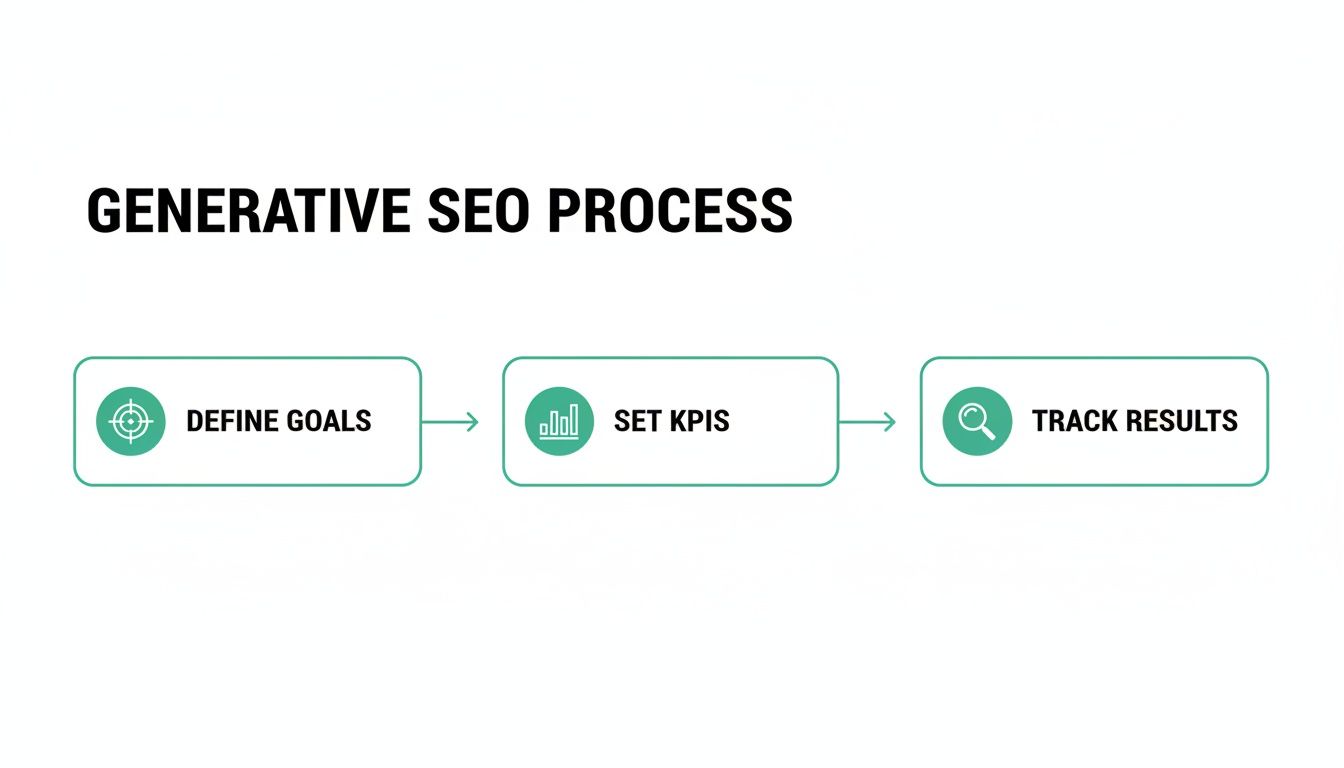
Defining Goals for Your Generative SEO Tracker
Before you even think about tracking AI Overviews, you need a crystal clear definition of what winning looks like. Otherwise, you are just collecting data for data's sake. A solid framework ties your efforts directly to business outcomes, getting you past vanity metrics and toward real progress. Start by setting sharp, measurable goals. Forget vague ambitions like "get more AI mentions." Get specific. Aim for something like, "increase our citation frequency by 30% for high intent keywords" or "displace competitor mentions in answers about our product category." That clarity turns your tracking from a passive report into a strategic weapon. You can learn more about how to integrate AI SEO with your existing workflows to make sure everyone on your team is aligned.
Setting Up Your LLM Tracking KPIs
Your goals should directly feed into the key performance indicators (KPIs) you watch. Think of these as the vital signs for your AI search visibility; they tell you if your strategy is actually working. The trick is to focus on KPIs that reflect real world impact, not just superficial numbers. A common mistake is treating AI Overviews like old school rankings. Success isn't about being 'position zero' anymore. It is about becoming the trusted, cited source inside the generated answer.
Here are a few powerful KPIs to build your AI Overviews tracker around:
Share of Voice in AI Responses: What percentage of AI answers for your target keywords mention your brand versus the competition? This is your market share in the new AI SERP.
Citation Frequency: A simple but potent metric. How many times is your domain cited as a source across all the keywords you are monitoring?
Citation Accuracy: Is the information attributed to you in an AI Overview actually correct? And is it framed positively? This is about quality, not just quantity.
Sentiment of AI Mentions: This tracks the tone of your brand mentions. Are they positive, neutral, or negative? This tells you how AI perceives your brand's reputation.
Comparing Core KPIs for Your AI Overviews Tracker
To build a truly robust tracking program, you have to know the difference between metrics that measure presence and those that measure influence. The table below breaks down the most common KPIs to help you pick the right mix for your goals.
| KPI Category | Primary Metric | What It Measures | Strategic Value |
|---|---|---|---|
| Visibility | Share of Voice in AI Responses | Your brand's presence vs. competitors | Benchmarks market position and competitive pressure. |
| Authority | Citation Frequency & URL Presence | How often AI engines trust your content | Indicates content quality and source credibility. |
| Influence | Sentiment of Mentions | The context and tone of your brand's inclusion | Gauges brand perception and message accuracy. |
| Traffic Impact | Referral Clicks from Citations | Direct user engagement from AI Overviews | Measures the direct traffic driving value of citations. |
By focusing on this blend of quantitative and qualitative metrics, your AI Overviews tracker becomes much more than a reporting tool. It evolves into a strategic asset that guides your content, flags competitive threats, and ultimately proves the ROI of your investment in generative SEO.
How to Build Your Own AI Overviews Tracker
Building a solid AI Overviews tracker is less about finding a magical piece of software and more about establishing a disciplined process. Think of it as creating a listening post for your brand in this new AI driven search world. When done right, this system will give you a clear, honest view of your visibility, where competitors are showing up, and where your next content opportunities lie. Your first big decision is whether to go manual or automated. For smaller businesses or focused projects, manual tracking in a spreadsheet works surprisingly well. You run your key search queries in Google, Perplexity, or Gemini, then log who gets cited. It is cheap, and the hands on approach gives you a granular feel for the results. But if you need to monitor a wider territory, you will hit a wall fast. That is where automated platforms come in. These tools can systematically check thousands of keywords, giving you dashboards that track citation frequency, share of voice, and competitor mentions over time. It is the only way to get the scale you need for serious LLM tracking.
A Comparison of AI Overview Tracking Methods
To help you decide, here is a quick breakdown of the two main approaches. Neither is universally better, but one will be a much better fit for your current needs and scale.
| Feature | Manual Tracking (Spreadsheets) | Automated Tracking (Specialized Tools) |
|---|---|---|
| Scale | Best for <100 keywords | Handles thousands of keywords easily |
| Cost | Low (mostly time investment) | Higher (monthly subscription) |
| Data Collection | Time consuming and repetitive | Fast, scheduled, and consistent |
| Insights | Deep, qualitative insights | Broad, quantitative trend analysis |
| Best For | Startups, niche sites, specific campaigns | Agencies, enterprises, competitive niches |
Ultimately, a manual approach is great for getting started and learning the ropes, but as your needs grow, you will likely find that an automated solution provides a much better return on your time.
Configuring Your AI Overviews Tracking System
Whether you go with a spreadsheet or a dedicated tool, the setup logic is similar. First, define a list of high priority keywords. Zero in on keywords with high commercial intent or the ones that form the foundation of your brand's authority. Do not boil the ocean; start with what matters most. Next, you have to monitor more than just Google. A holistic view means running queries in Gemini, ChatGPT, and Perplexity, too. You'll quickly notice that different engines serve up different answers and cite different sources. The market numbers back this up. The AI search engine market was valued at USD 16.28 billion and is forecasted to hit USD 50.88 billion by 2033. (Learn more about the AI search market projections). A common hurdle is the inconsistency of AI responses. An answer can change overnight, which is why consistent, scheduled tracking is so important. It lets you spot trends instead of overreacting to a single data point.
Analyzing Data from Your AI Overviews Tracker
Collecting data from your AI Overviews tracker is the easy part. The real advantage comes from turning that raw information into a sharp, actionable strategy that will guide your content efforts for 2025 and beyond. This is where you graduate from simply monitoring to active analysis. The goal is to understand the why behind the numbers. Why is a competitor getting cited for a keyword you should own? Why does one of your pages consistently show up as a source while others don't? Answering these questions means looking past simple mention counts and digging into the context of each AI generated answer. This deep dive is what separates the brands that will thrive in this new era from those that get left behind. It is all about building a repeatable process for spotting opportunities.
A Workflow for Analyzing AI Citation Patterns
To make sense of the data, you need a structured workflow. Start by grouping your keywords into thematic clusters like product features, user intent, or stages of the buyer's journey. This helps you spot broader trends. Once your keywords are segmented, focus your analysis on three key areas:
Your Wins: Pinpoint which of your pages consistently earn citations. Analyze these pages to figure out what makes them "AI ready." Look for patterns in their structure, clarity, and factual density.
Competitor Strongholds: Identify keywords where rivals dominate AI Overviews. Read their cited content and figure out their angle. Are they using data you're not? Is their explanation simpler?
Citation Gaps: Find queries where no one is a clear authority. These are prime opportunities to create the definitive piece of content designed to become the go to source for AI engines.
This structured analysis forces you to prioritize your optimization efforts, focusing your resources where they will make the biggest difference.
Using an LLM Tracking Tool to Find Deeper Insights
Sometimes, the most valuable insights from an LLM tracking tool come from looking one level deeper at the secondary sources AI engines rely on. Large language models often pull information from forums like Reddit, community Q&A sites, and niche industry publications. Monitoring these "sources behind the sources" can reveal the raw conversations and user questions that are actively shaping AI generated answers. This trend is only accelerating. Zero click searches have skyrocketed with AI Overviews, with some reports from early 2025 suggesting that nearly 60% of all searches now yield no clicks, as AI summaries keep users on the platform. You can find more of these AI and SEO statistics on semrush.com. This shift makes becoming a trusted citation source more critical than ever. By understanding the full ecosystem of information feeding the AI, you can start to engage in those communities and position your brand as an authority. It also changes how you measure success; you'll want to learn more about calculating your share of voice in these new environments.
Optimizing Content with Your AI Search Visibility Tracker
You have actionable data pouring in from your AI Overviews tracker. Now it is time to shift from monitoring to actively optimizing. This is where the real work begins: running targeted experiments to boost your visibility in AI search. The insights you have gathered will show you exactly which pages and topics to prioritize, zeroing in on those with the highest potential to earn citations. This process turns your tracker from a simple reporting tool into a strategic weapon for generative SEO.
A Practical Workflow for AI Content Optimization
Let’s walk through a real world scenario. Imagine your B2B company wants to improve its answer share for a key feature. Your tracker reveals that a competitor is consistently cited for the query "how to integrate payment gateways." That is a clear citation gap. Time for a tactical content update. Here is an example workflow:
Analyze the Cited Content: Pull up the competitor's page. Pay close attention to its structure, the specific facts it provides, and its use of clear, direct language.
Enhance Your Page: Now, make your own content better. Add a detailed comparison table. Weave in statistics on transaction security. Include a quote from a financial technology expert to add weight.
Implement Structured Data: Add relevant schema markup like
FAQPageorHowTo. This gives AI models a roadmap, making it easier for them to parse your information accurately.Measure the Impact: After you publish, keep that query locked in your tracker. Watch for changes in citation frequency over the next few weeks. This closes the loop and measures the direct impact of your changes.
Improving your content's "AI readiness" boils down to a few core principles. You want to make your content as clear, factual, and authoritative as possible. To get this right, it helps to understand the technology that powers these systems, specifically Natural Language Processing (NLP). By systematically finding weaknesses with your AI Overviews tracker and applying these techniques, you create a powerful feedback loop. This iterative process is the secret to steadily improving your presence in AI generated answers. We cover more of this in our detailed guide on how to optimize your content for AI search.
Summary and Path Forward
AI Overviews represent a fundamental shift in how people will find answers and discover brands by 2026. Brands that adapt will own their narrative, while those that do not will become invisible. An AI Overviews tracker provides the clarity to see where you stand, the data to understand why you are being cited or ignored, and the roadmap to improve your position. The most important takeaway is to be proactive. Start tracking your AI search visibility now, analyze the citation patterns in your niche, and begin optimizing your content to become the most trusted source for generative AI. The system you build today will define your brand’s growth and authority in this new era of search.
Frequently Asked Questions
What is the best AI Overviews tracker tool?
The "best" tool depends on your needs. For small scale tracking (<100 keywords), a manual spreadsheet is effective and low cost. For larger operations, automated tools from major SEO platforms offer the scale and trend analysis needed to compete seriously.
How does an AI Overviews tracker handle different search engines?
A comprehensive tracker should monitor not only Google but also other generative engines like Perplexity and Gemini. This provides a holistic view of your AI search visibility, as different LLMs often cite different sources for the same query.
Can I track competitor mentions in AI Overviews?
Yes, this is a core function. A good AI Overviews tracker allows you to monitor competitor domains for your target keywords, revealing their content strengths and showing you where you need to improve to win citations.
How do I measure the ROI of using an AI Overviews tracker?
Measure ROI by tracking the increase in your "Share of Voice in AI Responses" for high value keywords. While direct clicks are harder to attribute, an increased share of voice demonstrates growing brand authority and mindshare, which are leading indicators of future traffic and conversions.
What is the difference between an AI Overviews tracker and a traditional rank tracker?
A traditional rank tracker measures your website's position in a list of blue links. An AI Overviews tracker measures your brand's presence and citation frequency inside the AI generated summary, which is a more critical metric in the age of generative SEO.