Master Online Monitoring: How to Track Brand Mentions Online in 2025
Updated January 18, 2026
Tracking brand mentions online is the process of finding and analyzing every conversation about your brand across the internet. In 2025 and 2026, this goes far beyond simple social media alerts. It means monitoring discussions on news sites, forums, blogs, and the new frontier of AI search engines like ChatGPT and Google's AI Overviews. This isn't just a defensive move to protect your reputation; it's a proactive strategy to tap into raw customer feedback, measure your standing against competitors, and win in an AI driven world.
Why Monitoring Brand Mentions Is More Critical Than Ever
Not long ago, tracking your brand meant keeping an eye on your social media tags. Today, that’s just a tiny piece of the puzzle. As customer behavior shifts, monitoring has become a strategic necessity. People are no longer just typing keywords into a search bar; they're having conversations with AI, making your brand's visibility dependent on entirely new arenas. If you aren't listening everywhere, you're leaving massive blind spots in your strategy.
The Critical Need for Tracking Your Brand Online
Without a comprehensive system to track brand mentions online, you are flying blind. You will miss golden opportunities to amplify authentic praise or address critical feedback. Your competitors can easily dominate AI generated answers if you aren't monitoring which brands get cited and, more importantly, why. Your core message gets lost in translation if you don’t know how people are actually talking about you. The conversation about your brand is happening 24/7, and a single negative Reddit thread can silently steer thousands of potential customers away.
How Tracking Brand Mentions Feeds AI Search Visibility
As AI engines become a primary source for answers, their training data becomes your new battleground. These systems, including large language models (LLMs), create responses by synthesizing information from across the web. If your brand is mentioned frequently and positively on authoritative sites, you dramatically increase your odds of being cited in an AI generated answer. This practice, known as LLM tracking, is no longer a niche tactic; it's a core component of modern generative SEO. Ignoring these mentions is the same as letting your competitors write your story for you in the next generation of search.
Building Your Modern Brand Monitoring Playbook
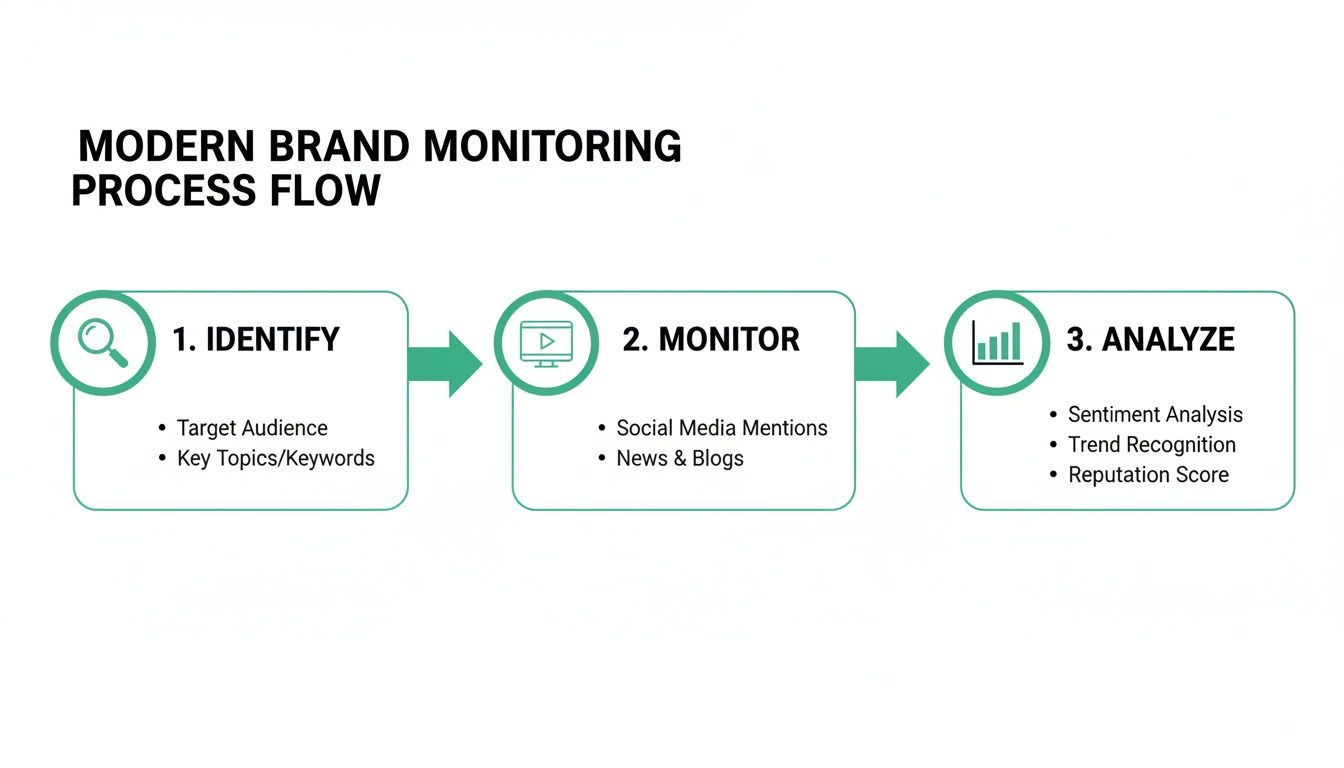
In 2025, tracking your brand requires a proactive intelligence system. It must capture the entire spectrum of your brand's presence, going beyond just your brand name to include key product terms, executive names, and even common misspellings. This comprehensive approach is how you stop missing valuable conversations. A modern playbook must strategically focus on the channels that actually matter to your audience and your business to avoid data overload.
Where to Look When Monitoring Your Brand's Mentions
Your monitoring scope should be a smart mix of traditional and emerging platforms. On social media like Instagram, mentions are a direct line to visibility. For instance, in the first half of 2022, Zara was the most mentioned brand on the platform, demonstrating how fashion giants convert conversations into currency. You can see how other big players stack up in the full research about brand mentions on Instagram. Don't overlook forums like Reddit and Quora, which are goldmines of candid feedback. News and blogs remain crucial for credibility and SEO. The non negotiable frontier is AI search interfaces, where you must track mentions within Google's AI Overviews and chatbot responses.
Configuring Your Strategy to Find Brand Mentions
As generative search becomes the main event, your own website becomes a critical part of your monitoring playbook. You need to ensure your content is structured so AI crawlers can easily understand it. This is what we call AI readiness. An AI ready page is clear, factually dense, and organized with logical headings and short paragraphs, making it a perfect citation source for an AI model. This step helps you control your own narrative in an age of automated answers. You can get a deeper look at the process in this guide on AI brand monitoring.
How to Analyze the Context of Your Brand's Mentions
Counting mentions is a vanity metric. The real value is in understanding the context and sentiment. Was it a positive shout out? A negative review? This is where you move from knowing you were mentioned to understanding the impact. According to Forrester's Brand Experience Index, companies that maintain a consistent, positive brand identity see an average 39.7% jump in recognition, showing a direct line from perception to performance. The table below outlines a simple workflow for acting on different kinds of mentions.
| Mention Type | Primary Signal | Sentiment Analysis | Recommended Action |
|---|---|---|---|
| Social Media Tag | Customer Engagement | Positive/Negative/Neutral | Engage directly. Amplify positive posts; address negative feedback publicly or privately. |
| Forum Discussion | Product Feedback | Usually mixed | Monitor for recurring issues or feature requests. Share insights with the product team. |
| News Article | Brand Authority | Generally Positive/Neutral | Share on owned channels. Reach out to the journalist to build a relationship. |
| AI Search Citation | Generative SEO Visibility | Implied Positive/Neutral | Audit the source page for AI readiness. Optimize it further to solidify the citation. |
Choosing the Right Tools to Track Your Brand Mentions
Picking the right tool is the foundation of a solid brand mention strategy. As we push through 2025 and look toward 2026, the market has split into two camps: classic media monitoring tools and a new breed of AI visibility platforms built for generative SEO and LLM tracking. Traditional tools are excellent for gauging public conversation on established channels, while modern AI visibility platforms answer the question: where is our brand being cited inside AI generated answers?
Must Have Features for Tools That Track Brand Mentions
No matter which type of tool you’re leaning toward, a few features are completely non negotiable. Your chosen platform must deliver on these fundamentals. It needs real time alerting to inform you of critical mentions as they happen. Sentiment analysis is also key, using AI to sort mentions into positive, negative, or neutral buckets. For AI visibility, citation source identification is the whole game; the tool must show you the exact URL an AI model used as a source. Finally, competitive benchmarking lets you track your competitors' mentions just as closely as your own.
Comparing Platforms for Monitoring Your Brand's Presence
To make the decision easier, it helps to see the core strengths of each tool type side by side. The choice boils down to your goals. Are you focused on customer service and social engagement, or is your priority AI search visibility? This comparison clarifies the divide. One type is about managing the conversations happening now; the other is about shaping the automated answers of tomorrow. Specialized tools like the Claude brand mention tracker exemplify platforms focused on the new AI frontier. You can also explore a guide on the top AI tools for social listening to see current leaders.
Finalizing Your Budget for Brand Monitoring Software
Finally, you have to square your choice with your budget and team capacity. Many of the best platforms offer free trials, which you should use to get hands on experience with the interface and data quality. Set a realistic budget, but remember that the insights from proper brand monitoring can deliver a huge return. You're not just buying software; you're investing in protecting your reputation and fueling a smarter content and SEO strategy.
Turning Brand Monitoring Data Into Actionable Intelligence
Collecting mentions is just the start. Raw data is noise; the real work begins when you transform it into intelligence that tells you what to do next. For 2025, this means digging past the simple count of mentions to understand the why. Who is talking about you? What are they really saying? This process helps you spot market trends and find gaps your competitors are leaving open. The entire point is turning data into actionable insights that drive your strategy forward.
Analyzing Mentions to Understand Your Brand's Reputation
Knowing you were mentioned is one thing. Understanding the sentiment and context behind it is everything. Sentiment analysis tools are a good first pass, automatically sorting mentions to give you a quick snapshot of public feeling. If you see a sudden surge in negative mentions pointing to a specific product feature, that’s a clear signal for your product team. This deeper analysis is crucial for managing your brand's reputation effectively.
How to Monitor Your Competitors' Mentions Online
A massive piece of your analysis should be laser focused on your rivals. Watching their mentions gives you a benchmark for your own efforts and uncovers opportunities. Pay close attention to where they show up in AI answers, especially in places where you don't. This is the new frontier of generative SEO. If a competitor consistently gets cited by an AI, find the source material the AI is referencing. That content is a roadmap telling you exactly what you need to build or improve to steal that citation.
Key Metrics for Tracking Brand Mentions Online
To measure your impact, you need to track the right KPIs. These metrics paint a clear picture of your brand's health and visibility. The most important ones include Share of Voice (SoV), which compares your brand's conversation share to your competitors; Sentiment Score, which tracks the ratio of positive to negative mentions; and Citation Frequency in AI Responses, a critical metric for tracking your success in generative SEO and AI search visibility. This table breaks down why these metrics matter.
| Metric | What It Measures | Why It Matters for Brand Monitoring |
|---|---|---|
| Share of Voice | Your brand's visibility versus competitors. | Identifies your market presence and competitive standing in online conversations. |
| Sentiment Score | The overall tone of brand mentions. | Provides a direct measure of public perception and brand health. |
| Citation Frequency | How often AI engines cite your brand. | A key indicator of your success in generative SEO and AI search visibility. |
| Reach | The potential audience size of your mentions. | Shows the potential impact and spread of conversations about your brand. |
Putting Your Brand Mention Insights Into Action
This is where the real work begins. Turning brand mention data from a passive report into an active growth driver is what separates the winners from the observers. For 2025 and beyond, this means building a direct feedback loop where insights from brand monitoring inform everything from your next blog post to your product roadmap. The goal is to stop just listening to conversations and start shaping them, which happens when your findings are baked into the daily workflows of your teams.
Operationalizing Brand Mention Data for SEO Teams
For any SEO pro, this data is a goldmine for improving AI search visibility. When you track mentions online, you can see the exact pages competitors use to earn citations in AI Overviews. This is a playbook for taking back that territory. If your monitoring tool flags a competitor's article as a recurring AI citation source, your SEO team should immediately dissect that page, audit your own equivalent content, and optimize it to become the superior source. This proactive loop focuses your efforts on pages with a proven track record of earning high value AI citations.
Using Brand Monitoring Insights in Your Content Strategy
Your content team can use mention insights to create material that connects with your audience. When you monitor online chatter, you get unfiltered access to your audience's language, their biggest problems, and the questions they are really asking. For instance, if you notice your brand name popping up on Reddit alongside a specific, recurring issue, that’s a direct order from the market to create a detailed guide that solves that exact problem. According to Andrew Holland, Director of SEO at JBH, "brand mentions are the new backlinks," which nails a fundamental shift in how search engines view authority.
Building a Feedback Loop Across Your Organization
The most sophisticated way to use brand mention data is to build a feedback loop that reaches beyond the marketing department. The intel you gather should be piped to other teams to drive improvements across the entire company. For example, if users on a forum are discussing a missing feature, that insight should be sent directly to the product team to prioritize it in the next development sprint. This cross functional workflow ensures the valuable lessons from LLM tracking and social listening don't die in a silo but instead become a catalyst for making the whole business smarter.
Summary and Key Takeaways
Shifting from passive monitoring to an active, integrated strategy is the final, most important step. In 2025, effectively tracking brand mentions online demands a strategic approach that goes beyond basic social listening to include forums, news media, and the critical new frontier of AI search. By identifying the right signals, getting your content AI ready, and analyzing the context of every mention, you turn raw data into actionable intelligence. This proactive stance not only protects your reputation but also fuels your growth by uncovering customer insights and securing your visibility in the next era of search.
Frequently Asked Questions
How can I effectively track brand mentions in AI generated answers?
You need specialized AI visibility platforms for this. Tools like Riff Analytics monitor responses from models like ChatGPT and Google's AI Overviews, flagging when your brand is cited and pinpointing the exact source URLs the AI used. This lets you see where the information is coming from and optimize those pages.
What is the difference between brand monitoring and social listening?
Social listening is one piece of the puzzle, focusing exclusively on social media channels. Brand monitoring is the bigger picture, covering news sites, blogs, forums, review sites, and now, AI search engines. It provides a complete view of your digital footprint.
How do I handle negative brand mentions without making the situation worse?
The key is to be prompt, professional, and empathetic. Acknowledge the issue publicly if appropriate, but try to move the detailed conversation to a private channel like DMs or email to resolve it. Never get defensive; always focus on finding a solution.
Why are unlinked brand mentions important for SEO?
Search engines like Google increasingly see unlinked mentions on reputable websites as signals of brand authority and trust. These mentions help establish your brand as a credible entity in your industry, which can positively influence your rankings even without a direct backlink.
How can a small business track brand mentions on a budget?
Start with free tools like Google Alerts for your brand name and key product terms. Combine this with a schedule of manual checks on platforms most relevant to your audience, such as specific subreddits or industry forums. This hands on approach can provide valuable insights without significant cost.