How to Rank in Google AI Overviews: A Practical Guide for 2025
Updated December 12, 2025
Getting your content featured in Google's AI Overviews is the new frontier of SEO, and it's less about old keyword tactics and more about becoming a trusted source of information. By 2025 and into 2026, visibility in these AI generated summaries is non negotiable. To rank, you must create exceptionally clear, factually accurate content that directly answers a user's question, reinforced by strong E-E-A-T signals that prove your authority to Google's AI models.
The New Reality of Search: How to Get Visibility in AI Overviews

Google AI Overviews (AIOs) represent a fundamental shift in how search results are delivered. Instead of the traditional list of ten blue links, Google now uses artificial intelligence to read, synthesize, and summarize information from multiple web pages, presenting a direct answer at the very top of the SERP. For users, this means instant answers. For businesses, it means the rules of search visibility have been completely rewritten.
This isn't just another feature; it's the new starting line for a significant volume of queries. The adoption has been swift, signaling a permanent change in user behavior and SEO strategy.
Why You Must Adapt Your SEO Strategy for AI Search
With AIOs dominating the top of the search results, simply ranking number one organically is no longer enough. True visibility now means being cited within that AI generated answer. This new discipline, often called generative SEO, requires a different approach. The focus shifts from merely matching keywords to providing comprehensive, authoritative, and easily digestible information that AI models can parse and trust.
According to research from Single Grain, keywords that trigger an AIO saw the #1 organic position experience a 27% year over year drop in click through rates. While most AIO citations come from pages already ranking in the top 10, the overlap is not perfect. A lower ranking page can still be cited if its answer is superior, creating an opportunity for sites that prioritize clarity and factual accuracy.
Understanding Key Differences for AI Search Visibility
To succeed, you must understand how priorities have shifted. The tactics that worked for classic search results need a significant upgrade for this AI driven landscape. Your content is no longer just for human readers; it is being evaluated by large language models that determine whether your brand gets featured or ignored.
| Tactic | Traditional SEO Focus | Generative SEO Focus |
|---|---|---|
| Content Goal | Rank for a target keyword | Become a citable source for a query |
| Language | Keyword dense, often formal | Natural, clear, factual, and direct |
| Structure | Standard blog posts | Highly structured with lists, tables, and short paragraphs |
| Authority | Backlinks and domain authority | E-E-A-T signals, author expertise, and factual accuracy |
Auditing Your Content for AI Readiness
Before optimizing for Google AI Overviews, you must assess where your content currently stands. A strategic audit is the essential first step to prepare your site for the generative search world of 2025 and beyond. This process isn't about traditional keyword analysis; it is about evaluating your content's clarity, factual accuracy, and structure to determine if it is citable by an AI. The goal is to identify pages with the highest potential for AI search visibility, typically informational articles and how to guides that already have some traction.
How to Find High Potential Pages for AI Overviews
Begin by identifying content that already answers specific user questions. Look for pages ranking on the first or second page of Google for informational queries, as these have already passed Google’s initial relevance test. You can find these assets in Google Search Console by filtering for question based keywords like "how," "what," and "why." Prioritize pages that provide a direct, concise answer, as these are far more likely to be sourced by an AI than long, meandering articles.
Core Elements for Auditing AI Search Readiness
Your content audit must focus on key areas critical for generative SEO. An AI model needs to easily parse, understand, and trust your information. A systematic approach, grading each high potential page against clear criteria, is best. For a deeper technical dive, our comprehensive site audit checklist offers a detailed framework.
Key areas to check include:
- Answer Directness: Does the content immediately and clearly answer the main question?
- Factual Accuracy: Are all claims, stats, and data points verifiable and linked to authoritative sources?
- Structural Clarity: Is the content broken down with logical H2 and H3 subheadings, lists, and tables?
- Language Simplicity: Is it written in plain, natural language, avoiding jargon and complex sentences?
Comparing Audit Tools and Workflows
No single tool provides the complete picture. A more comprehensive view of your opportunities and weaknesses comes from combining data from different sources. This multi tool approach ensures you cover all bases, from on page structure to semantic richness and factual accuracy.
| Tool / Workflow | Primary Use Case | Key Metrics to Analyze |
|---|---|---|
| Google Search Console | Identifying high potential pages | Queries with impressions but low clicks, top question based keywords |
| Screaming Frog | Analyzing on page structure at scale | H1/H2 tags, word count, meta descriptions |
| SurferSEO / Clearscope | Assessing semantic richness and NLP | Content score, related term usage, readability grade |
| Manual Content Review | Evaluating factual accuracy and clarity | Tone, answer directness, E-E-A-T signals |
Summarizing Your Audit for Actionable Insights
After completing the audit, translate your findings into a concrete plan. Group pages into categories like "High Priority Optimization," "Minor Tweaks Needed," and "Content Refresh Required." This organized approach ensures you tackle the biggest opportunities first, building a solid foundation for winning citations in Google AI Overviews. Remember, an audit is not a one time task but an ongoing process of reassessment as AI models evolve.
Crafting Content for AI Overview Citations

To win citations in Google AI Overviews in 2025, you must shift your writing style. Your new primary audience is a large language model (LLM), which processes information differently than a person. LLMs value structure, clarity, and directness. They are not impressed by clever prose but are hunting for extractable facts and clear instructions. Your content creation process needs a tactical upgrade, focused on making information easy for an AI to parse, trust, and cite.
Nail the Content Structure for AI Citations
The organization of your page is as critical as the words you use. A well structured article provides a clear roadmap for AI crawlers, helping them identify valuable information quickly. Lead with the answer by placing it immediately after the relevant subheading. Keep paragraphs short, ideally one to three sentences, to create clean, citable snippets. Use bulleted lists, numbered lists, and tables for processes or comparisons, as models find this format easy to interpret.
Answer Long Tail Questions to Improve AI Search Visibility
Long tail informational queries are prime opportunities for AI Overviews. These specific questions signal a user wants a direct answer, not a lengthy guide. Instead of targeting a broad term like "digital marketing," create content answering questions like, "what is the average CTR for B2B SaaS email campaigns?" Each niche question you address becomes a new opportunity to be featured. Understanding how AIs process information is key, which is why concepts like What Is Prompt Engineering? are increasingly important for modern SEOs.
Build Topical Authority With Semantic Richness
To be seen as a credible source, your content must demonstrate expertise. This is where semantic richness is crucial. Go beyond your main keyword to naturally include related concepts, entities, and synonyms. If writing about "how to rank in Google AI Overviews," you should also discuss generative SEO, LLM tracking, and answer engine optimization. This signals to Google that your content is comprehensive, covering the topic from all angles and solidifying your topical authority.
Use Schema Markup to Get Featured in Google's AI
Finally, structured data is your direct line of communication to search engines. Implementing FAQ Schema and HowTo Schema provides Google's AI with explicit context about your content. FAQ schema clearly marks a question and its corresponding answer, making it simple for an AI to pull that exact pair for an overview. Similarly, HowTo schema breaks a process into distinct, numbered steps. This technical implementation removes ambiguity and presents your information as a prime candidate for citation.
Building Authority Signals for Generative SEO

Google's AI actively seeks sources it can trust. To get cited in AI Overviews in 2025 and 2026, building real authority is essential. This is where E-E-A-T (Experience, Expertise, Authoritativeness, and Trustworthiness) becomes the foundation of your strategy. AI Overviews are designed to deliver confident, correct information, meaning the underlying LLMs are programmed to prefer content from sources with verifiable credibility. Your goal is to make your expertise so apparent that the AI views you as a definitive source.
Amplify Author Expertise to Improve AI Search Rankings
Anonymous content is a major red flag for AI systems. One of the most direct ways to boost your AI search visibility is by associating your content with a real person with a verifiable resume. Detailed author bios are now a critical asset. They should include credentials like degrees and certifications, links to professional profiles like LinkedIn, and a summary of the author's hands on experience. This helps Google connect your content to a real human with demonstrable expertise, directly addressing the "Experience" and "Expertise" components of E-E-A-T.
Leverage Third Party Validation to Get Cited in AI Overviews
Authority is not just about what you say about yourself; it is about what others say about you. Google's AI models increasingly use data from community platforms to understand public sentiment and find authentic, experience based answers. Forums like Reddit are becoming significant sources for AI Overviews because genuine, helpful discussions are treated as strong signals of real world experience.
According to the team at Ahrefs, their research found that online brand mentions showed one of the strongest correlations with being cited by AI. This means your strategy must extend beyond your own domain. Participate in niche communities, earn mentions in reputable publications, and encourage real reviews to build a web of trust that AI models can use for validation.
Technical SEO and Measurement in the AI Era
A rock solid technical foundation is non negotiable for getting a spot in Google's AI Overviews. Even with compelling content and strong authority, Google's AI models cannot cite what they cannot efficiently crawl, understand, and trust. Getting your technical SEO in order is the final piece of the puzzle, connecting your content strategy directly to the machine. A clean site architecture, a flawless mobile experience, and excellent Core Web Vitals are the baseline requirements in 2025.
Optimizing Your Technical Foundation for AI Overviews
Beyond the basics, you must focus on technical elements that help AI models interpret your content's meaning and structure. Structured data, or schema markup, is your most powerful tool. It adds a layer of digital signposts to your content that tells AI exactly what it's looking at.
- FAQ Schema: Clearly defines question and answer pairs, making them simple for an AI to extract.
- HowTo Schema: Breaks down processes into distinct, logical steps, perfect for repurposing into a list.
- Article Schema: Specifies details like the author and publication date, reinforcing E-E-A-T signals.
The Emerging Field of LLM Tracking and Measurement
How do you know if your efforts are working? Traditional metrics like keyword rankings and organic traffic no longer tell the full story. Welcome to the new discipline of LLM tracking, a critical practice for success in generative search. This involves monitoring when, where, and how your content is used inside AI generated answers. Track brand mentions, product names, and specific data points that appear in an AI Overview, even without a direct citation, to get a complete picture of your AI search visibility.
Comparing Tools for Tracking AI Overview Performance
Measuring your success requires a new toolkit built for this new search reality. Traditional rank trackers are not equipped to monitor visibility inside the dynamic world of AI Overviews. A dedicated platform is essential for direct measurement.
| Tool Category | Purpose | Examples |
|---|---|---|
| Specialized AI Trackers | Monitors brand mentions and citations directly within AI Overviews. | Riff Analytics, BrightEdge |
| SERP Monitoring Tools | Tracks the presence and frequency of AI Overviews for your target keywords. | Semrush, Moz Pro |
| Web Analytics | Measures changes in referral traffic from Google and user engagement. | Google Analytics 4, Plausible |
For instance, a specialized tool like the Google AI Overviews Visibility Tracker can show you precisely which pages are being cited and in what context, allowing you to adapt your strategy effectively.
Your Action Plan for Ranking in AI Overviews
Let's translate theory into practice. Winning in the generative search world of 2025 and 2026 requires a clear, repeatable process. This checklist will help you earn citations and boost your AI search visibility. Your mission is to make your content the most authoritative, trustworthy, and easily digestible answer available. This demands a solid technical approach focusing on structure, schema, and measurement.
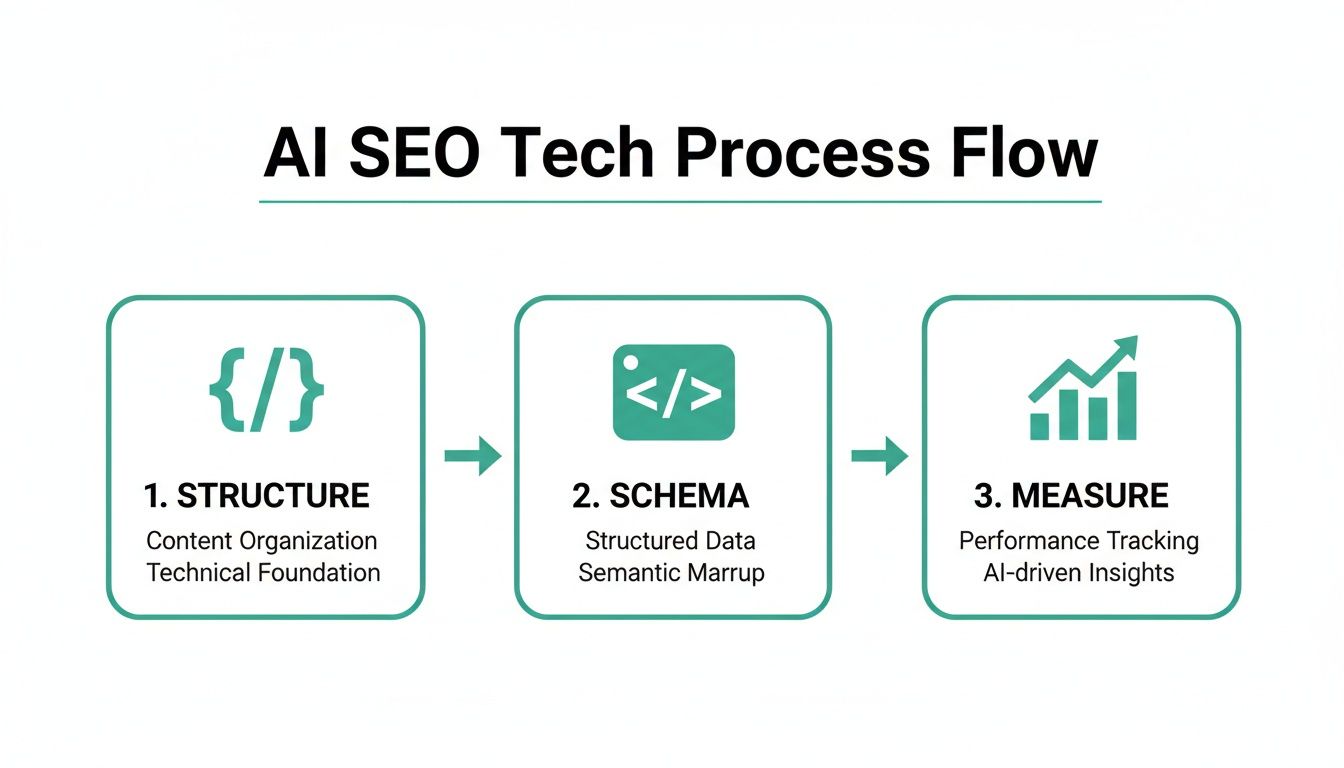
This process is a flywheel. Strong on page structure and clean schema markup form the foundation, making accurate performance measurement possible. From auditing your content to building E-E-A-T signals and deploying LLM tracking, each step builds on the last. For a more granular guide, this tactical checklist for getting cited in AI answers is an excellent resource. By consistently applying these principles, you position your brand as a primary source for the next generation of search.
Summary and Frequently Asked Questions
Succeeding with Google AI Overviews requires a strategic shift from traditional SEO to generative SEO. The focus is now on creating clear, factual, and highly structured content that is easy for AI models to parse and trust. Building strong E-E-A-T signals through author expertise and third party validation is critical. Finally, a solid technical foundation with proper schema markup, combined with specialized LLM tracking tools, will allow you to measure and refine your strategy for sustained visibility in this new search landscape.
What is the most important factor for ranking in Google AI Overviews?
Clarity and factual accuracy are paramount. Your content must provide a direct, verifiable answer to a user's query. This information must be presented in a simple, structured format that an AI can easily understand and repurpose as a trustworthy source.
How does E-E-A-T affect my chances of being cited in an AI Overview?
E-E-A-T (Experience, Expertise, Authoritativeness, Trustworthiness) is a critical factor. AI models are trained to prioritize information from credible sources. Demonstrating expertise through detailed author bios, authoritative backlinks, and positive brand mentions signals to Google that your content is reliable and worthy of citation.
Can a small business compete with large brands for AI Overview spots?
Yes, absolutely. AI Overviews often prioritize the quality and clarity of the answer over raw domain authority. A small niche site with a superior, well structured, and expert written piece of content can often outperform a larger, more generic competitor for a citation on a specific query.
Should I change my entire content strategy for AI Overviews?
Not entirely, but you should adapt it. Continue creating high quality, user focused content, but place a much stronger emphasis on direct question answering, structured formatting (lists, tables), and semantic richness. Focus on updating your most important informational pages first to align with generative SEO best practices.
How do I track my performance in Google AI Overviews?
Traditional SEO metrics are insufficient. You need to adopt specialized LLM tracking tools that monitor brand mentions and content citations directly within AI generated answers. This provides a clear picture of your actual AI search visibility, allowing you to measure the direct impact of your optimization efforts.