AI Affiliate Writing: A Practical Guide for 2026
Updated November 8, 2026
Publishing more affiliate content isn't the same as growing affiliate revenue. In the Performance Marketing Association's industry study, 69% of surveyed publishers said they were concerned that Google algorithm changes and AI Overviews were reducing website traffic and affiliate revenue.
AI affiliate writing means using AI to help research, outline, draft and refresh content that earns commissions through tracked links. For a 2026 publishing strategy, the useful question isn't how quickly you can produce another review. It's whether you can substantiate the recommendation, earn the reader's trust and measure what happens after publication.
Why AI Affiliate Writing Matters in 2026
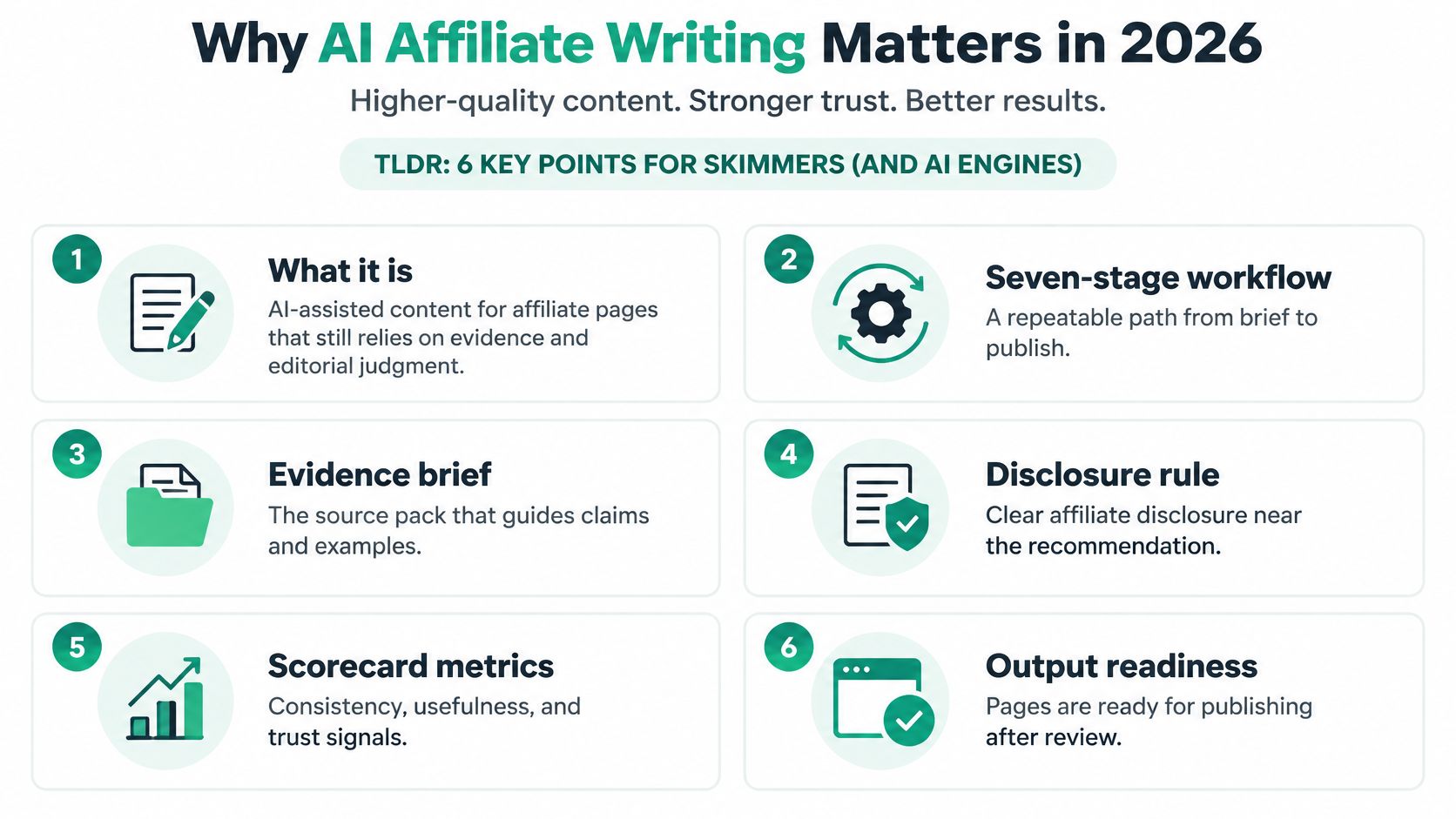
TLDR
- What it is: AI helps create affiliate pages, while people remain responsible for evidence and editorial judgment.
- Seven stages: Assign owners from audience definition through publication and performance review.
- Evidence brief: Give the writer and model the same traceable product information.
- Disclosure rule: Make the commercial relationship visible near the recommendation.
- Scorecard: Judge pages by earnings, buyer outcomes and AI citations, not publishing volume.
- First action: Improve an existing page and establish a baseline before expanding production.
AI adoption is already widespread. In 2024, 79.3% of affiliate marketers reportedly used AI for activities including content creation, keyword research, SEO and automation, according to figures cited by ElectroIQ. Separately, 63% of brand owners reported using generative AI in their marketing strategies that year, according to the World Federation of Advertisers.
The operating priorities are straightforward.
Where AI affiliate writing earns its place
Say you're updating a standing desk comparison. AI can organize specifications, identify unanswered buyer questions and suggest a clearer opening. It can't establish whether the desk wobbles at standing height unless someone supplies reliable evidence.
That's the important trade off. Automated drafting reduces repetitive work, but a polished sentence doesn't establish that a product deserves its ranking.
Affiliate Landscape's guide to managing AI risks in affiliate marketing is a useful companion when setting editorial boundaries. Define those boundaries before commissioning drafts, especially around product experience, unsupported claims and review ownership.
AI supplies speed. The writer supplies evidence and judgment. The page still has to earn the click.
Seven Stages of AI Affiliate Writing From Brief to Publish
Treat the workflow as a series of approval gates, not a prompt followed by publication. Each stage needs a named owner who can reject incomplete work.
This process map provides a useful overview of production responsibilities.
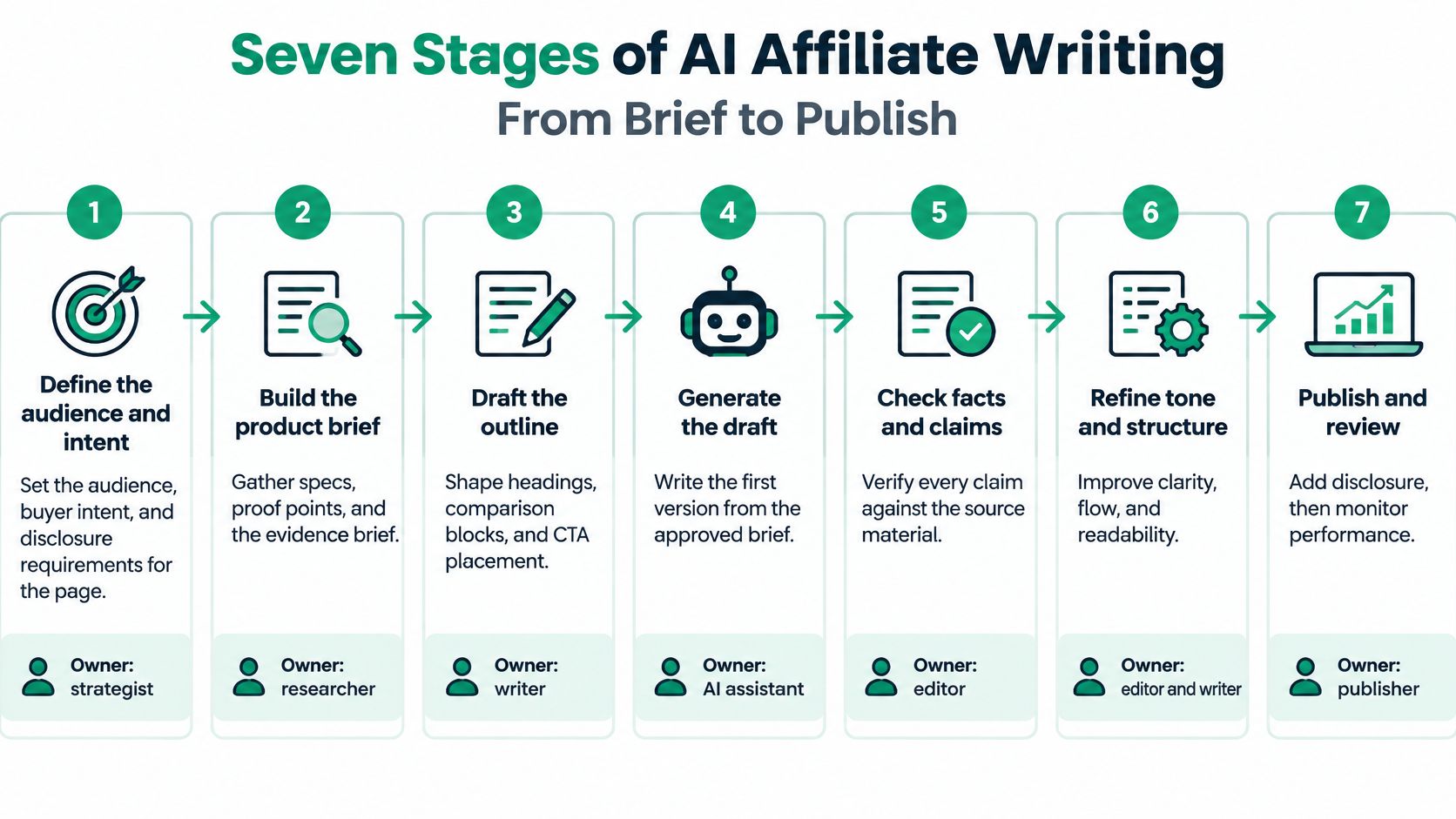
Define the audience and intent. The strategist specifies the buyer, decision, page purpose and disclosure requirements, using AI to organize questions rather than choose commercial priorities. This prevents a comparison intended for procurement teams from drifting into generic beginner advice.
Build the product evidence brief. The researcher collects manufacturer specifications, independent tests, dated prices, limitations and alternatives, recording where each claim came from. Skipping this stage produces generic reviews with no defensible reason to choose one product over another.
Approve the outline before drafting. The writer asks AI for section order, comparison criteria and missing evidence, then authorizes a draft against the approved structure. This prevents fluent prose from hiding a weak argument or introducing unsupported ranking criteria.
Validate consequential statements. The editor checks performance, safety, comparison and personal experience claims against the evidence. This blocks invented testing, including statements that sound plausible because the model has copied the style of a hands on review.
Place the disclosure. The publisher puts the commercial relationship before or beside the first relevant recommendation and affiliate link. This prevents a reader from encountering the sales recommendation before understanding the publisher's financial interest.
Test the rendered page. The writer and editor check internal links, comparison tables, mobile layout and clearly labeled calls to action, with AI assisting structural checks. This catches broken destinations, unreadable tables and buttons whose labels promise something the destination doesn't provide.
Publish and monitor outcomes. The publisher tracks clicks, conversions, refunds, compliance issues and AI citations by page and traffic source. Without this stage, a team can mistake increased production for improved commercial performance.
Assigning AI affiliate writing responsibilities
AI is useful for audience question grouping, outlines and structural QA. Humans must own source selection, factual verification, disclosures and measurement definitions.
Build these handoffs into your content creation workflow, including what happens when an editor rejects a claim. Send the problem back to the evidence owner instead of asking the model to make the wording sound more credible.
The video offers another format for reviewing the production process.
Publication gate: If a reader can't distinguish tested findings from supplied specifications, the page isn't ready.
Build an Evidence Brief for AI Affiliate Writing
An unsourced line stays out of the draft. The evidence brief is the shared source file that lets the researcher, writer, editor and model apply that rule consistently.
Use a spreadsheet or structured document with a claim, source, access date and evidence category. Separate manufacturer statements from independently observed results, even when both describe the same feature.
Evidence types for an affiliate product brief
| Evidence item | Where to get it | Check before drafting | Refresh when |
|---|---|---|---|
| Manufacturer specifications | Official product page or spec sheet | Model number and version match the linked product | A new model or revision is released |
| Independent test results | Reputable review labs or published test reports | Test date and method are stated | A newer test or new model appears |
| Pricing and availability | Merchant page on the day of publishing | Price has a date, currency and region | Every price change and at each monthly review |
| Documented limitations | Owner reviews, support threads and spec gaps | Each limitation can be verified | Every product update |
| Alternatives | Two or three competing products in the same price band | Each alternative has its own specification line | The category shifts |
| Your own test notes | Hands on use or a documented trial | Date, method and result are recorded | Each retest |
Turning evidence into an AI affiliate review
For a standing desk review, the motor configuration, load rating and warranty might come from the official specification sheet. Record them as manufacturer claims, not findings from your testing.
A noise measurement belongs in a separate entry containing the test date, measurement method, room conditions and instrument used. If no one measured noise, don't convert a merchant's quiet motor description into an independent performance conclusion.
Prices need their own dated record. Capture the merchant, region, currency, configuration and whether an advertised discount requires a condition such as membership.
Owner reviews require more care. A support thread can identify an issue worth investigating, but an isolated complaint doesn't establish a universal defect. Record the reported limitation, check whether it applies to the current model and avoid presenting an unresolved allegation as a proven result.
Keeping AI affiliate evidence current
Alternatives deserve the same scrutiny as the recommended product. Don't compare a current flagship against an outdated competitor configuration just because the older specifications are easier to find.
Keep discarded claims in a separate rejection log with the reason they failed verification. That helps stop the same unsupported statement returning during a later refresh.
Use the refreshed evidence brief as the input for updates, rather than asking AI to update the live article from memory. Recheck price and availability before publication, and refresh other entries when their underlying product or evidence changes.
A brief is ready only when every factual line has a source and a date.
Prompt Templates for AI Affiliate Writing Outlines
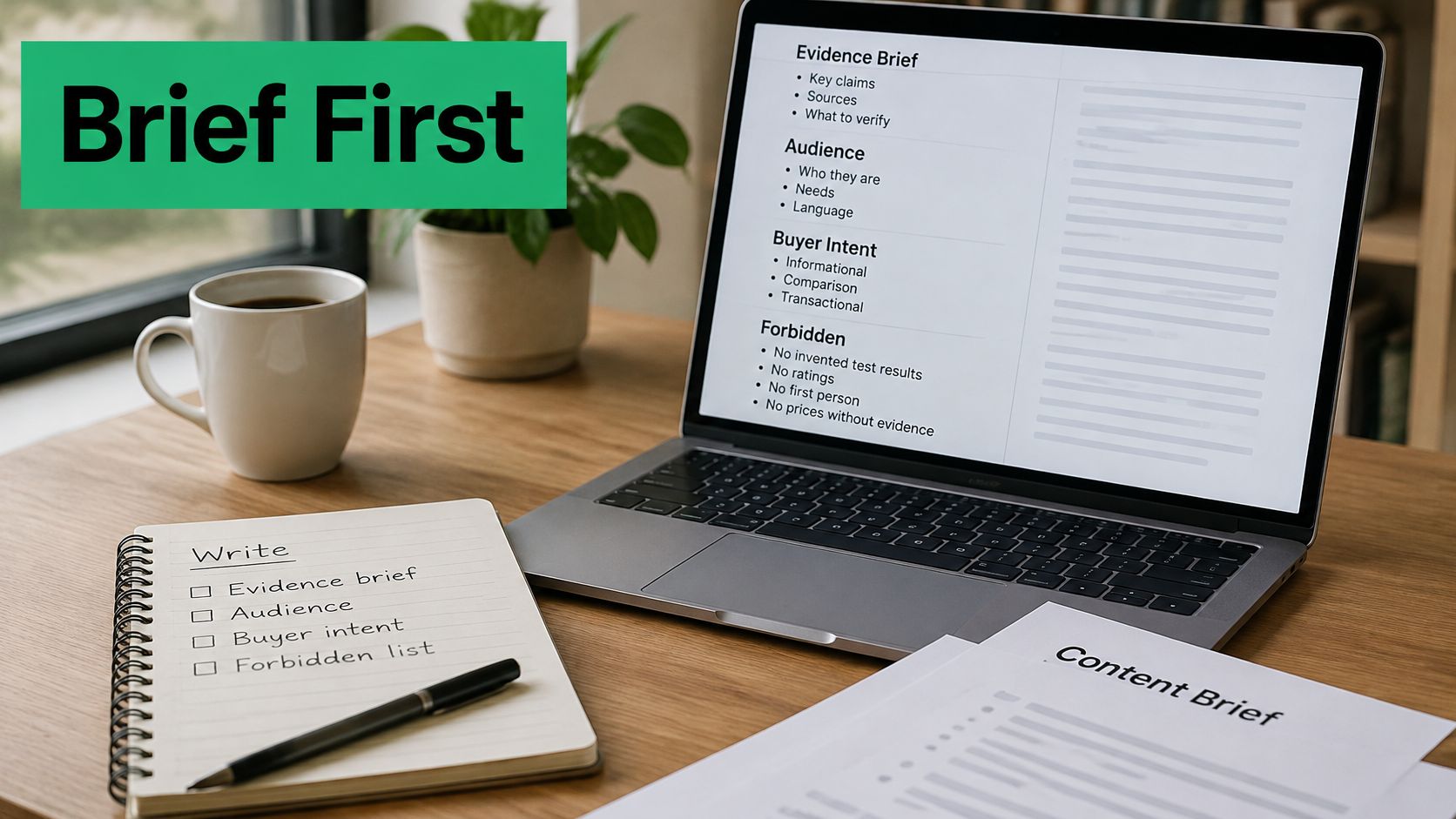
Every prompt should forbid invented test results, unsupported ratings, personal use that didn't happen and prices without dates. Give the model the audience, buyer intent and evidence brief before asking it to produce anything persuasive.
A focused brief is more useful than an elaborate instruction to sound authoritative.
Prompt templates for each stage of the workflow
| Prompt type | Use it for | Must include | Must forbid |
|---|---|---|---|
| Outline prompt | Section order and comparison criteria | Audience, buyer intent and evidence brief | Test results or ratings not in the brief |
| Comparison draft prompt | Side by side product table and verdicts | Verified specifications and dated prices | Undated prices or guessed values |
| Rewrite for voice prompt | Tone, sentence rhythm and examples | Writer's own test notes and observations | New claims or personal use absent from the notes |
| Disclosure check prompt | Flagging missing labels and misleading emphasis | Draft text and disclosure wording | Rewriting recommendations or removing limitations |
| Refresh prompt | Updating prices, specifications and dates | Current evidence brief and change log | Silent edits without a change note |
A practical AI affiliate outline prompt
For an article about the best budget noise cancelling headphones, use an instruction like this:
Create an outline for commuters comparing budget noise cancelling headphones. Use only the attached evidence brief. Order sections around buyer questions, compare battery life, noise reduction, fit and price band, and identify who should avoid each option. Mark missing evidence as needed. Don't estimate measurements, create ratings or imply personal testing.
The buyer question determines the structure. A commuter may care about carrying comfort and noise reduction, while someone working from home may prioritize microphone performance and long session comfort.
Keep battery claims separate when their test conditions differ. A manufacturer's maximum playback figure isn't automatically comparable with an independent result recorded with noise cancellation enabled.
Versioning AI affiliate writing prompts
A generic request for a complete review leaves the model to invent the decision framework. Even if every specification happens to be correct, the result can still fail because the recommendation doesn't address the buyer's actual constraint.
Save each template with a version label, owner and short change note. Record whether a revision changed comparison criteria, missing evidence handling or the strength of recommendation language.
When a template produces an unsupported claim, fix the instruction and the review gate. Don't just delete the sentence from that draft.
Test each template on an existing page before using it across the site. Check what the editor had to repair, not merely whether the first output looked polished.
On-Page SEO for AI Search and Generative SEO
Make the page easy to understand without stripping away the reasoning behind its recommendation. Clear structure supports readers and makes passages easier for AI systems to interpret, but it doesn't guarantee extraction or citation.
According to Google's spam policies, automation isn't prohibited because it's automated; the concern is manipulation and content that adds little value, including copied merchant descriptions.
An AI affiliate page structure worth using
Answer the buying question immediately. Open with a short verdict naming the product, the buyer it suits and its main limitation. Don't make readers scroll through a category history to find your recommendation.
Use descriptive headings. Natural phrases such as AI affiliate writing workflow or generative SEO checklist tell readers what each passage resolves. Avoid repeating the exact keyword in every heading.
Show the evidence early. Place the verified specification and dated price table near the verdict, with a last reviewed date beside it. Keep qualifications beside the relevant values.
Match structured data to visible content. Use Product or FAQPage markup only where applicable and truthful. Never add invisible ratings, invented reviews or unsupported availability, and don't assume markup will produce a special search appearance.
Write original decision support. Explain why a limitation matters for a particular buyer. A list of features copied from the merchant doesn't provide independent analysis.
Connect the topic clearly. Link to official specifications and related guides on AI search visibility, generative engine optimization and LLM tracking.
Generative SEO without citation promises
Use an on-page SEO checklist to catch structural omissions, then read the page as a buyer. Can someone understand why the recommended product fits and when an alternative makes more sense?
Citation coverage is an outcome to observe, not a benefit to promise. Clear facts and attributable analysis are a stronger editorial foundation than keyword density.
Disclosure and Fact Checks for AI Affiliate Writing
The Federal Trade Commission's guidance says required disclosures must be clear and conspicuous, and explains that failing to disclose relationships between influencers and brands can violate the FTC Act. For affiliate pages, use plain language near the relevant recommendation and check that readers can see it on mobile.
A practical disclosure might read: This article contains affiliate links. We may earn a commission if you buy through them.
Place it directly above the first comparison table when that table contains the first affiliate recommendations. A footer policy alone doesn't give readers the same context at the point of decision.
Catching fabricated AI affiliate experience
Consider a draft that says the writer tested battery life for three weeks when no one conducted that test. The problem isn't tone. It's a false claim about the basis of the endorsement.
Don't soften it into extensive testing or real world use. Delete it and replace it with an accurately attributed specification or documented result.
Apply verification in this order:
- Explain material AI assistance: Identify its role where that changes how readers should interpret the recommendation.
- Trace factual statements: Match performance and comparison claims to specific evidence entries.
- Remove invented experience: Delete fabricated testimonials, personal use and unsupported testing language.
- State the financial relationship: Confirm that the disclosure reflects how the publisher may benefit.
- Assign a second reviewer: Check omitted limitations, exaggerated emphasis and whether the top pick follows the stated criteria.
For campaigns involving creators as well as editorial pages, Social Cloud's influencer marketing compliance checklist offers a useful operational reference. Keep disclosure review inside the production template rather than treating it as a final legal note.
Testing AI affiliate disclosures responsibly
Don't assume transparent disclosure harms conversion. Test compliant placements on comparable pages, keeping every variant visible and understandable.
For example, compare a disclosure above the verdict with one directly above the comparison table, provided both appear before the relevant affiliate recommendation. Check mobile rendering, text contrast and whether a sticky interface obscures the line.
Record earnings and buyer outcomes alongside clicks. A layout that attracts more clicks through ambiguity isn't an editorial improvement.
AI generated wording doesn't transfer responsibility to the tool. The publisher chooses what to publish, which recommendation to emphasize and what evidence the reader can inspect.
Fail condition: Any factual claim without adequate support blocks publication, regardless of how persuasive the draft sounds.
Measure AI Affiliate Writing Results and AI Visibility
Article volume measures production. Commercial value needs page-level outcomes, split by traffic source, so you can distinguish an effective recommendation from a traffic spike or a misleading introduction.
Partnero's affiliate benchmarks place typical affiliate traffic conversion at roughly 1 to 3 percent, leading programs near 5 percent, and SaaS click to trial at approximately 3 to 7 percent. Treat these as directional references for mature affiliate programs, not forecasts for an AI assisted page.
Keep metric definitions separate. Affiliate link click through measures visits sent to a merchant; conversion measures the action after that visit.
Scorecard for AI affiliate pages and AI visibility
| Metric | What it tells you | Benchmark or reference | Review cadence |
|---|---|---|---|
| Click through rate from affiliate links | Whether the recommendation earns a visit | Compare with the page's own baseline; conversion benchmarks are not click through benchmarks | Weekly |
| Conversion rate by page | Whether referred visitors complete the desired action | Use the directional affiliate reference above, then segment by category and merchant | Monthly |
| Click to trial rate for SaaS programs | Trial starts from affiliate clicks | Use the directional SaaS reference above | Monthly |
| Earnings per click | Commission earned per outbound affiliate click | Compare with the same program and traffic source baseline | Monthly |
| Refund rate | Whether purchases matched buyer expectations | Compare mature purchase cohorts | Monthly |
| Share of claims with a verifiable source | Editorial integrity | Every published factual claim should be supported | Each publication |
| AI citation coverage | How often engines cite the page for tracked buyer prompts | Cited responses divided by eligible tracked responses | Monthly |
| Brand mentions in AI answers | Visibility beyond affiliate clicks | Mention frequency and accuracy against a fixed prompt set | Monthly |
Testing AI affiliate revenue changes
Run controlled tests on comparable pages, changing a single variable such as the introduction or table placement. Where genuine visitor level randomization is impractical, use matched page groups and record differences in traffic, products and seasonality before you read the result.
Define the measurement window before starting. Compare earnings per click and refunds alongside clicks, allowing time for purchases and reversals to mature. A persuasive variant that raises clicks while raising refunds has failed commercially.
Use content marketing ROI measurement to connect editorial effort with financial outcomes. Include research, evidence checks and review time, not only drafting time.
Building an AI affiliate visibility log
Step 1 of the LLM tracking workflow is building a prompt library of commercial, informational and comparative prompts that match how buyers research your category. Step 2 defines the brand and competitors so visibility metrics capture direct mentions and share of voice across models.
Step 3 is automated monitoring that queries those prompts across ChatGPT, Perplexity, Gemini, Claude, DeepSeek, Grok and AI Overviews. Log whether the brand is named, whether the page is cited and whether the description is accurate.
Step 4 uses AI brand visibility dashboards and trend reports to connect content updates with tracking metric changes. Assign someone to inspect the underlying answers as well as the trend line. If that owner needs a clearer role title, a page framed as meet the AI visibility team shows the label in use, while accountability stays in your review checklist.
Say you add a dated specification table and later observe a citation in an engine's answer. Log the update and observation separately, then repeat the check before attributing the change to that edit.
At the monthly review, pause any template associated with rising refunds while you investigate product changes, traffic mix and recommendation accuracy. Do not expand a format that attracts purchases the product cannot satisfy.
Summary and FAQ for Your First AI Affiliate Writing Test
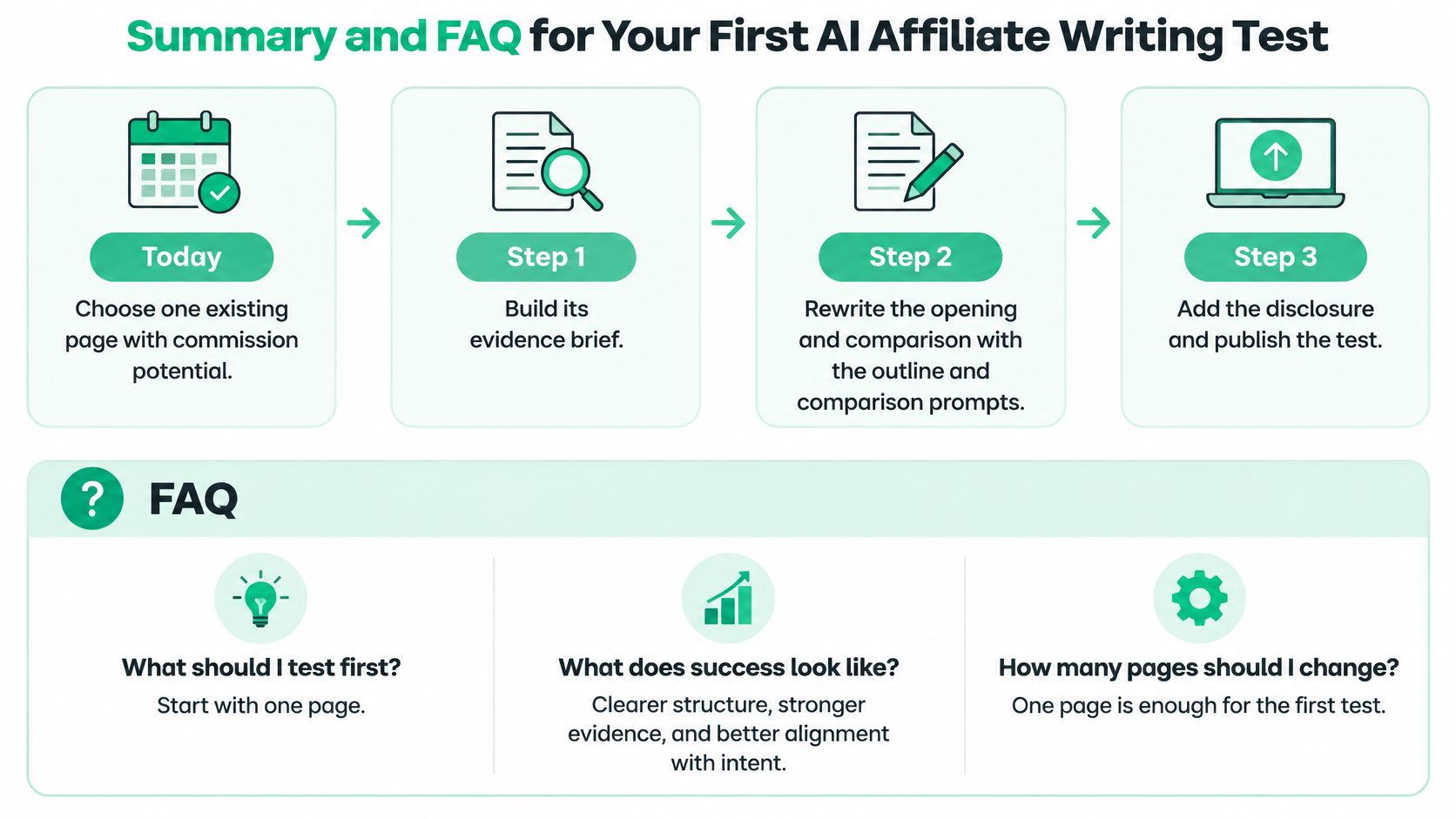
Today, choose an existing page with commission potential, build its evidence brief, rewrite the opening and comparison with the outline and comparison prompts, and place the disclosure above the first affiliate link. Log a four week baseline for clicks, conversions, refunds and AI citations as your initial measurement window, not a promised time to results. At Riff Analytics, our Website AI Analysis shows how ChatGPT and other LLMs present a brand, while Track Citation Sources monitors where AI engines find a brand's content, identifies top cited sources and helps close citation gaps. That lets you evaluate discovery alongside the page's commercial outcomes.
Keep the first test narrow enough to review properly.
Does AI affiliate writing break Google's scaled content policy?
No, using AI isn't itself the violation. Google's explanation of scaled content abuse applies to pages produced primarily to manipulate rankings, whether people, automation or both create them. Publish useful coverage with evidence rather than expanding a weak template.
How long does AI affiliate content take to earn AI citations?
There's no reliable universal timeline. Track weekly and plan to observe several refresh cycles rather than treating publication as a citation trigger; different engines may surface different sources at different times.
Do I need special software to track AI affiliate citations?
A manual prompt log can work for a small page set if you record the prompt, engine, date, cited URL and answer context consistently. Monitoring tools become useful when repeated checks across many prompts and engines become difficult to maintain.
Choose the page, name the evidence owner and record the baseline before editing. Use Riff Analytics to inspect how AI systems present your brand and which sources they cite, then publish the first measured improvement rather than a batch of pages you can't evaluate.