AEO vs SEO: Navigating the Future of Digital Visibility in 2026
Updated January 11, 2026

What is the real difference between AEO vs SEO? In 2026, it comes down to a simple choice: do you want to rank a webpage, or do you want to be the answer? Search Engine Optimization (SEO) is the classic discipline of earning visibility for your website on Google. Answer Engine Optimization (AEO), its new counterpart, is the practice of getting your brand, data, and facts cited directly inside AI generated answers on platforms like ChatGPT, Perplexity, and Google’s AI Overviews. One drives clicks to your website; the other embeds your authority directly into the user's result, creating powerful AI search visibility. This shift from ranking pages to becoming a citable source is the most significant change in digital marketing this decade.
Understanding the New AEO vs SEO Reality
For nearly two decades, SEO has been the undisputed king of digital marketing. It was a game of keywords, links, and technical wizardry, all aimed at climbing Google's ten blue links. But the rise of generative AI is fundamentally changing how people get information, and our strategies must evolve. A winning digital strategy for 2025 and beyond cannot be about one or the other. It demands a dual focus. SEO is about being discoverable when people search; AEO is about becoming the source of truth when they ask. It is not a replacement, it is an expansion.
What is the Difference Between AEO and SEO?
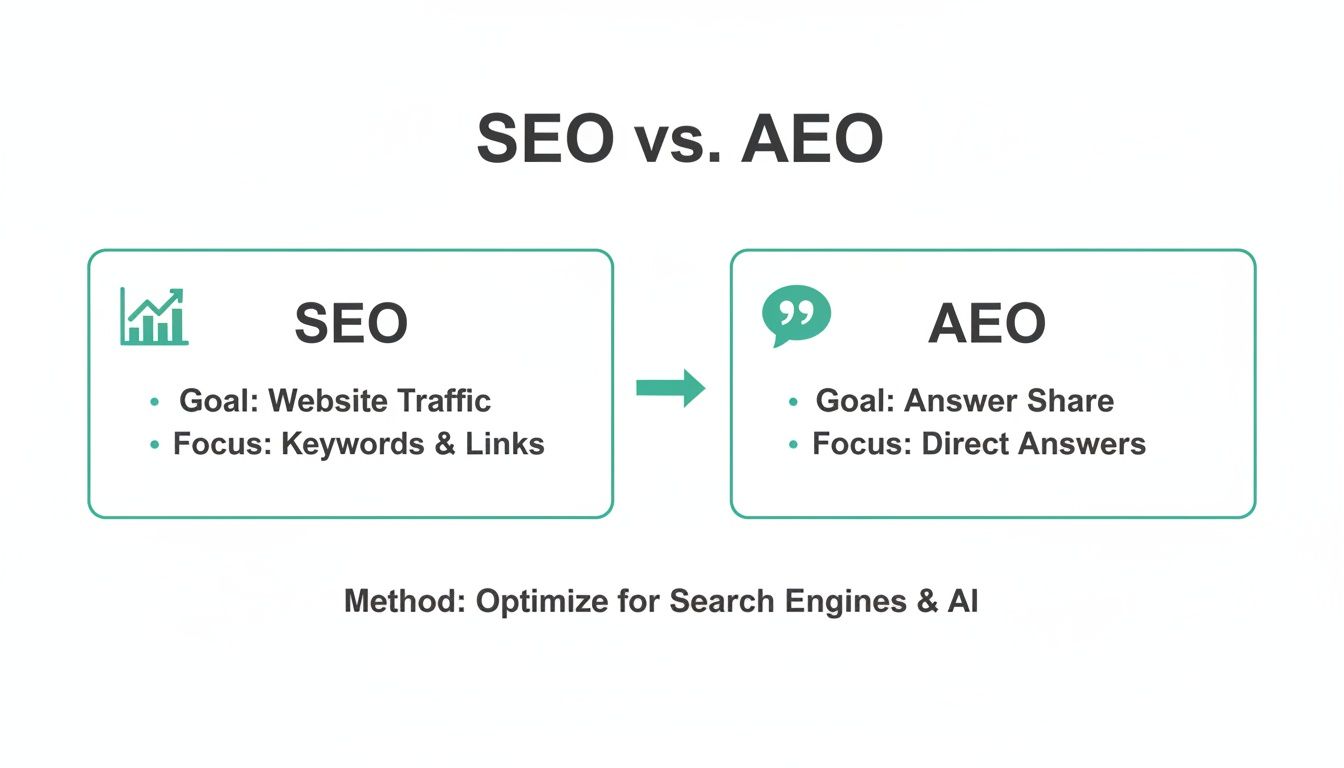
You still need to optimize for curious humans browsing the web, but you also have to structure your content so machines can consume, understand, and cite it as fact. Our own guide explains in more detail what Answer Engine Optimization is and why it's so critical right now. While both SEO and AEO aim for visibility, their methods and what they measure are worlds apart. SEO lives and dies by traffic, rankings, and conversions. AEO is obsessed with "answer share" and how often your brand gets mentioned inside AI responses. This requires a new focus on what is sometimes called generative SEO.
AEO and SEO Workflows Explained
The actual work is different, too. AEO puts a much heavier emphasis on structured data, factual consistency, and entity management. To really get a handle on the technologies driving this shift, check out this complete guide to AI SEO, including Geo SGE and LLMs. Traditional SEO workflows focus on keyword research and backlink acquisition. AEO workflows prioritize creating a machine readable knowledge base and earning citations from authoritative sources. This strategic difference is crucial for success in the modern search landscape.

Comparing Core Objectives in AEO vs SEO
While Search Engine Optimization and Answer Engine Optimization both chase digital visibility, their core goals are fundamentally different. Understanding this distinction is crucial for any marketing strategy that hopes to win in both traditional search results and the new world of AI answers. The mindset shifts from pulling eyeballs to a webpage to becoming an embedded source of truth inside a machine generated answer. For decades, traditional SEO has had one clear mission: rank high on a Search Engine Results Page (SERP) for specific keywords. Success is measured by how much organic traffic you drive.
The AEO vs. SEO Goalpost Shift
Answer Engine Optimization completely redefines what a “win” looks like. The primary goal is not just traffic, it is to become a citable, authoritative source that large language models (LLMs) use to build their answers. The real prize is achieving answer share and securing brand mentions directly within the AI response. Success here means an AI engine answers "What is the best project management software?" by synthesizing information from multiple places and explicitly citing your company’s guide as a key reference. It is a strategic move from optimizing for clicks to optimizing for citation. Want to go deeper on this? We break down the nuances in our complete guide comparing AI SEO vs. traditional SEO.
Measuring Different Definitions of Success for AEO and SEO
This split in objectives naturally leads to different metrics. An SEO manager lives and breathes keyword rankings, click through rates, and organic sessions. An AEO specialist, on the other hand, tracks metrics that barely existed a few years ago, like citation frequency and answer share across different LLMs. According to research from Optimizely, AEO demands a focus on "structured content, semantic clarity, and authoritative sources," a clear departure from the keyword and backlink model of traditional SEO. The tools for each discipline reflect these separate goals. SEO pros use platforms that analyze SERP volatility, while AEO requires tools for LLM tracking and monitoring brand presence across conversational AI engines.
Key Strategic Differences in AEO and SEO Workflows
When you move from high level goals to day to day operations, you see just how different Answer Engine Optimization and Search Engine Optimization really are. Their workflows, tools, and tactical priorities could not be more distinct. Understanding these operational splits is the key to adapting your team for the age of AI search. An SEO workflow is built to attract, engage, and convert human visitors on your website. In stark contrast, an AEO workflow is engineered to make your brand’s information machine readable, citable, and factually undeniable.
Comparing AEO vs SEO Research and Content
The first major fork in the road is research. SEO teams focus on identifying specific, high volume search queries that signal user intent. AEO thinks bigger, centering on entities and topics. Instead of just targeting "best project management software," an AEO strategy works to build comprehensive authority around the entity of "project management software" itself. This means covering every related concept, definition, and data point an AI needs to construct a complete, accurate answer. Content creation workflows also look completely different. For AEO, the primary audience is the AI model, so content must be fact based, hyper structured, and packed with structured data like schema markup.
Technical Optimization and Authority Signals in AEO and SEO
Technical SEO has always revolved around website performance like site speed and crawlability. Technical AEO adds another layer entirely: making your data machine readable. This involves implementing robust schema markup and ensuring your facts are consistent across every digital property. Link building strategies also diverge. SEO has long valued backlinks from high authority websites. AEO prioritizes citations from verifiably authoritative sources like academic papers and industry reports. For marketing teams looking to blend these two disciplines, understanding how to tweak current practices is non negotiable. We break down the integration process in our guide on how to integrate AI SEO with existing SEO workflows. Platforms like Riff Analytics offer capabilities like generative SEO monitoring that simply don’t exist in the standard SEO toolkit.
How AI Search Quality Changes the AEO vs SEO Equation
It’s easy to get lost in the technical weeds of AEO vs SEO and forget the one question that actually matters: what’s the ROI? The answer comes down to a simple truth: not all traffic is created equal. While SEO has long been the undisputed champ of driving sheer volume, AEO adds a powerful new variable to the mix with high quality, high intent visitors who are worth exponentially more. This shift from quantity to quality is completely reshaping how we should think about the value of search visibility. Users turning to AI engines are typically much further down the research funnel.
The AEO vs SEO Conversion Rate Gap
That difference in user mindset translates directly to the bottom line. Winning a top spot in traditional search might bring a flood of visitors, but earning a citation in an AI answer delivers a smaller, laser focused audience that’s primed to act. This makes AEO an incredibly efficient channel for generating real demand. New research throws this disparity into sharp relief. According to one study, the average AI search visitor can convert at a rate 4.4 to 23 times higher than a visitor from a classic Google search. This massive gap reflects the core difference in engagement: AI search users arrive with a clear need, having already received a trusted recommendation from an AI. You can dig deeper into the numbers to understand the full impact on AI search SEO traffic.
Redefining the Value of an AI Search Click
This new reality forces us to redefine what a "click" is actually worth. A single visitor who comes from an AI generated answer after seeing your brand cited as an authority is fundamentally more qualified than someone who clicked a blue link during a broad discovery search. This insight justifies investing in new strategies and tools built specifically for AI search visibility. The goal is no longer just to attract eyeballs; it’s to attract the right eyeballs at the exact moment they’re ready to purchase. This is where AEO monitoring tools, which provide critical data on LLM tracking and answer share, become absolutely essential for capitalizing on this high value channel.
Building a Unified Strategy for AEO and SEO Success
Let's move past the theory. The real challenge for marketers in 2025 is weaving AEO and SEO into a single, cohesive strategy that wins on all fronts. Running separate programs is not efficient. A truly powerful approach treats them as two sides of the same visibility coin. Your rock solid SEO fundamentals become the perfect launchpad for total AEO dominance. The core idea is simple: create content that serves two audiences at once. It needs to be factually dense and perfectly structured for AI models, but it also has to be engaging for the human readers who actually buy your product.
How to Blend AEO and SEO Strategies
You do not need to tear down your existing SEO workflow to integrate AEO. Think of it as layering on a new set of tactics. The goal is to fine tune your content so it speaks the language of machines without losing its human touch. This means amplifying your E-E-A-T (Experience, Expertise, Authoritativeness, and Trustworthiness) signals in a way that both Google’s algorithms and large language models can understand. According to Optimizely, a successful modern strategy requires a dual approach. "SEO is your foundation," ensuring content is discoverable. "AEO is your AI amplifier," making that discovered content understandable and citable for AI models.
Tools for a Unified AEO and SEO Workflow
A blended strategy requires a blended toolkit. Your traditional SEO platforms are still essential for tracking keyword rankings and backlinks, but they cannot handle LLM tracking or monitor your answer share. This table breaks down the essential tools for a modern, unified workflow that incorporates both disciplines. By integrating these tools, your team gets a complete picture of your visibility across the entire search ecosystem, from traditional result pages to AI driven answers.
| Tool Category | SEO Focus (Examples) | AEO Focus (Examples) |
|---|---|---|
| Research & Planning | Keyword research tools (Ahrefs, Semrush) | Entity analysis, knowledge graph mapping tools |
| Content Optimization | On page optimizers (SurferSEO) | Schema generators, factual accuracy checkers |
| Performance Tracking | SERP trackers, web analytics (GA4) | AI visibility platforms (Riff Analytics) |
| Authority Building | Backlink analyzers (Moz, Majestic) | Citation and brand mention tracking software |
Measuring Success in the New Age of AEO vs SEO
In the blended world of Answer Engine Optimization and traditional SEO, the old metrics just do not tell the whole story anymore. Relying solely on keyword rankings and organic traffic in 2026 is like trying to navigate a new city with an old map. To prove ROI and make smart decisions, you need a new measurement framework that captures both high volume search traffic and high quality brand presence in AI answers. This means expanding your KPIs beyond the familiar. Success is not just about where your URL ranks; it is about how often your brand is cited as a source of truth by AI.
Evolving Metrics for AEO and SEO
The AEO landscape introduces KPIs that feel foreign to traditional SEO. These metrics track your brand’s influence inside the AI ecosystem. While you still need a solid foundation in practices like What Is SERP Tracking and How It Shapes Your SEO Strategy, AEO demands we track new, critical data points. Key metrics include Answer Share, the percentage of AI answers in your niche that cite your brand, and Citation Frequency, the raw count of how many times AI models reference your content. Platforms built for LLM tracking are now essential for this purpose.
Complementary Forces in AEO and SEO
A common fear is that AI search will swallow traditional search whole, rendering SEO obsolete. The data, however, suggests the opposite. Adopting AI tools often correlates with increased search engine engagement. According to an analysis from SparkToro, 95% of Americans remain regular users of traditional search engines, with usage declining by a negligible 0.5% over 2.5 years even as AI tool adoption quintupled. This challenges the replacement narrative, pointing to a future where users lean on both channels for different needs. You can dig deeper into these counterintuitive search behavior findings.
Summary: AEO vs SEO is a Partnership, Not a Battle
The debate over AEO vs SEO is not about choosing a winner. It is about recognizing that the digital landscape has expanded. SEO remains the bedrock for driving website traffic and building broad brand awareness through traditional search engines. AEO is the critical new layer for establishing your brand as a citable, authoritative source within AI driven answer engines. A successful strategy in 2026 and beyond requires mastering both. By creating factually accurate, well structured content and measuring success with a blend of traditional and AI focused metrics, you can build a resilient digital presence that wins no matter how users search for information.
Frequently Asked Questions About AEO vs SEO
1. What is the main difference between AEO and SEO goals?
The biggest difference is the target outcome. SEO’s goal is to rank a webpage high in search results to get clicks and drive traffic. AEO’s goal is to get your content or brand cited as an authority within an AI generated answer, focusing on "answer share" instead of just traffic.
2. How does AEO relate to E-E-A-T?
AEO is the practical application of E-E-A-T (Experience, Expertise, Authoritativeness, Trustworthiness) for an AI audience. While SEO uses E-E-A-T to appeal to Google's algorithms, AEO focuses on providing clear, verifiable facts and citing authoritative sources that LLMs can easily parse and trust as credible.
3. Will AEO replace SEO in the future?
No, AEO will not replace SEO. Instead, it complements it. SEO will remain crucial for top of funnel visibility and driving traffic from traditional search engines. AEO is essential for capturing high intent users and building brand authority within the rapidly growing ecosystem of AI answer engines. A balanced strategy needs both.
4. How can I track my brand's AI search visibility?
Tracking AI search visibility requires specialized tools. Platforms offering LLM tracking and generative SEO analytics are necessary to measure metrics like answer share and citation frequency across different AI models like ChatGPT and Gemini, as these cannot be monitored with traditional SEO software.
5. What is the first step to starting an AEO strategy?
The best first step is to conduct an AI readiness audit of your most important content. Review your key pages for factual accuracy, clarity, and structure. Implement detailed schema markup (like FAQ and HowTo) to make your information more machine readable. This strengthens your content for both AI models and Google’s E-E-A-T guidelines.